
Best & Worst Blackjack Rules (3:2 vs 6:5, H17 vs S17)

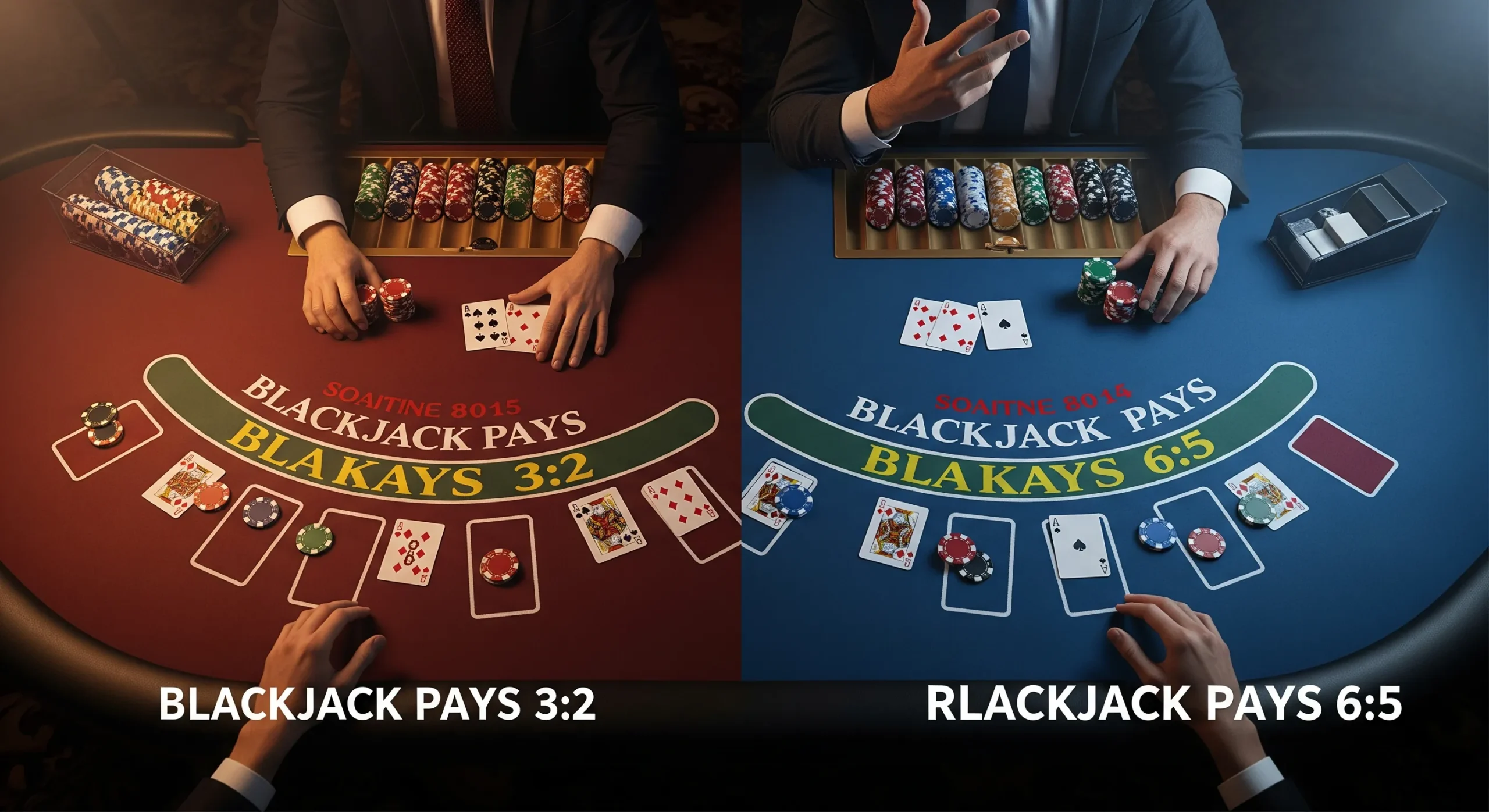
Blackjack might look the same at every table, but the rules can dramatically change your chances of winning. Two tables sitting right next to each other can have completely different house edges—sometimes by more than 1.5%—just because of small rule variations. Most players don’t realize that choosing the wrong table costs them money before they even place their first bet. Understanding which blackjack rules help you and which ones hurt you is essential for anyone who wants to play smart and stretch their bankroll further.
Understanding Blackjack Rule Variations
Blackjack isn’t a single game with universal rules. Casinos adjust specific rules to change how much advantage they hold over players. These changes might seem minor—like how the dealer plays their hand or what a blackjack pays—but they add up quickly. The combined effect of rule variations can turn a beatable game into one where you’re fighting an uphill battle.
The base game of blackjack, played with optimal strategy under favorable rules, gives the house an edge as low as 0.5%. But change a few rules, and that edge can jump to 2% or higher. That’s the difference between losing $5 per hour and losing $20 per hour at a $10 table.
Why Rules Matter More Than Most Players Think

Every rule change shifts the mathematical balance of the game. When casinos adjust payouts, dealer rules, or player options, they’re directly manipulating the house edge. Players who don’t pay attention to these details often sit down at tables where they’re giving away an extra 1-2% advantage without realizing it.
Consider this: two players with identical skill levels playing identical strategies will have completely different results if one plays at a 3:2 table and the other at a 6:5 table. Over 100 hands, that difference could mean winning $50 versus losing $20—and that’s before accounting for variance.
The Single Most Important Rule: Blackjack Payout
The blackjack payout is the most critical rule at any table. This determines what you get paid when you’re dealt a natural blackjack (an ace and a ten-value card). The standard payout has been 3:2 for decades, meaning a $10 bet pays $15. But many casinos now offer 6:5 blackjack, where that same $10 bet only pays $12.
3:2 Blackjack: The Standard You Should Demand
At a 3:2 table, a natural blackjack pays one and a half times your bet. This is the traditional payout that’s been the standard since the game’s modern form developed in the 1950s. When you bet $20 and get blackjack, you win $30 plus your original bet back.
This payout structure is fair and keeps the house edge reasonable. It properly rewards players for getting the best possible hand in the game. Professional players and serious recreational players refuse to play at tables that don’t offer 3:2 because the alternative is significantly worse.
6:5 Blackjack: The Rule That Destroys Your Odds
6:5 blackjack pays only $6 for every $5 wagered. On a $10 bet, you get $12 instead of $15. That $3 difference might not sound like much, but it increases the house edge by approximately 1.4%. This single rule change wipes out almost all the advantage you gain from using basic strategy.
Casinos introduced 6:5 blackjack in the early 2000s, primarily in Las Vegas, and it’s spread to other markets since. They often pair it with single-deck games to make it look more attractive, but the payout reduction far outweighs any benefit from fewer decks. A single-deck game with 6:5 payouts is significantly worse than a six-deck game with 3:2 payouts.
Never play 6:5 blackjack. There’s no strategy adjustment that can overcome the built-in disadvantage. You’re better off finding a different table, a different casino, or even a different game entirely.
Real Money Impact of Payout Differences
Let’s compare two players over a typical four-hour session:
Player A (3:2 table):
- 80 hands per hour = 320 total hands
- Gets blackjack approximately 15 times (4.7% frequency)
- $25 average bet
- Wins $37.50 per blackjack
- Total blackjack winnings: $562.50
Player B (6:5 table):
- Same 320 hands, same bet size
- Same 15 blackjacks
- Wins $30 per blackjack
- Total blackjack winnings: $450
Player A makes $112.50 more just from blackjack payouts alone. Over a year of regular play, this difference becomes thousands of dollars. The 6:5 payout doesn’t just reduce your winnings—it fundamentally changes whether blackjack is worth playing.
If you’re looking for reliable options, consider blackjack sites with fair rules that guarantee 3:2 payouts across all their tables.
Dealer Rules: H17 vs S17
How the dealer plays their hand with a soft 17 (an ace counted as 11 plus a 6) significantly impacts the house edge. This rule is usually abbreviated as either H17 (dealer hits soft 17) or S17 (dealer stands on soft 17).
S17 (Stand on Soft 17): The Better Rule
When the dealer must stand on soft 17, they take fewer cards and bust less often, but they also improve their hand less frequently. This rule is better for players because it reduces the house edge by approximately 0.2% compared to H17.
At an S17 table, the dealer’s hand is complete more often with medium-strength totals (17, 18, 19). This consistency is actually favorable for players using basic strategy because the dealer has fewer opportunities to improve weak hands into strong ones.
You’ll typically find S17 rules at higher-limit tables and in casinos that cater to more experienced players. In some markets, particularly online casinos serving Asian markets, S17 is more common across all table limits.
Many licensed online blackjack casinos now feature S17 tables even at lower betting limits, making these favorable rules accessible to all players.
H17 (Hit on Soft 17): The Casino-Friendly Rule
H17 requires the dealer to take another card when holding soft 17. This rule increases the house edge by about 0.2% because it gives the dealer more chances to improve their hand. When the dealer hits soft 17, they’ll sometimes improve to 18, 19, 20, or 21, beating hands that would have won at an S17 table.
The H17 rule particularly hurts players when the dealer shows a weak upcard like a 5 or 6. In these situations, you’re hoping the dealer will bust, but H17 gives them an extra opportunity to make a decent hand instead.
Most casinos in North America use H17, especially at lower-limit tables. It’s become standard in many jurisdictions, but that doesn’t make it any less costly for players.
Strategic Adjustments for H17 vs S17
Basic strategy changes slightly depending on the dealer rule. At H17 tables, you’ll double down more aggressively in certain situations because the dealer’s extra disadvantage when they do bust is worth the risk. Specifically:
- Double down on 11 vs dealer ace (H17 only)
- Double down on soft 18 vs dealer 2 (H17 only)
- Double down on soft 19 vs dealer 6 (H17 only—rare play)
These adjustments are minor but mathematically optimal. If you’re serious about blackjack house edge explained and minimizing it, learning the H17 strategy variations is worthwhile.
Number of Decks: Does It Really Matter?

Blackjack can be played with anywhere from one to eight decks. The number of decks affects the house edge, but less dramatically than most players think.
Single-Deck vs Multi-Deck Games
Single-deck blackjack offers the lowest base house edge, approximately 0.17% lower than six-deck games. Fewer decks mean:
- Blackjacks occur slightly more frequently
- Card composition matters more
- Card counting is more effective
- Dealer busts slightly more often
However, casinos know single-deck games favor players, so they compensate with worse rules. Single-deck games often have 6:5 blackjack payouts, restrictions on doubling down, or no resplitting. These rule changes more than wipe out the deck advantage.
A six-deck game with 3:2 payouts, S17, and standard rules is far superior to a single-deck game with 6:5 payouts. Don’t be fooled by the allure of single-deck games—check the payout structure first.
When searching for quality games, prioritize 3:2 blackjack tables online where the payout structure is clearly displayed before you start playing.
The Practical Reality of Deck Variations
For players using basic strategy without counting cards, the number of decks matters less than other rules. The difference between a two-deck game and an eight-deck game with identical rules is only about 0.2% house edge.
Focus on finding games with 3:2 payouts and favorable dealer rules before worrying about the number of decks. A six-deck shoe game with excellent rules beats a double-deck game with poor rules every time.
Player-Favorable Rules That Improve Your Odds
Certain rule variations work in the player’s favor, reducing the house edge and making the game more beatable.
Double Down After Split (DAS)
This rule allows you to double your bet after splitting a pair. If you split 8s and catch a 3 on the first one, DAS lets you double down on that 11.
DAS reduces the house edge by about 0.14%. It’s valuable because it lets you put more money on the table in favorable situations. Most modern casinos offer this rule, but always check before playing.
Most reputable online casino games platforms include DAS as a standard feature, ensuring you have access to this player-friendly rule.
Late Surrender
Late surrender lets you forfeit half your bet after the dealer checks for blackjack. If you have 16 against a dealer 10 and the dealer doesn’t have blackjack, you can surrender and lose only half your wager instead of playing out a terrible hand.
This rule reduces the house edge by approximately 0.07%. It’s less common than it used to be, but some casinos still offer it, particularly in Asian markets and at higher-limit tables.
Resplitting Aces
Standard rules only allow you to split aces once and give you one card on each. Resplitting aces lets you split them again if you catch another ace, and some very liberal rules also let you draw multiple cards to split aces.
This rule reduces the house edge by about 0.06%. It’s rare but extremely valuable when available. You’ll occasionally find it at online casinos serving global markets.
Casino-Favorable Rules That Hurt Your Odds
Just as some rules help players, others are designed specifically to increase the house advantage.
No Resplitting
Some tables don’t allow you to resplit pairs after the initial split. If you split 8s and get another 8, you’re stuck with it instead of splitting again.
This restriction adds about 0.03% to the house edge. It’s a minor disadvantage but frustrating when you’re in a situation where resplitting would be optimal.
No Doubling After Split
Tables that don’t allow doubling after splitting (no DAS) increase the house edge by approximately 0.14%. This rule severely limits your ability to maximize good situations and is a significant disadvantage.
Blackjack Pays Even Money
Some specialty blackjack variants pay even money (1:1) on blackjacks instead of 3:2 or 6:5. This increases the house edge by approximately 2.3%—making the game essentially unbeatable with basic strategy alone.
Avoid these games entirely unless they have extremely favorable rules elsewhere that compensate (which is rare).
Dealer Wins All Ties
In some regions, particularly parts of Asia, you might encounter tables where the dealer wins all pushes instead of ties being returned to the player. This rule massively increases the house edge by about 9% and should be avoided completely.
How to Evaluate Any Blackjack Table
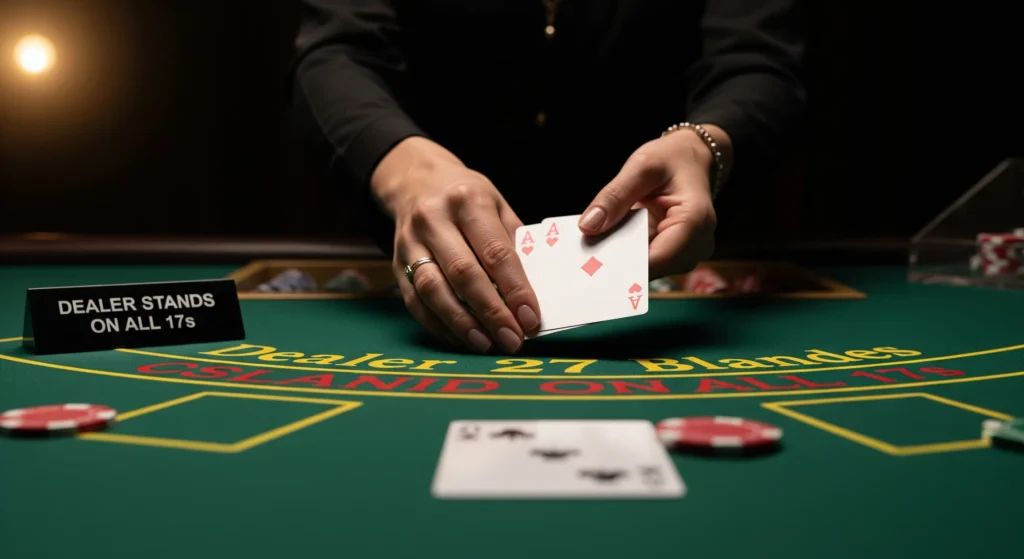
When you walk up to a blackjack table, you need to quickly assess whether it’s worth playing. Here’s a systematic approach:
Step 1: Check the Blackjack Payout
Look at the felt or ask the dealer: does blackjack pay 3:2 or 6:5? If it’s 6:5, walk away immediately. This should be your first and most decisive check.
Step 2: Identify the Dealer Rule
Does the dealer stand on all 17s (S17) or hit soft 17 (H17)? This is usually printed on the table felt. Prefer S17 tables when possible.
Step 3: Count the Decks
Single-deck games look attractive but check the blackjack payout first. Six-deck shoes with 3:2 payouts are perfectly playable and often have better overall rules than single-deck games.
Step 4: Verify Player Options
- Can you double down on any two cards?
- Can you double after splitting?
- Can you resplit pairs?
- Is surrender available?
The more player-friendly options, the better.
Step 5: Calculate the Approximate House Edge
With 3:2 payouts, S17, DAS, and standard rules in a six-deck game, you’re looking at approximately 0.5% house edge with perfect basic strategy. That’s a playable game.
Add 0.2% for H17, subtract 0.14% for DAS, and adjust accordingly for other rules. If your mental math puts you above 1% house edge, look for a better table.
Regional Considerations for Malaysia and Singapore
Players in Southeast Asian markets face different rule sets than those in North America or Europe. Understanding the local casino environment helps you find the best games.
Malaysia Online Casino Rules
Malaysian players accessing international online casinos typically find:
- Mix of 3:2 and 6:5 games (always check payout)
- Predominantly H17 tables
- Standard doubling and splitting rules
- Wide variety of live dealer options
Live dealer blackjack from studios in the Philippines, Europe, or elsewhere typically offers better rules than RNG (random number generator) games. The 3:2 payout is more common in live dealer games, and you can verify the dealer’s actions in real-time.
For players in the region, Asia-friendly blackjack sites provide live dealer options with verified 3:2 payouts and transparent rule displays.
Singapore Market Options
Singapore-based players have access to both Marina Bay Sands and Resorts World Sentosa, which offer physical blackjack, plus international online options.
Physical casinos in Singapore typically feature:
- 3:2 blackjack payouts at most tables
- Mix of H17 and S17 (check each table)
- Higher minimum bets than many international markets
- Standard player options (DAS, resplitting)
Online options for Singapore players mirror the Malaysian market, with the same advice: prioritize 3:2 payouts and verify dealer rules before playing.
The Complete Rules Ranking System
Here’s how different rule combinations stack up, from best to worst:
Tier 1: Excellent Games (0.3-0.5% house edge)
- 3:2 blackjack
- S17
- DAS
- Resplit any pair (including aces)
- Late surrender
- 1-2 decks
Tier 2: Good Games (0.5-0.7% house edge)
- 3:2 blackjack
- H17
- DAS
- Standard resplitting
- 4-8 decks
Tier 3: Acceptable Games (0.7-1% house edge)
- 3:2 blackjack
- H17
- No DAS
- Limited resplitting
- 6-8 decks
Tier 4: Poor Games (1-2% house edge)
- 6:5 blackjack
- Any dealer rule
- Limited player options
Tier 5: Terrible Games (2%+ house edge)
- 6:5 blackjack
- H17
- Restricted doubling
- No resplitting
- Even money blackjacks
Only play Tier 1-3 games. Tier 4-5 aren’t worth your time or money, regardless of other factors like comps or promotions.
Making Rule-Based Decisions in Real Casinos
Theory is useful, but practical application matters more. Here’s how to use rule knowledge in real casino situations:
When You Have Multiple Table Options
If your casino has different blackjack tables with different rules:
- Always choose 3:2 over 6:5, even if the 6:5 table has a lower minimum bet
- Choose S17 over H17 when both are available at similar limits
- Choose lower limits with better rules over higher limits with worse rules
Your bankroll lasts longer at a $10 table with 3:2 payouts than a $5 table with 6:5 payouts.
When Rules Change at Different Bet Levels
Many casinos reserve their best rules for higher-limit tables. A $25 minimum table might offer S17 and surrender, while the $10 tables are all H17.
Calculate whether the better rules justify the higher minimum bet. If you’re comfortable with the larger wager and your bankroll can handle it, the upgrade is worth it. A $25 bet at 0.4% house edge is better than a $10 bet at 0.9% house edge from a percentage standpoint, though the total dollar risk is higher.
When Online vs Physical Casinos Differ
Online casinos often offer better rules than physical casinos because their operating costs are lower. You’ll find more 3:2 games, more S17 tables, and better player options online.
However, online games also play faster—you might see 200+ hands per hour vs 60-80 at a physical table. The faster pace means you’ll face more variance and put more money into action even with better rules. Adjust your bet sizing accordingly when playing online.
If you prefer the pace and interaction of live games, live dealer blackjack platforms offer the perfect balance between online convenience and authentic casino atmosphere.
Specific Rules That Require Strategy Adjustments
Some rule variations require you to modify basic strategy to maintain optimal play.
H17 Strategy Adjustments
When the dealer hits soft 17:
- 11 vs Ace: Double down (stand at S17 tables)
- A,7 vs 2: Double down (stand at S17 tables)
- A,8 vs 6: Double down (stand at most S17 tables)
These are aggressive plays that exploit the dealer’s increased bust rate with H17.
Surrender Adjustments
When late surrender is available:
- 16 vs 9, 10, Ace: Surrender
- 15 vs 10: Surrender
- Pair of 8s vs 10: Surrender (controversial—some players still split)
Surrender is a defensive tool that reduces your losses in the worst possible situations. Use it.
Single-Deck Adjustments
If you find a legitimate single-deck game with 3:2 payouts:
- Double 11 vs Ace at single-deck (not at multi-deck S17)
- Split 3s vs 2 or 3 at single-deck
- Double 9 vs 2 at single-deck
These adjustments account for the different card composition effects in single-deck games.
Finding a table with 3:2 payouts and S17 rules is the baseline — finding one that also pays out quickly is harder. Our team has done both checks: see the best online blackjack sites Malaysia 2026.
FAQ
What’s the single most important blackjack rule to check?
The blackjack payout is the most critical rule. Always verify whether the table pays 3:2 or 6:5 for blackjack before sitting down. This single rule affects the house edge by approximately 1.4%, more than any other rule variation. Never play 6:5 blackjack regardless of other favorable rules the table might have.
Is single-deck blackjack always better than multi-deck games?
No. Single-deck blackjack offers a lower base house edge, but casinos typically compensate with worse rules—especially 6:5 blackjack payouts. A six-deck game with 3:2 payouts and dealer stands on soft 17 is significantly better than a single-deck game with 6:5 payouts. Always check the payout structure before considering the number of decks.
How much does H17 vs S17 really matter?
The difference between dealer hits soft 17 (H17) and dealer stands on all 17s (S17) changes the house edge by approximately 0.2%. While this seems small, it becomes significant over time. At a $25 average bet over 100 hands, this difference equals about $5 in expected loss. For serious players, seeking S17 tables when available is worth the effort.
Can good rules overcome bad basic strategy?
No. Even the best possible rule combination (3:2, S17, DAS, surrender, single-deck) still gives the house an edge if you play poorly. Rules reduce the house edge from about 2-4% down to 0.3-0.5%, but you only achieve that low edge with correct basic strategy. Good rules and good strategy work together—neither alone is sufficient for optimal play.
Are online blackjack rules generally better or worse than physical casinos?
Online casinos typically offer better rules because of lower operating costs. You’ll find more 3:2 payouts, S17 tables, and favorable player options online. However, online games play much faster (200+ hands per hour vs 60-80 at physical tables), which increases your total action and variance even with better rules. Choose reputable licensed platforms and always verify the specific rules before playing.
Does doubling after split (DAS) significantly improve my odds?
Yes. DAS reduces the house edge by approximately 0.14%, which is meaningful over extended play. This rule lets you double your bet in advantageous situations after splitting pairs, particularly with low pairs against dealer weak cards. Always prefer tables that allow DAS over those that don’t, all else being equal.
What rules should I absolutely refuse to play under?
Never play blackjack that pays 6:5 or even money for naturals. Avoid tables where the dealer wins all ties (extremely rare but exists in some markets). Refuse to play games with extremely restricted doubling or splitting options. These rules create house edges of 2% or higher, making the game essentially unbeatable. Walk away and find a better table or casino.
How do I quickly calculate if a table is worth playing?
Start with 0.5% house edge as your baseline for a standard 3:2, H17, six-deck game with DAS. Add 1.4% for 6:5 payouts (and walk away immediately if this is the case). Subtract 0.2% for S17 instead of H17. Subtract 0.14% if DAS is allowed. If your mental calculation exceeds 1% house edge, look for a better table. Under 0.7% is good, under 0.5% is excellent.
Conclusion
Blackjack rules determine whether you’re playing a beatable game or voluntarily donating money to the casino. The payout structure, dealer rules, and player options combine to create house edges ranging from 0.3% to over 2%—and that massive difference comes entirely from rule variations, not luck or skill.
Smart blackjack starts before you sit down. Check the payout, verify the dealer stands or hits on soft 17, and confirm your doubling and splitting options. Choose 3:2 payouts over 6:5 every single time, prefer S17 over H17 when possible, and look for tables that allow doubling after split. These decisions matter more than any single hand you’ll play.
Play at the best tables your bankroll allows, learn basic strategy for those specific rules, and manage your money responsibly. Blackjack rewards players who do their homework and make informed decisions about where and how they play.
📌 Find the best blackjack tables: Browse best online casino Malaysia 2026 for low house edge games, compare fastest payout casino Malaysia for quick cashouts after winning sessions.
📝 Editorial transparency: Evaluated using our published live casino methodology — our seven-stage evaluation framework with documented test methodology, refresh cadence, and named accountability. Read: How We Test Live Dealer Casinos →











 Slot Games Hub1 year ago
Online Casino Pussy888 Apk & Ios Download for Free
- Malaysia Casino Review1 year ago
WE88: Trusted Online Casino Malaysia | SafeGaming
- Thailand Casino Review5 months ago
เว็บพนันออนไลน์ ที่ดีที่สุด 2026 สำหรับผู้เล่นชาวไทย
- Singapore Casino Review1 year ago
Uwin33 Review – Trusted Casino in Singapore 2026 | SafeGaming
- Malaysia Casino Review1 year ago
UWin33 Casino Review Malaysia 2026 | SafeGaming
- Malaysia Casino Review1 year ago
12Play Casino Review Malaysia 2026 | Get Casino Bonus | SafeGaming
- Singapore Casino Review1 year ago
12Play Review Casino Singapore 2026 | SafeGaming
- Malaysia Casino Review1 year ago
WinClub88 Casino Review Malaysia 2026 | Trusted ✅ | SafeGaming