
Basic Blackjack Strategy Explained (Charts, Logic & Common Mistakes)

Expert Review by Casino Gaming Professionals
Learning blackjack basic strategy transforms casual players into informed competitors who make mathematically optimal decisions in every situation. This comprehensive guide provides everything needed to master basic strategy charts, understand the decision logic behind each play, and avoid costly mistakes that increase the house edge.
Whether you’re preparing for casino visits or playing online, implementing perfect basic strategy reduces the house advantage to approximately 0.5%—making blackjack one of the most player-friendly casino games available in 2026.
What Is Basic Strategy and Why It Works
Basic strategy represents the statistically optimal way to play every possible blackjack hand. Developed through computer simulations analyzing billions of hands, these proven tactics tell you exactly when to hit, stand, double down, split, or surrender.
The Computer-Powered Foundation
In the 1960s, mathematicians used early computers to simulate millions of blackjack hands, testing every conceivable scenario. They programmed machines to play each possible combination—every player hand total against every dealer upcard—recording which actions produced the best long-term results.
Modern simulations process billions of hands using advanced algorithms, confirming and refining the original basic strategy with incredible precision. These computational analyses prove that following basic strategy consistently reduces the house edge to 0.40-0.60% depending on specific rule variations.
Mathematical Edge: Expected Value
Every blackjack decision carries an “expected value”—the average profit or loss over thousands of identical situations. Basic strategy always chooses the action with the highest (or least negative) expected value.
Example: With hard 16 versus dealer 10:
- Standing loses approximately 77% of the time (-$0.77 per $1 bet)
- Hitting loses approximately 74% of the time (-$0.74 per $1 bet)
- Surrendering loses exactly 50% (-$0.50 per $1 bet)
Basic strategy recommends surrender (when available) or hitting—both perform better than standing despite all three options being unfavorable. These marginal improvements compound over thousands of hands.
Reading Basic Strategy Charts
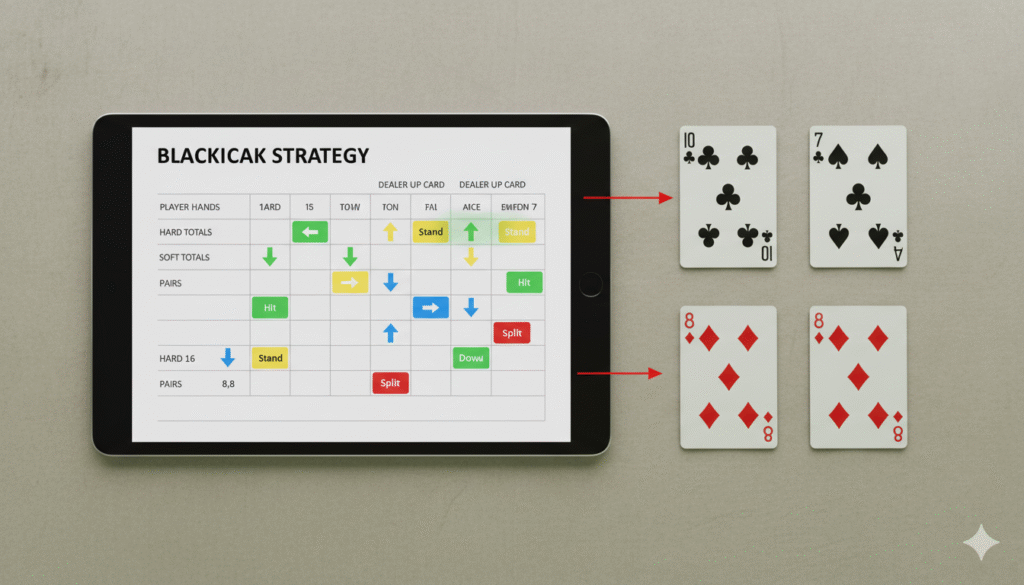
Strategy charts condense complex mathematics into simple visual references showing optimal plays for every hand combination.
Chart Structure and Components
Three Main Sections:
- Hard Hands (no Ace or Ace counted as 1)
- Soft Hands (Ace counted as 11 without busting)
- Pairs (two identical cards offering split opportunities)
Chart Layout:
- Horizontal Axis (Top): Dealer’s upcard (2 through Ace)
- Vertical Axis (Left): Your hand total or pair
- Grid Cells: Recommended action at each intersection
Action Abbreviations:
- H = Hit (take another card)
- S = Stand (keep current total)
- D = Double if allowed, otherwise hit
- Ds = Double if allowed, otherwise stand
- P = Split the pair
- Ph = Split if double after split allowed, otherwise hit
- Rh = Surrender if allowed, otherwise hit
- Rs = Surrender if allowed, otherwise stand
Rule Variations and Strategy Adjustments
Different blackjack games require slightly modified charts based on these key rules:
Dealer Soft 17 Rule:
- S17 (Dealer Stands on Soft 17): More player-favorable, baseline strategy
- H17 (Dealer Hits Soft 17): Requires minor adjustments, adds ~0.22% house edge
Number of Decks:
- Single Deck: Some splitting/doubling adjustments
- Double Deck: Minor variations from multi-deck
- Six/Eight Deck: Standard strategy for most online games
Other Critical Rules:
- Double after split (DAS) allowed or restricted
- Resplitting pairs permitted or limited
- Surrender availability (late surrender standard)
- Blackjack payout ratio (always play 3:2, never 6:5)
Most online blackjack games use six or eight decks with dealer standing on all 17s. Focus on mastering H17 six-deck strategy as your foundation—it covers the majority of situations you’ll encounter.
Hard Hand Strategy: Complete Breakdown
Hard hands form the foundation of basic strategy and appear most frequently during play.
Always Hit: Hard 8 or Less
With totals of 8 or below, hitting is automatic. You cannot possibly bust, and even drawing a face card only brings you to 18. These hands have zero downside risk with significant upside potential.
Strategic Logic: Mathematical analysis shows that any hand totaling 8 or less benefits from additional cards regardless of dealer upcard. The probability of improving substantially outweighs any potential drawback.
Doubling Opportunities: Hard 9, 10, 11
These totals create favorable doubling situations when facing weak dealer upcards:
Hard 11:
- Double against dealer 2-10 (strongest doubling hand)
- Hit against Ace
- ~31% chance of drawing to 21
- High expected value justifies doubling bet
Hard 10:
- Double against dealer 2-9
- Hit against dealer 10 or Ace
- ~30.8% chance of reaching 20
- Strong position against most dealer cards
Hard 9:
- Double against dealer 3-6 only
- Hit in all other situations
- More selective doubling due to lower starting total
- Profitable against weakest dealer upcards
Why These Rules Work: When you’re likely to make a strong hand (19-21) and the dealer shows weakness, increasing your bet through doubling maximizes profit potential. Against strong dealer cards (9, 10, Ace), the risk of losing your doubled bet outweighs potential gains.
The Stiff Hands: Hard 12-16
Stiff hands—totals between 12 and 16—represent blackjack’s most challenging decisions. These hands can easily bust yet are too weak to win consistently.
Hard 12:
- Hit against dealer 2-3 (exception to the rule)
- Stand against dealer 4-6 (dealer bust cards)
- Hit against dealer 7-Ace (dealer strength)
Your 12 has relatively low bust probability (only four cards bust you: 10, J, Q, K). Against dealer 2-3, hitting performs marginally better than standing because dealer bust rates aren’t quite high enough to justify standing.
Hard 13-16:
- Stand against dealer 2-6 (dealer has high bust probability)
- Hit against dealer 7-Ace (you need improvement)
- Surrender 16 vs. 9/10/Ace if available
- Surrender 15 vs. 10 if available
Strategic Logic: Against dealer bust cards (2-6), the dealer must hit until reaching 17, giving them multiple chances to exceed 21. Your stiff hand doesn’t need to be good—it just needs to be standing when the dealer busts.
Against dealer pat cards (7-Ace), the dealer will likely make 17+ (~74-83% of the time). Your weak total loses to all dealer pat hands, making hitting necessary despite bust risk.
Pat Hands: Hard 17-21
Always stand on hard 17 or higher. These totals compete effectively with dealer outcomes while carrying too much bust risk to justify hitting.
Even hard 17 versus dealer Ace—an unfavorable matchup—should stand. Your bust probability (approximately 69%) far exceeds any reasonable improvement chance.
Soft Hand Strategy: Leveraging Flexibility
Soft hands contain an Ace counted as 11, providing unique flexibility since busting is impossible on the next card.
The Soft Hand Advantage
When holding Ace-6 (soft 17), drawing a 10 doesn’t bust you—the Ace converts to 1, creating hard 17. This “safety net” enables aggressive play through hitting and doubling that would be suicidal with hard hands.
Critical Distinction: Soft 17 can be hit freely, while hard 17 must always stand. This fundamental difference drives soft hand strategy.
Soft Doubling Strategy
Soft hands create profitable doubling opportunities against dealer bust cards:
Soft 13-14 (Ace-2, Ace-3):
- Double against dealer 5-6
- Hit in all other situations
Soft 15-16 (Ace-4, Ace-5):
- Double against dealer 4-6
- Hit against all other upcards
Soft 17 (Ace-6):
- Double against dealer 3-6
- Hit against all other upcards
Soft 18 (Ace-7):
- Double against dealer 2-6 (maximize profit)
- Stand against dealer 7-8 (competitive hand)
- Hit against dealer 9, 10, Ace (you’re underdog, need improvement)
The soft 18 decision confuses many players. Against dealer 7-8, your 18 competes reasonably well. Against dealer 9-Ace, you’re significantly behind and must hit despite having a decent total. Against dealer 2-6, doubling capitalizes on extreme dealer weakness.
Soft 19-20 (Ace-8, Ace-9):
- Always stand (already excellent hands)
Why Soft Doubling Works
Against dealer bust cards (especially 4-6), you hold dual advantages: (1) high dealer bust probability, and (2) your hand cannot bust. This combination creates ideal doubling conditions where you’re favored to win and want maximum money at risk.
Pair Splitting Strategy: Complete Guide
When dealt identical cards, splitting creates two independent hands with separate bets. Splitting decisions balance creating two potentially winning hands against risking two bets.
Always Split: Aces and Eights
Splitting Aces:
- Creates two hands starting at 11 (best possible starting value)
- Each Ace gives ~31% chance of reaching 21
- Two chances at blackjack far outweighs keeping soft 12
- Most casinos restrict to one card per split Ace
Splitting Eights:
- Transforms terrible 16 into two hands starting at 8
- Even against strong dealer upcards (9, 10, Ace), splitting outperforms keeping 16
- Hard 16 is blackjack’s worst starting hand—any alternative is preferable
Strategic Proof: Computer simulations show these splits are profitable (or least unprofitable) in all situations. Never deviate from always splitting Aces and eights.
Never Split: Tens and Fives
Never Split Tens (10-10, J-J, Q-Q, K-K):
- Your 20 wins approximately 85% of hands
- Splitting creates two hands starting at 10, each winning ~65%
- Mathematical expected value strongly favors keeping 20
Never Split Fives (5-5):
- Pair of fives totals 10—excellent doubling hand
- Splitting creates two weak hands starting at 5
- Treat as hard 10 and follow doubling strategy
Situational Splits: Context Matters
Twos and Threes (2-2, 3-3):
- Split against dealer 2-7
- Hit against dealer 8-Ace
- Creates opportunity against weak/neutral dealers
Fours (4-4):
- Generally just hit (splitting creates weak starting points)
- Some charts suggest splitting vs. dealer 5-6 in favorable rule conditions
Sixes (6-6):
- Split against dealer 2-6
- Hit against dealer 7-Ace
- Your 12 is terrible; splitting improves prospects against weak dealers
Sevens (7-7):
- Split against dealer 2-7
- Hit against dealer 8-Ace
- Similar logic to splitting twos/threes
Nines (9-9):
- Split against dealer 2-6 and 8-9
- Stand against dealer 7 (your 18 competes well)
- Stand against dealer 10, Ace (splitting risks two bets against strength)
The nine-splitting strategy appears counterintuitive. Against dealer 7, your 18 is already competitive—splitting doesn’t improve expectation. Against dealer 8-9, splitting creates two chances to beat similar dealer totals. Against dealer 10-Ace, keeping one hand at 18 performs better than risking two bets in deeply unfavorable situations.
Surrender Strategy: Minimizing Losses
Surrender allows forfeiting your hand and losing exactly half your bet. While psychologically uncomfortable, surrender minimizes losses in the game’s most unfavorable situations.
Late Surrender Basic Strategy
Hard 16:
- Surrender against dealer 9, 10, Ace
- Hit or stand against other upcards per standard strategy
Hard 15:
- Surrender against dealer 10
- Play normally against other upcards
Additional H17 Surrenders: When dealer hits soft 17, also surrender:
- Hard 17 vs. dealer Ace
- Pair of eights vs. dealer Ace (surrender instead of splitting)
Why Surrender Works Mathematically
With hard 16 versus dealer 10, you’re expected to lose approximately 77 cents per dollar bet if you play out the hand (whether hitting or standing). Surrendering loses exactly 50 cents per dollar bet.
Over 1,000 hands betting $10 with hard 16 versus dealer 10:
- Playing the hand: Lose approximately $7,700
- Surrendering: Lose exactly $5,000
- Savings: $2,700
These “least bad” situations justify surrender despite the uncomfortable feeling of “giving up.”
Common Strategy Mistakes and Corrections

Even players familiar with basic strategy make these frequent errors:
Mistake 1: Taking Insurance
The Error: Accepting insurance when dealer shows Ace, especially when holding blackjack (“even money”).
Why It’s Wrong: Insurance carries ~7% house edge. Only 4 of 13 card ranks complete dealer blackjack (10, J, Q, K), paying 2:1 on true odds of 2.25:1.
Correct Play: Always decline insurance and even money. Over time, collecting 3:2 on winning blackjacks outweighs occasional pushes against dealer blackjack.
Mistake 2: Misplaying Soft Hands
The Error: Standing on soft 17 or failing to double soft 18 against dealer 4-6.
Why It’s Wrong: Soft hands cannot bust on one card, enabling aggressive play that would be reckless with hard hands. Standing on soft 17 wastes the Ace’s flexibility.
Correct Play: Always hit soft 17 or less. Double soft 16-18 against dealer 4-6. Hit soft 18 against dealer 9-Ace.
Mistake 3: Splitting Tens
The Error: Splitting tens against dealer bust cards, attempting to create two strong hands.
Why It’s Wrong: Your 20 already wins/pushes ~90% of hands. Splitting sacrifices near-certain victory for two uncertain outcomes.
Correct Play: Never split tens under any circumstances. Keeping 20 offers superior expected value in all situations.
Mistake 4: Not Surrendering
The Error: Never surrendering because it “feels like giving up.”
Why It’s Wrong: Surrender minimizes losses in deeply unfavorable situations where you’ll lose more than 75% of the time.
Correct Play: Always surrender 16 vs. 9/10/Ace and 15 vs. 10 when available. Save money in the worst spots.
Mistake 5: Playing Hunches Over Math
The Error: Deviating from basic strategy based on “feelings,” recent results, or other players’ advice.
Why It’s Wrong: Your intuition cannot compete with billions of computer-simulated hands. Pattern recognition fails in randomized card games.
Correct Play: Trust the mathematics. Follow basic strategy consistently regardless of short-term results or gut feelings.
Memorization Techniques for Perfect Strategy
Achieving automatic, error-free strategy execution requires dedicated memorization work.
Rule-Based Learning Method
Instead of memorizing hundreds of individual cells, learn overarching rules:
Hard Hand Rules:
- Hit 11 or less, stand 17+
- Hit stiff hands (12-16) vs. dealer strength (7-Ace)
- Stand stiff hands vs. dealer weakness (2-6), except hit 12 vs. 2-3
- Double 9 vs. 3-6, double 10 vs. 2-9, double 11 vs. 2-10
Soft Hand Rules:
- Always hit soft 17 or less
- Always stand soft 19+
- Double soft hands vs. dealer 4-6, specifics vary by hand
Splitting Rules:
- Always split Aces and eights
- Never split tens or fives
- Split other pairs vs. weak dealers (2-7), specifics vary
These simplified rules cover ~85% of situations. Refine with exceptions after mastering basics.
Chunked Practice Sessions
Week 1: Hard hands only (two hours daily practice) Week 2: Soft hands only (two hours daily practice) Week 3: Pairs only (two hours daily practice) Week 4: Integration and testing (three hours daily practice)
Breaking strategy into digestible segments prevents overwhelming cognitive load.
Flashcard Drilling
Create physical or digital flashcards:
- Front: Hand scenario (e.g., “Soft 18 vs. dealer 9”)
- Back: Correct action (“Hit”)
Shuffle daily and quiz yourself until responses become instantaneous. Focus extra repetitions on frequently missed scenarios.
Online Trainers and Apps
Multiple free resources test strategy knowledge:
- Wizard of Odds Basic Strategy Practice
- Blackjack Apprenticeship mobile app
- Casino.org strategy trainer
- Various iOS/Android blackjack training apps
These tools deal random hands, evaluate your decisions, and track error rates—providing measurable progress indicators.
Practicing Strategy Online
Online blackjack offers ideal learning environments for perfecting strategy execution.
Free Play Advantages
Most reputable online casinos offer demo modes where you can:
- Practice with play money (zero financial risk)
- Keep strategy charts open in separate windows
- Take unlimited time making decisions
- Play thousands of hands building muscle memory
- Track strategy adherence without pressure
Recommended Approach:
- Play 500+ hands in demo mode with charts visible
- Progress to demo play referencing charts only for unusual situations
- Attempt demo play from memory, noting errors
- Only transition to real money after achieving 98%+ accuracy
Strategy Verification Tools
Many online platforms provide:
- Hand history reviews showing all past decisions
- Statistical tracking of win rates by hand type
- Built-in strategy advisors highlighting correct plays
- Performance analytics identifying weak areas
Use these features actively during learning phases to identify persistent mistakes requiring extra practice.
Real Money Transition
When moving from demo to real money:
- Start with absolute minimum bets ($1-2)
- Maintain chart access during initial real-money sessions
- Play shorter sessions until confidence builds
- Accept that some errors will occur under pressure
- Don’t increase stakes until strategy becomes automatic
Strategy improves your odds — but only on a platform where payouts are reliable. See our verified picks: best online blackjack sites Malaysia 2026 — all tested for RNG fairness, live dealer quality, and MYR withdrawal speed.
Frequently Asked Questions
How long does it take to learn basic strategy?
Most dedicated students achieve solid basic strategy knowledge in 20-40 hours of study and practice. Perfect memorization typically requires 50-100+ hours including flashcard drills, online practice, and real gameplay. Casual learners may need 3-6 months of periodic practice.
Can I use strategy cards at casino tables?
Most casinos permit basic strategy cards at blackjack tables. However, policies vary—some restrict electronics, and dealers may ask you to play at a reasonable pace. Always ask pit bosses about specific casino policies before playing.
Does basic strategy guarantee I’ll win?
No. Basic strategy minimizes the house edge to ~0.5% but doesn’t eliminate it. You’ll still experience losing sessions due to variance. Over thousands of hands, basic strategy minimizes losses and maximizes winning during favorable runs—but short-term results vary significantly.
Why does strategy change with different rules?
Rule variations affect optimal strategy because they alter expected values of different actions. When dealers hit soft 17, they improve weak hands more often, changing some doubling and surrender decisions. Single-deck games shift card-removal effects, modifying splitting strategies.
Should I adjust strategy based on other players’ cards?
No. In multi-deck games, exposed cards at other positions have negligible impact on your optimal plays. Basic strategy assumes fresh shoe probabilities—minor composition changes from visible cards don’t justify strategic deviations.
Is card counting necessary to beat blackjack?
Basic strategy alone cannot overcome the house edge—you’ll lose approximately $0.50 per $100 wagered long-term. Card counting adds 0.5-1.5% player edge, creating positive expectation. However, basic strategy makes blackjack highly competitive entertainment even without counting.
What’s the biggest mistake beginners make?
Playing 6:5 blackjack represents the costliest beginner error, adding ~1.4% house edge. Among strategic mistakes, taking insurance, misplaying soft hands, and failing to split eights hurt players most. Always verify payout ratios and master soft hand strategy.
Can I profitable play blackjack using only basic strategy?
No. Perfect basic strategy reduces house edge to 0.4-0.6% but doesn’t create positive expectation. You’ll lose slowly over time. Profitable blackjack requires advantage play techniques (card counting, shuffle tracking, etc.) beyond basic strategy.
How often should I practice to maintain strategy skills?
Once memorized, basic strategy becomes permanent with occasional refreshers. Play at least monthly to maintain sharpness. If taking extended breaks (6+ months), review strategy charts before returning to serious play.
Are online strategy trainers accurate?
Reputable trainers from Wizard of Odds, Blackjack Apprenticeship, and established casino sites provide accurate basic strategy practice. Verify trainers match your target rule set (H17 vs. S17, number of decks, etc.) before extensive use.
Conclusion
Mastering basic blackjack strategy represents the foundation of skilled play. By understanding strategy charts, learning decision logic, and avoiding common mistakes, you transform blackjack from luck-based gambling into informed strategic entertainment.
Remember these key principles:
- Basic strategy is mathematically optimal for every situation
- Soft hands enable aggressive play impossible with hard hands
- Always split Aces and eights; never split tens or fives
- Surrender minimizes losses in deeply unfavorable spots
- Consistent application matters more than occasional perfect plays
Combined with proper bankroll management and game selection, basic strategy creates sustainable blackjack enjoyment at minimal theoretical cost.
Whether you’re playing online or in traditional casinos, commit to perfect strategy execution. The house edge difference between perfect and “good enough” strategy compounds dramatically over thousands of hands—precision matters.
Invest time mastering these fundamentals. Your dedication will reward you with improved results, enhanced confidence, and deeper appreciation for blackjack’s strategic depth.
📌 Apply your strategy at top sites: See best online casino Malaysia 2026 for blackjack-strong platforms, check fastest payout casino Malaysia, and read our online casino safety guide.
📝 Editorial transparency: Tested using our published crypto casino methodology — our seven-stage evaluation framework with documented test methodology, refresh cadence, and named accountability. Read: How We Test Crypto Casinos →





 Malaysia Casino Review4 years ago
12Play Casino Review Malaysia 2026 | Get Casino Bonus | SafeGaming
- Singapore Casino Review4 years ago
12Play Review Casino Singapore 2026 | SafeGaming
- Malaysia Casino Review4 years ago
WinClub88 Malaysia 2026: Login Guide, Bonus & Safety
- Malaysia9 months ago
Best Online Casinos in Malaysia 2026 for Real Money
- Singapore Casino Review4 years ago
BK8 Casino Review Singapore 2026 | SafeGaming
- Singapore Casino Review4 years ago
MYBET88 Casino Singapore Review 2026 | SafeGaming
- Singapore Casino Review4 years ago
Maxim88 Casino Review 2026 | Online Casino Singapore
- Malaysia Casino Review4 years ago
QQClubs Casino Review Malaysia 2026 | SafeGaming