
Blackjack House Edge Explained: Rules That Impact Your Odds


Reviewed by Gaming Mathematics Experts 2026
Understanding blackjack house edge separates informed players from those leaving money on the table. While the game offers some of the best odds in any casino, specific rule variations can transform an excellent 0.28% house edge into a punishing 2% or higher. Every rule modification carries measurable mathematical impact, and these effects compound rapidly.
This comprehensive guide examines how house edge works in blackjack, identifies rules that help or hurt players, and provides actionable strategies for finding the most favorable games in 2026. Whether playing online or in traditional casinos, knowing which tables offer optimal conditions dramatically affects your long-term results.
What Is House Edge in Blackjack?
House edge represents the mathematical advantage casinos maintain over players, expressed as the percentage of each wager the casino expects to retain long-term. In blackjack, house edge measures how much the casino wins from your total action over thousands of hands.
The Mathematics Behind Casino Advantage
Unlike purely random games, blackjack house edge stems from specific structural disadvantages built into gameplay. The primary source of casino advantage comes from player action order—you must decide whether to hit or stand before seeing the dealer’s final hand.
When both player and dealer bust, the player loses automatically despite the dealer also exceeding 21. This “double bust” rule creates approximately 8% inherent house advantage before any other factors.
However, player-favorable rules like 3:2 blackjack payouts, doubling options, and splitting opportunities reduce this edge dramatically. Under optimal conditions with perfect basic strategy, the net house edge can drop to 0.28-0.50%, making blackjack one of the casino’s most player-friendly offerings.
House Edge vs Return to Player (RTP)
These related concepts describe the same phenomenon from different perspectives:
House Edge – The casino’s expected profit percentage. A 0.5% house edge means the casino expects to profit $0.50 from every $100 wagered long-term.
Return to Player (RTP) – The percentage returned to players over time. A game with 0.5% house edge offers 99.5% RTP, meaning players receive $99.50 back from every $100 wagered on average.
These percentages represent long-term statistical expectations across thousands of hands. Short-term variance creates significant deviations—you might win or lose substantially in individual sessions regardless of house edge.
How House Edge Accumulates
Consider a player wagering $25 per hand over a four-hour session:
- Playing 80 hands per hour = 320 total hands
- $25 × 320 hands = $8,000 total action
- At 0.5% house edge = $40 expected loss
- At 2.0% house edge = $160 expected loss
The difference between finding a 0.5% game versus accepting a 2.0% game costs this player $120 per session through rule variations alone. Over frequent play, these differences compound into thousands of dollars annually.
Critical Rules That Reduce House Edge (Player-Favorable)
Certain rule variations significantly benefit players by expanding options, improving payouts, or limiting dealer advantages.
3:2 Blackjack Payout (Essential)
House Edge Impact: Baseline (necessary for acceptable game)
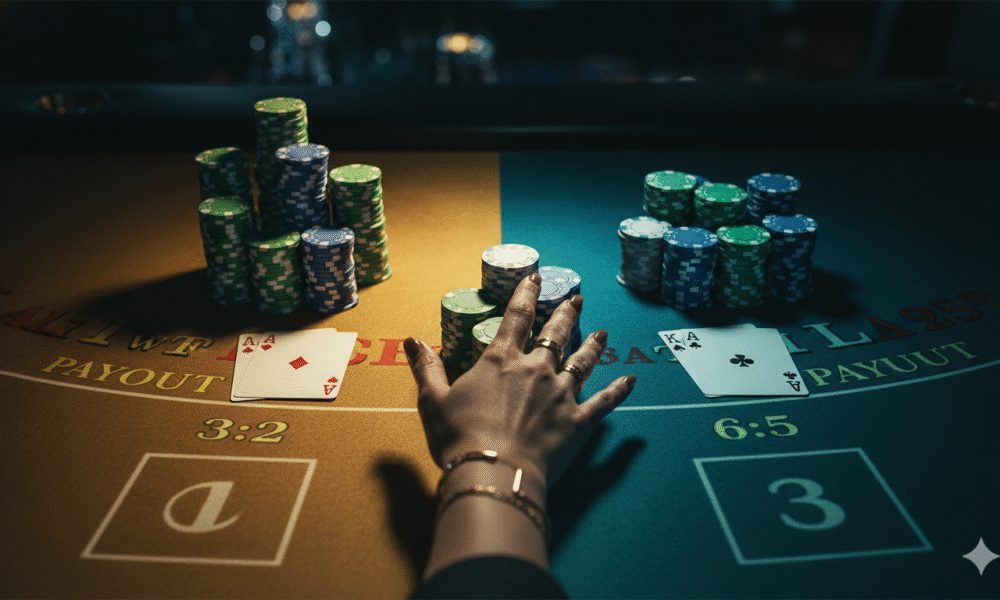
Natural blackjack should pay 3:2, meaning a $10 bet wins $15 rather than even money ($10). This enhanced payout compensates for the double-bust disadvantage and creates blackjack’s player-friendly mathematics.
Critical Warning: Many casinos now offer 6:5 blackjack, paying only $12 on a $10 natural. This seemingly minor change increases house edge by approximately 1.4%—completely negating the benefits of perfect basic strategy.
Real-World Impact: A $25 bettor hitting natural blackjack once per hour loses $6.25 in reduced winnings at 6:5 tables compared to 3:2. Over a weekend of 20 hours play, this single rule change costs approximately $125 in foregone winnings.
Recommendation: Never play 6:5 blackjack under any circumstances. This rule makes blackjack worse than most slot machines. Always verify payout ratios before joining tables.
Dealer Stands on All 17s (S17)
House Edge Impact: -0.20% compared to H17
The dealer’s soft 17 rule creates one of blackjack’s most significant house edge variations. Soft 17 consists of an Ace counted as 11 plus other cards totaling 6 (Ace-6 being most common).
Dealer Stands on Soft 17 (S17): The dealer must stand with soft 17. Players can often beat dealer soft 17, and the dealer gains no improvement opportunity.
Dealer Hits on Soft 17 (H17): The dealer must draw additional cards with soft 17. This rule allows improvement to 18-21 approximately 14% of the time while only busting around 4%. This asymmetric improvement significantly favors the house.
Why It Matters: Soft 17 puts the dealer in mediocre position. Forcing them to stand preserves player advantage in these situations. Allowing hits gives dealers additional winning opportunities without corresponding bust risk.
Double Down on Any Two Cards
House Edge Impact: Baseline (restricted doubling increases edge by +0.18%)
Optimal blackjack allows doubling your wager after receiving any two-card combination. This flexibility maximizes profit in favorable situations like 11 versus dealer 6 or soft 18 versus dealer 5.
Some casinos restrict doubling to hands totaling 10 or 11 only. This limitation eliminates profitable soft hand doubles and marginal hard hand doubles, increasing house edge by approximately 0.18%.
Double After Split (DAS)
House Edge Impact: -0.15%
Doubling after splitting pairs adds strategic flexibility, particularly with favorable split hands like a pair of fives against dealer 6, or pair of sixes against dealer 4.
Without DAS, you can only hit split hands. With DAS, you can double your bet on the first card received after splitting if it creates favorable doubling opportunity.
Resplitting Allowed
House Edge Impact: -0.03% to -0.05% depending on pair
Many casinos allow resplitting pairs if you receive another matching card after the initial split. For example, you split eights and receive another eight—resplitting creates a third hand.
Some casinos permit resplitting up to four total hands, while others limit to two or three hands maximum. More resplits slightly benefit players by extending pair-splitting opportunities.
Late Surrender
House Edge Impact: -0.07%
Surrender allows forfeiting your hand and losing only half your bet in deeply unfavorable situations. Late surrender (standard version) permits surrendering after the dealer checks for blackjack.
When to Surrender:
- Hard 16 versus dealer 9, 10, or Ace
- Hard 15 versus dealer 10
- Additional hands versus dealer Ace in H17 games
Many players avoid surrender thinking it represents “giving up.” However, in situations where you’re expected to lose more than 75% of the time, losing half your bet immediately performs better mathematically than playing out the hand.
Fewer Decks in Play
House Edge Impact: -0.48% (single deck vs. eight decks)
The number of decks significantly impacts house edge through card removal effects and blackjack frequency:
Single Deck: Lowest house edge at approximately 0.15% with optimal rules. Each card removal creates larger impact on remaining deck composition.
Double Deck: House edge approximately 0.35% with optimal rules. Still offers meaningful single-deck advantages while being more commonly available.
Six Deck: House edge approximately 0.55% with optimal rules. Most common online and casino configuration.
Eight Deck: House edge approximately 0.63% with optimal rules. Minimal card removal effects, greatest casino advantage.
Important Caveat: Many single-deck games compensate with poor rules like 6:5 blackjack payout or restricted doubling. Always calculate net house edge considering all rules, not just deck count.
Harmful Rules That Increase House Edge

Equally important to finding player-favorable rules is avoiding tables with poor conditions that unnecessarily increase the casino’s advantage.
6:5 Blackjack Payout (Avoid Completely)
House Edge Impact: +1.39%
This devastating rule change represents the single worst blackjack variation in modern casinos. By paying only 6:5 ($12 on $10) instead of 3:2 ($15 on $10) for natural blackjack, casinos add approximately 1.4% to house edge.
Why It’s So Harmful: Players average one natural blackjack approximately every 21 hands. The reduced payout directly costs money multiple times per session while providing zero offsetting benefits.
Marketing Deception: Casinos often pair 6:5 payouts with seemingly attractive features like single-deck games or lower minimum bets. These superficial advantages don’t compensate for the massive payout reduction.
Calculation Example:
- Playing 500 hands per weekend trip
- Approximately 24 natural blackjacks expected
- $10 average bet
- 3:2 payout: 24 × $15 = $360 in blackjack wins
- 6:5 payout: 24 × $12 = $288 in blackjack wins
- Net difference: $72 lost per weekend from payout rule alone
Absolute Recommendation: Walk away from any 6:5 blackjack table immediately. This rule makes blackjack less favorable than most slot machines and virtually unbeatable long-term.
Dealer Hits Soft 17 (H17)
House Edge Impact: +0.22%
When dealers must hit soft 17 instead of standing, they improve weak hands approximately 14% of the time while only busting around 4%. This asymmetric outcome heavily favors the house.
The H17 rule particularly hurts players when holding totals of 11, 12, or soft 18-19 against dealer soft 17 situations. Your decent hands lose more frequently when dealers can improve their soft 17s.
No Hole Card (European Style)
House Edge Impact: +0.11%
American blackjack deals the dealer one upcard and one hole card face-down, checking for blackjack before players act. European blackjack deals only the upcard initially, dealing the dealer’s second card after all players complete their hands.
Why This Hurts Players: In no-hole-card games, you can double or split against dealer Ace or 10, only to discover the dealer had blackjack after you’ve put additional money at risk. You lose all additional bets, not just your original wager.
Mitigation: Some European-style games offer ENHC (European No Hole Card) rules where you only lose your original bet even when doubling or splitting against dealer blackjack. This modification eliminates most of the house edge increase.
Restricted Doubling Rules
House Edge Impact: +0.18% (restricting to 10-11 only)
Limiting doubling to specific totals eliminates profitable opportunities on soft hands and marginal hard hands like 9 versus weak dealers.
Common Restrictions:
- Double on 10 or 11 only (worst restriction, +0.18% edge)
- Double on 9, 10, or 11 only (+0.09% edge)
- No doubling after splitting (+0.14% edge)
These limitations remove strategic options without providing offsetting player benefits. Seek tables allowing doubles on any two cards.
No Resplitting or Split Restrictions
House Edge Impact: +0.03% to +0.10% depending on restrictions
Limiting splits to one time per hand, restricting Ace splits, or disallowing resplitting removes profitable opportunities when receiving favorable additional cards after splitting.
Most Harmful Restrictions:
- Splitting Aces receive only one card (common, minimal impact)
- No resplitting of any pairs (+0.03%)
- Cannot split Aces at all (+0.18%)
- Restricting splits to specific pairs like 8s and Aces only (+0.45%)
Calculating Net House Edge
Individual rules don’t exist in isolation—their effects combine to create total house edge. The best way to evaluate any blackjack game involves calculating its net house edge from all rule variations.
Starting Point: Six-Deck Baseline
Begin with six-deck blackjack using these baseline assumptions:
- 3:2 blackjack payout
- Dealer stands on all 17s
- Double on any two cards
- Double after split allowed
- Resplitting allowed except Aces
- No surrender
- Dealer checks for blackjack
Baseline House Edge: Approximately 0.55%
Example Calculations
Excellent Game:
- Single deck: -0.40% adjustment
- S17 dealer: included in baseline
- Late surrender: -0.07%
- DAS: included in baseline
- Net House Edge: Approximately 0.08%
Poor Game:
- Six decks: 0.55% baseline
- 6:5 blackjack: +1.39%
- H17 dealer: +0.22%
- Double 10-11 only: +0.18%
- No DAS: +0.14%
- Net House Edge: Approximately 2.48%
The difference between these games means the poor game extracts 31 times more money from players than the excellent game—a massive difference created entirely by rule variations.
Finding the Best Blackjack Games in 2026

Armed with understanding of how rules impact house edge, you can systematically identify superior blackjack opportunities.
Online Casino Evaluation
1. Read Game Rules Completely – Online casinos display complete rule sets in game information screens. Review before playing:
- Payout ratios (must be 3:2)
- Dealer soft 17 rules (prefer S17)
- Doubling policies (any two cards best)
- Number of decks (fewer is better with good rules)
- Surrender availability
2. Seek RNG Certification – Verify that third-party auditors (eCOGRA, iTech Labs, GLI) have tested the blackjack RNG for fairness. Reputable sites display audit certificates.
3. Compare Across Providers – Different game developers offer varying rule sets. Compare blackjack variants from Evolution, Playtech, NetEnt, and other providers to find optimal conditions.
4. Test in Demo Mode – Most online platforms offer free play. Use demo mode to verify rules and test gameplay before risking real money.
Physical Casino Strategy
1. Compare Table Felt Language – Walk the casino floor reading felt markings before sitting. Look for:
- “Blackjack Pays 3 to 2” (never 6:5)
- “Dealer Stands on All 17s” (best)
- “Double on Any Two Cards”
- Deck count when visible
2. Ask Dealers About Rules – Dealers answer rule questions freely. Ask about:
- Surrender availability
- Resplitting policies
- Double-after-split rules
- Specific deck count
3. Check Different Casino Areas – In Las Vegas, downtown casinos often offer better rules (3:2 payouts, lower minimums) than Strip properties. Similar patterns exist in other gambling regions.
The lowest house edge means nothing if the casino delays your payout. Our team has verified withdrawal speed and licence details on every site in the best online blackjack casinos Malaysia 2026 guide.
Frequently Asked Questions
What is a good house edge for blackjack?
A house edge below 0.60% represents a good blackjack game with reasonable rules. Excellent games achieve 0.30-0.40% with optimal rule combinations. Anything above 1.0% indicates poor rules that should be avoided.
Does the number of decks really matter?
Yes. Single-deck blackjack offers approximately 0.48% lower house edge than eight-deck games (all else equal). However, many single-deck games compensate with 6:5 payouts, negating any deck advantage. Always evaluate complete rule sets.
Why is 6:5 blackjack so bad?
The 6:5 payout adds approximately 1.4% to house edge by reducing blackjack winnings from $15 to $12 on a $10 bet. Players get blackjack roughly every 21 hands, making this reduction extremely costly over time. It transforms blackjack from player-friendly to nearly unbeatable.
Should I play blackjack with dealer hitting soft 17?
H17 adds 0.22% to house edge but doesn’t make games unplayable if other rules are favorable. If you must play H17, ensure other rules compensate (3:2 payout, DAS, surrender, fewer decks). Avoid H17 combined with other poor rules.
What’s the best rule combination I can find?
The best widely available combination: Single or double deck, 3:2 payout, S17, DAS, late surrender, resplitting allowed. This achieves house edge around 0.10-0.20%. Such games exist primarily at select downtown Las Vegas casinos or premium online platforms.
Can I overcome house edge with perfect strategy?
No. Perfect basic strategy minimizes house edge to its lowest point (typically 0.40-0.60%) but doesn’t create positive expectation. You’ll still lose slowly over time. Overcoming house edge requires advantage play techniques like card counting.
Do side bets affect the main game’s house edge?
No. Side bets carry independent house edges (usually 2-10%+) but don’t change the main blackjack game’s edge. However, playing side bets increases your overall house edge exposure by adding high-edge wagers to your total action.
How do I calculate house edge for a specific game?
Use online calculators like Wizard of Odds’ Blackjack House Edge Calculator. Input all rule variations (decks, S17/H17, doubling rules, DAS, surrender, resplitting) to receive precise house edge calculation for that specific game.
Are online blackjack house edges fair?
Licensed online casinos with RNG certification offer mathematically fair house edges matching their stated rules. Verify licensing, seek eCOGRA/iTech Labs/GLI certification, and check published RTP percentages. Reputable platforms provide provably fair games.
What’s the worst blackjack rule I can encounter?
The 6:5 blackjack payout represents the single worst rule, adding 1.4% house edge. Other terrible rules include: no doubling after split, double on 11 only, no Ace resplitting, and H17 with multiple other restrictions combined.
Conclusion
Blackjack house edge varies dramatically based on rule variations, ranging from excellent 0.28% in optimal conditions to punishing 2%+ in poor games. Every rule modification carries measurable mathematical impact that compounds with other rules to create total house edge.
The most critical factors include:
- 3:2 blackjack payout (never accept 6:5)
- Dealer stands on soft 17 (S17 preferable to H17)
- Doubling allowed on any two cards
- Double after split permitted
- Fewer decks (when other rules remain favorable)
Avoiding unfavorable rules matters as much as seeking favorable ones. Walking away from 6:5 blackjack immediately, regardless of other seemingly attractive features, protects your bankroll from unnecessary drain.
Combined with perfect basic strategy execution and disciplined bankroll management, playing games with optimal rules transforms blackjack into one of the casino’s best entertainment values. Take time researching rule sets before playing—the difference between best and worst blackjack games equals hundreds or thousands of dollars over regular play.
Whether you’re playing online or in traditional casinos, demand fair rules that respect your action. With proper game selection and strategic play, blackjack offers sustainable entertainment at minimal theoretical cost.
📌 Reduce your house edge: Pick from our best online casino Malaysia 2026 list for platforms with low house edge blackjack. Compare fastest payout casino Malaysia for reliable withdrawals.
📝 Editorial transparency: Evaluated using our published live casino methodology — our seven-stage evaluation framework with documented test methodology, refresh cadence, and named accountability. Read: How We Test Live Dealer Casinos →







 Malaysia Casino Review4 years ago
12Play Casino Review Malaysia 2026 | Get Casino Bonus | SafeGaming
- Singapore Casino Review4 years ago
12Play Review Casino Singapore 2026 | SafeGaming
- Malaysia Casino Review4 years ago
WinClub88 Malaysia 2026: Login Guide, Bonus & Safety
- Malaysia9 months ago
Best Online Casinos in Malaysia 2026 for Real Money
- Singapore Casino Review4 years ago
BK8 Casino Review Singapore 2026 | SafeGaming
- Singapore Casino Review4 years ago
MYBET88 Casino Singapore Review 2026 | SafeGaming
- Singapore Casino Review4 years ago
Maxim88 Casino Review 2026 | Online Casino Singapore
- Malaysia Casino Review4 years ago
QQClubs Casino Review Malaysia 2026 | SafeGaming