Blackjack Insurance Explained: 7 Reasons It’s a Trap (Avoid This Costly Bet)

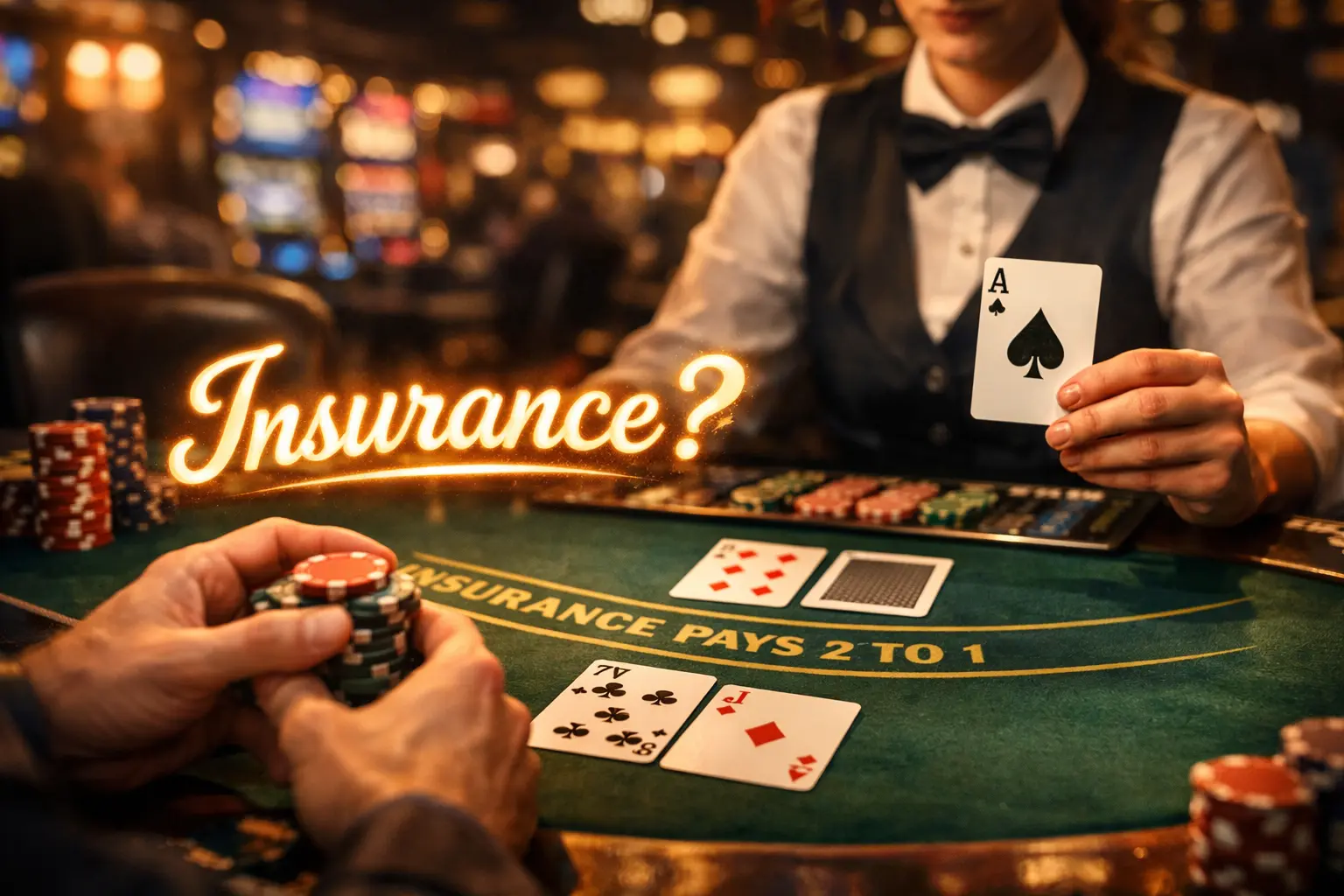
Picture this: you’re sitting at the blackjack table, you’ve got a solid hand, and the dealer flips an Ace. Suddenly the dealer looks at you and asks, “Insurance?” It sounds reasonable, even reassuring—like the casino is doing you a favour. You nod, place the side bet, and feel like you’ve just made a smart, protective move.
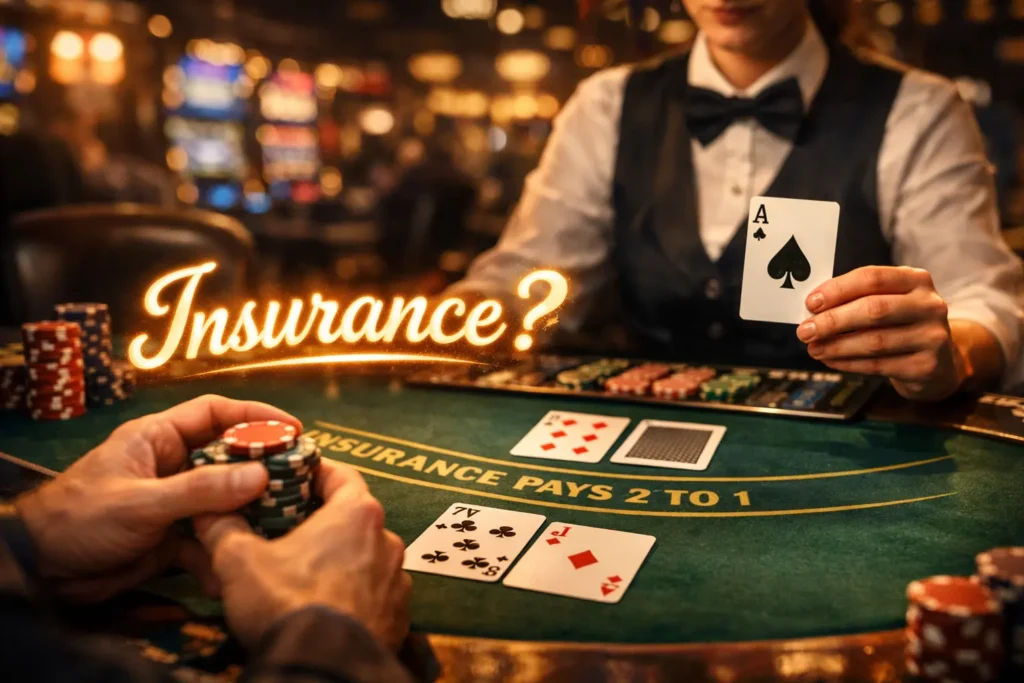
Here’s the truth: you almost certainly just handed the casino free money.
Blackjack insurance is one of the most cleverly named and persistently misunderstood bets in casino gaming. Whether you’re playing at a land-based table in Las Vegas or spinning through hands on an online platform, the question of “should I take insurance?” comes up for virtually every player. And for the overwhelming majority, the mathematically correct answer is the same every single time: no.
This guide, brought to you by SafeGaming, breaks down exactly what the blackjack insurance bet is, how the odds are stacked against you, the psychological tricks behind it, and the one very specific scenario where it might make sense. By the end, you’ll never second-guess this decision again.
QUICK ANSWER: What Is Blackjack Insurance and Why Is It a Trap?
Blackjack insurance is a side bet offered when the dealer shows an Ace. You wager up to half your original bet that the dealer holds a ten-value card in the hole, paying 2:1 if correct. It’s a trap because the dealer only has blackjack ∼30.8% of the time—lower than the 33.3% needed for the bet to break even—giving the casino a house edge of up to 7.47%.
Blackjack Insurance Strategy: Should You Ever Take It?
The correct blackjack insurance strategy for most players is simple: never take it. Unless you are counting cards and the deck is rich in ten-value cards, blackjack insurance remains a negative expected value bet.
What Is Blackjack Insurance?
To fully understand why experts call it a trap, you first need to understand what blackjack insurance actually is—and, critically, what it is not.
Blackjack insurance is a standalone side bet. It is not a modification of your main hand, it does not alter your odds of winning the round, and it does not “protect” your original wager in any meaningful way. It is an entirely separate prediction: you are betting that the dealer’s face-down card (the “hole card”) is a ten-value card—a 10, Jack, Queen, or King—which combined with their visible Ace would give them a natural blackjack.
The insurance bet is only offered when the dealer’s upcard is an Ace. At no other point in the game will you be asked about insurance. The offer typically appears before the dealer checks their hole card, meaning you’re making a decision under uncertainty.
How Blackjack Insurance Works (Step-by-Step Guide)
The Mechanics
When the dealer shows an Ace, they will pause and ask the table: “Insurance?” The rules are consistent across virtually all casinos:
• You may place up to half your original bet on the insurance line.
• If the dealer has a ten-value hole card (completing blackjack), the insurance bet pays 2 to 1.
• If the dealer does not have blackjack, the insurance bet is lost immediately and the hand continues normally.
A Worked Example
Imagine you bet $20 on your hand. The dealer shows an Ace and you decide to take insurance for $10 (the maximum, being half your original bet).
• Scenario A – Dealer has blackjack: You lose your $20 main bet but win $20 from your $10 insurance payout (2:1). Net result: break even.
• Scenario B – Dealer does not have blackjack: You immediately lose your $10 insurance bet. You then play out your main hand—even if you win, you are already $10 behind for the round.
The critical takeaway: the insurance bet has zero connection to your hand. Whether you hold a 21, a 20, or a 12, the insurance wager is purely about the dealer’s hole card. Nothing else.
What Is “Even Money” in ?
Even money is a special form of the insurance bet that applies when you are dealt a natural blackjack and the dealer shows an Ace. Instead of waiting to see the dealer’s hole card, you can accept an immediate 1:1 payout rather than the standard 3:2.
Even money is mathematically identical to taking insurance on your own blackjack. And as we’ll show below, declining it is the superior long-term play.
Blackjack Insurance Odds Explained (The Math Behind the Bet)
Deck Composition and Dealer Blackjack Probability
Understanding the blackjack insurance odds starts with a simple card-counting exercise. In a standard 52-card deck, there are 16 ten-value cards (four 10s, four Jacks, four Queens, four Kings). When the dealer shows an Ace, the probability of their hole card being one of those tens is:
• Single-deck game: approximately 31.37% (16 out of 51 remaining cards)
• Standard six-deck shoe: approximately 30.8% (96 out of 311 remaining cards)
• Eight-deck shoe: approximately 30.7%
The Break-Even Point
A bet paying 2 to 1 is only mathematically fair if the winning event occurs at least one-third (33.33%) of the time. At 33.33%, you break even in the long run. Below that threshold, the bet has a negative expected value—you lose money over time.
The actual probability of the dealer having a ten in the hole (∼30.8%) is below the 33.3% break-even threshold. That gap is the trap.
Expected Value (EV) Calculation
Expected Value tells you the average financial outcome of making the same bet repeatedly. Using a six-deck shoe:
• Win probability: 96/311 = 30.87%
• Loss probability: 215/311 = 69.13%
• EV = (2 × 0.3087) + (−1 × 0.6913) = 0.6174 − 0.6913 = −0.074
Result: For every $100 wagered on blackjack insurance, you can expect to lose $7.40 in the long run. This is a consistently negative outcome for recreational players.
Even Money: The Expected Value Breakdown
The even money offer when you hold blackjack breaks down as follows:
• Taking even money: guaranteed 100% return on your bet.
• Declining even money: expected return of approximately 103.88% – because you win 3:2 the majority of the time and only push (break even) when the dealer also has blackjack.
By accepting even money, you voluntarily surrender nearly 4% of your expected value to avoid a rare push scenario. As blackjack probability expert Michael Shackleford (the “Wizard of Odds”) has stated: “You’re gambling, to begin with, so gamble!”
Why Blackjack Insurance Is a Trap (Mathematical Proof)
The insurance bet is a trap not because it can never win—it can, and does, roughly 30% of the time. It’s a trap because of the sustained mathematical disadvantage it places on anyone who takes it regularly. Casinos understand human psychology better than most players realise, and the design of the insurance offer exploits that understanding at every level.
The Name Is the First Trick
The word “insurance” is a marketing masterstroke. In everyday life, insurance is rational—you pay a small premium to protect against a large loss. The casino borrows this framing to make a negative-EV side bet feel like prudent financial planning. It is not. Real insurance is actuarially priced so the insurer profits over time. So is blackjack insurance—but the insurer here is the casino.
Loss Aversion and the Fear of Missing Out
Behavioural economics identifies loss aversion—the tendency for people to feel losses more acutely than equivalent gains—as a powerful driver of irrational decisions. When the dealer shows an Ace and you’ve got a strong hand, the thought of losing to a blackjack triggers that loss aversion. Insurance feels like a logical hedge. It is not a hedge—it is a second, separate bet with a higher house edge than the game you’re already playing.
The Emotional Certainty Trap IN Blackjack Insurance
Some players justify insurance by saying it gives them a “100% chance of being happy” by locking in a result. While that psychological certainty has real appeal, it comes at a measurable cost. Repeatedly choosing emotional certainty over mathematical expectation is precisely how recreational players consistently lose more than they should.
At SafeGaming, we believe that understanding the mechanics behind casino traps like the insurance bet is a foundational element of responsible and informed gambling. Knowing why a bet is structured against you helps you make cleaner, more rational decisions at the table—and better protects your bankroll over time.
House Edge and Probability: Insurance vs. the Base Game IN Blackjack Insurance
The contrast between the house edge on the base game of blackjack and the house edge on the insurance bet is stark. Here is a direct comparison:
Game / Bet Condition House Edge
Blackjack (Main Game) Basic strategy, liberal Vegas rules ~0.28%
Blackjack (Main Game) Basic strategy, standard 6-deck ~0.50%
Insurance Bet Single deck ~5.88%
Insurance Bet 2 decks ~6.80%
Insurance Bet 4 decks ~7.25%
Insurance Bet 6 decks ~7.40%
Insurance Bet 8 decks ~7.47%
Even Money (Your Blackjack) Dealer shows Ace, any deck ~3.88% vs. declining
The insurance bet carries a house edge 20 to 25 times higher than the base game. This is not a minor trade-off—it is a fundamentally different proposition. For more on how house edge affects long-term outcomes, see the
For authoritative probability analysis, see the Wizard of Odds blackjack guide, and for responsible gaming context around iGaming odds literacy, visit the GamCare gambling information hub. The UK Gambling Commission player protection resources also provides clear guidance on understanding casino odds.
When Blackjack Insurance Might Actually Make Sense
There is one—and only one—scenario in which taking the blackjack insurance bet becomes a mathematically sound decision: when you have reliable, real-time knowledge that the remaining deck is significantly ten-rich.
How Card Counting Changes the Equation
Professional blackjack players use card counting systems to track the ratio of high-value cards to low-value cards remaining in the shoe. As low cards are dealt, the concentration of tens in the remaining deck rises—and when it rises above the 33.3% break-even threshold, the insurance bet flips from negative to positive expected value.
In the widely used Hi-Lo counting system, the benchmark for this shift is a True Count of +3 or higher. At that point, the deck contains enough ten-value cards that the insurance bet becomes a profitable play.
How Significant IsBlackjack Insurance to Card Counters?
For professional card counters, the insurance bet is not a minor detail—it accounts for more than 30% of the total gain achievable through card counting. Knowing when to take insurance is considered the single most important strategy variation in advantage play.
The Practical Reality
For recreational players without a reliable counting system in operation, the instinct that “the deck feels ten-rich” is almost always wrong. Human intuition is not a valid substitute for a systematically maintained True Count. If you are not actively counting and verifying a True Count of +3 or above, the correct decision is to decline insurance—every single time.
Common Myths About Blackjack Insurance
Myth The Reality IN Blackjack Insurance
Insurance protects your hand It is a completely separate side bet. Your main hand plays out exactly the same whether you take insurance or not. If the dealer has blackjack, your main bet is still lost.
You should insure a strong hand (like a 20) This is actually the worst time to take insurance. If you hold two ten-value cards, you have removed two of the cards the dealer needs—making the bet even less likely to win.
Even money is always smart Even money costs you approximately 3.88% of expected value. Declining it and playing the hand out is statistically superior on every 3:2 table.
Insurance reduces volatility It adds a high-margin side bet to your session. Over time, it increases the rate at which casual players lose money, not decreases it.
It’s a win-win It is a net loss in the long run. The 69%+ of the time the dealer does not have blackjack far outweighs the occasional insurance win.
Final Verdict: Should You Take Blackjack Insurance?
The professional consensus is clear, consistent, and backed by decades of mathematical analysis: for recreational players, the answer to “should you take insurance in blackjack?” is always no.
• Every standard blackjack basic strategy chart in existence advises against taking insurance under normal circumstances.
• The house edge on the insurance bet (5.88%–7.47%) dwarfs the house edge of the base game (0.28%–0.50%).
• The bet is designed to exploit loss aversion and the psychological appeal of certainty, not to offer you genuine protection.
• The only valid exception is for card counters operating with a verified True Count of +3 or higher.
At SafeGaming, we advocate for players who understand the games they play. The insurance bet is a textbook example of a casino-side wager that is dressed up as player protection. Recognising it for what it is—a high-margin side bet with a negative expected value—is one of the clearest decisions you can make at the blackjack table.
Stick to basic strategy. Decline insurance. Protect your bankroll with knowledge, not side bets.
Frequently Asked Questions: Blackjack Insurance
1. What is blackjack insurance and how does it work?
Blackjack insurance is a side bet offered when the dealer’s upcard is an Ace. You wager up to half your original bet that the dealer has a ten-value card in the hole, completing a blackjack. The bet pays 2:1 if correct and is immediately lost if the dealer does not have blackjack. It is a separate bet with no connection to your main hand. Learn more about blackjack rules at Wikipedia
2. Is blackjack insurance ever a good bet?
For the vast majority of players, no. The insurance bet has a house edge of 5.88% to 7.47% depending on the number of decks—far higher than the 0.28% to 0.50% edge on the base game. The only scenario in which insurance becomes profitable is when a card counter has verified a True Count of +3 or higher, indicating the remaining deck is significantly ten-rich.
3. What is “even money” in blackjack and should I take it?
Even money is offered when you hold a natural blackjack and the dealer shows an Ace. Accepting even money pays your blackjack at 1:1 immediately rather than the standard 3:2. It is mathematically identical to taking insurance on your own hand. You should decline it: the expected return of playing the hand out is approximately 103.88% versus the 100% of taking even money.
4. Why do casinos offer blackjack insurance?
Because it is highly profitable for the casino. The insurance bet exploits loss aversion and the human desire for certainty—both of which are heightened when a player has a strong hand and the dealer shows a threatening Ace. The house edge on insurance is 20 to 25 times higher than on the base game, making it one of the most profitable side bets in table gaming.
5. Does taking insurance affect my basic strategy?
No. Basic strategy assumes you will never take insurance (unless counting cards). If you decline insurance on every hand, you are already following the mathematically optimal path. Taking insurance does not interact with your main hand decisions—it only drains your bankroll by introducing a separate high-edge wager into your session.
Related Posts



📝 Editorial transparency: Evaluated using our published live casino methodology — our seven-stage evaluation framework with documented test methodology, refresh cadence, and named accountability. Read: How We Test Live Dealer Casinos →




 Malaysia Casino Review4 years ago
12Play Casino Review Malaysia 2026 | Get Casino Bonus | SafeGaming
- Malaysia Casino Review4 years ago
WinClub88 Malaysia 2026: Login Guide, Bonus & Safety
- Singapore Casino Review4 years ago
12Play Review Casino Singapore 2026 | SafeGaming
- Malaysia9 months ago
Best Online Casinos in Malaysia 2026 for Real Money
- Singapore Casino Review4 years ago
BK8 Casino Review Singapore 2026 | SafeGaming
- Singapore Casino Review4 years ago
MYBET88 Casino Singapore Review 2026 | SafeGaming
- Singapore Casino Review4 years ago
Maxim88 Casino Review 2026 | Online Casino Singapore
- Malaysia Casino Review4 years ago
QQClubs Casino Review Malaysia 2026 | SafeGaming