
When Should You Split in Blackjack?

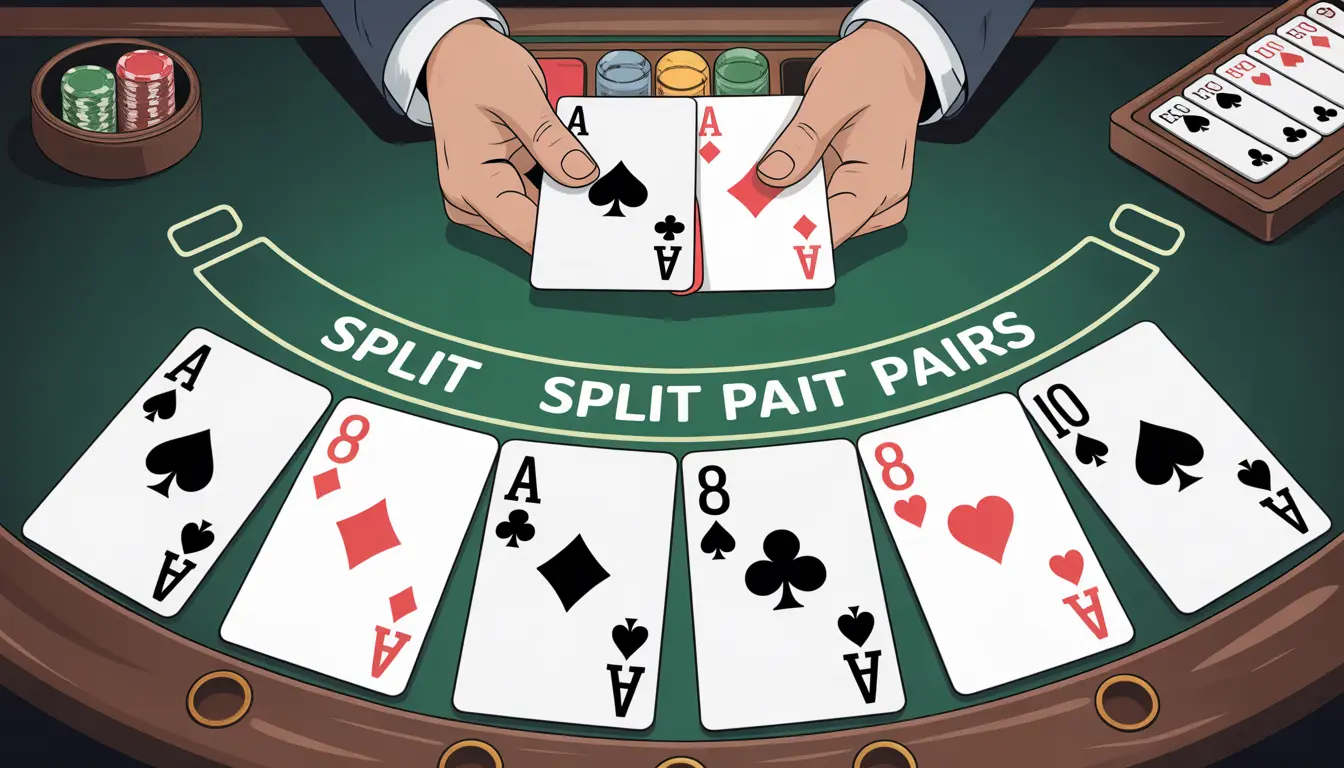
You glance down at your cards and see two 8s staring back at you. The dealer’s showing a 10. Your stomach drops a little. Hard 16 — the worst hand in blackjack — and the dealer looks strong. You think about hitting. You think about standing. Then the dealer asks: “Split?”
If that question makes you hesitate, you’re not alone. Splitting is one of the most misunderstood moves at the blackjack table. Players split when they shouldn’t, refuse to split when they should, and rarely understand why the strategy says what it says. The result is money left on the table, or worse, money handed directly to the house on decisions that had a mathematically clear answer all along.
This guide gives you that clarity. Not just the rules — the logic behind them. You’ll understand not just when to split, but why the math demands it, when splitting is genuinely defensive rather than aggressive, and how specific house rules like Double After Split change the entire calculation for certain pairs.
At SafeGaming, we believe informed decisions are the foundation of responsible gambling. Knowing your blackjack split strategy cold is one of the most direct ways to reduce the house edge and stay in control of your session from the first hand to the last.
| QUICK ANSWER: When Should You Split in Blackjack?In blackjack, you should always split Aces and 8s regardless of the dealer’s upcard. You should never split 10s or 5s — these are already strong hands. For all other pairs (2s, 3s, 6s, 7s, 9s), split only when the dealer shows a weak upcard, typically 2 through 7, and factor in whether Double After Split (DAS) is available at your table. The Big Four Rules Every Player Must Know:• Always split Aces — turns a weak 2 or 12 into two hands starting with 11.• Always split 8s — removes the worst hand in blackjack (hard 16).• Never split 10s — a total of 20 wins ~83% of the time; don’t risk it.• Never split 5s — a hard 10 should be doubled, not split into two weak 5s. |
What Does Splitting Mean in Blackjack?
A split occurs when your first two cards are of the same rank — two 8s, two Aces, two 7s, or any combination of 10-value cards (10, Jack, Queen, King). You have the option to divide them into two independent hands by placing a second wager equal to your original bet. The dealer then deals a new second card to each split card, and you play each hand separately against the dealer.
Splitting can reduce the house edge by approximately 0.36% when executed correctly — a meaningful advantage in a game where the entire house edge is often below 1%. This is why blackjack pair splitting is a mandatory part of basic strategy, not an optional bonus play.
The decision to split is not about instinct or mood — it is about Expected Value (EV): the average financial outcome of making the same decision thousands of times. When the EV of splitting exceeds the EV of playing the original hand, you split. When it doesn’t, you don’t.
Blackjack Splitting Rules: What You Need to Check First
Before applying any split strategy, you need to know the specific rules at your table. These variations change which pairs are profitable to split and which should be played differently.
Double After Split (DAS)
DAS is the most strategically significant rule variation for splitting. When DAS is permitted, you can double down on a hand created by a split — for example, splitting 4s and drawing a 7 to get 11, then doubling. DAS turns several borderline splits into mandatory ones, particularly for 2s, 3s, 4s, and 6s against specific dealer upcards. Always confirm DAS availability before sitting down.
Resplitting
Most modern casinos allow resplitting if you are dealt a third card of the same rank after a split, typically up to a maximum of four total hands. Resplitting rules for Aces are usually more restrictive — many tables allow only one resplit of Aces, or none at all.
Split Ace Restrictions
Splitting Aces is almost always restricted to one additional card per Ace. You cannot hit again after receiving that card, and a 21 on a split Ace is usually paid at 1:1 (even money) rather than the standard 3:2 blackjack bonus. Despite these restrictions, splitting Aces is still always the correct play.
European No Hole Card (ENHC) Games
In European blackjack and other No Hole Card games, the dealer does not check for blackjack until the end of the round. In these games, do not split 8s or Aces against a dealer 10 or Ace — because if the dealer holds a natural blackjack, you lose both split bets rather than just one.
The Blackjack Split Strategy Chart (Multi-Deck, DAS, S17)
The following chart provides the mathematically optimal splitting decision for every pair against every dealer upcard, based on standard multi-deck rules with Double After Split (DAS) allowed and the dealer standing on Soft 17 (S17). This is the core tool of blackjack split strategy.
Colour key: ■ Green = Split ■ Red = Do Not Split ■ Amber = Split only if DAS allowed ■ Blue = Double Down instead
| Your Pair | 2 | 3 | 4 | 5 | 6 | 7 | 8 | 9 | 10 | A |
| A, A | Split | Split | Split | Split | Split | Split | Split | Split | Split | Split |
| 10, 10 | Stand | Stand | Stand | Stand | Stand | Stand | Stand | Stand | Stand | Stand |
| 9, 9 | Split | Split | Split | Split | Split | Stand | Split | Split | Stand | Stand |
| 8, 8 | Split | Split | Split | Split | Split | Split | Split | Split | Split | Split |
| 7, 7 | Split | Split | Split | Split | Split | Split | Hit | Hit | Hit | Hit |
| 6, 6 | Split* | Split | Split | Split | Split | Hit | Hit | Hit | Hit | Hit |
| 5, 5 | Double | Double | Double | Double | Double | Double | Double | Double | Hit | Hit |
| 4, 4 | Hit | Hit | Hit | Split* | Split* | Hit | Hit | Hit | Hit | Hit |
| 3, 3 | Split* | Split* | Split | Split | Split | Split | Hit | Hit | Hit | Hit |
| 2, 2 | Split* | Split* | Split | Split | Split | Split | Hit | Hit | Hit | Hit |
* Amber (Split*) = Split only when Double After Split (DAS) is permitted at your table. If DAS is not offered, Hit instead.
Pair-by-Pair Breakdown: The Logic Behind Every Decision
Aces — Always Split
A pair of Aces counts as either 2 or Soft 12 — both are among the weakest starting hands in blackjack. Splitting creates two hands each starting with an Ace counted as 11, the strongest starting point available. Even with the restriction to one card per split Ace, the probability of improving both hands dramatically outweighs playing a combined hand of 2 or Soft 12. Split Aces against every dealer upcard without exception.
8s — Always Split (The Defensive Split)
Hard 16 is statistically the worst hand in blackjack. When you hit a 16 against a dealer 10, you lose approximately $53.50 per $100 wagered on average. When you split those 8s, your expected loss drops to approximately $47.57 per $100 — a saving of nearly $6 per hand, simply from making the correct mechanical decision. You are not splitting to win; you are splitting to lose less. Against a strong dealer 9 or 10, splitting 8s still minimises your loss more effectively than any alternative.
10s — Never Split
A total of 20 wins against the dealer approximately 83% of the time when the dealer shows a 5. Splitting those 10s drops your win probability per hand to approximately 63%. You are converting one near-certain winning hand into two separate hands that are each significantly less likely to win. The only exception is for expert card counters operating with a verified True Count of +5 or higher — a scenario that does not apply to recreational players.
9s — Conditional Split
A total of 18 is a good hand… unless you can do better. Split 9s against dealer upcards 2 through 6 and 8 through 9, where two hands starting at 9 each offer better expected value than a combined 18. Stand against a dealer 7: your 18 already beats the dealer’s most probable outcome (17), making splitting unnecessary and statistically costly. Stand against 10 and Ace as well — the dealer is too strong.
7s — Split Against Weak Cards Only
Two 7s total 14, which is a stiff hand with no attractive options. Splitting against dealer upcards 2 through 7 gives each new hand a fighting chance at 17 or better, while the dealer’s weak position increases bust probability. Against 8 through Ace, the dealer is too strong — hit the combined 14 instead.
6s — Split With Caution
Split 6s against dealer 2 through 6 — but only split against a dealer 2 if DAS is permitted (amber on the chart). Without DAS, a dealer 2 is just strong enough that the expected value of splitting tilts slightly negative. Against dealer 7 through Ace, hit the combined total; the dealer is too dangerous to invest a double stake.
5s — Never Split (Double Instead)
Two 5s equal a hard 10 — one of the best doubling opportunities in the game. Splitting them creates two hands each starting with 5, which are among the weakest possible starting points. Against dealer 2 through 9, double down on the combined 10 instead. Against dealer 10 or Ace, simply hit the 10.
4s — Only in Specific DAS Conditions
Splitting 4s is only profitable against dealer 5 or 6 AND when DAS is available. In all other situations, hitting the combined total of 8 is the superior play. If DAS is not offered, never split 4s.
2s and 3s — Opportunistic Splits
Split 2s and 3s against dealer 2 through 7 when DAS is available. Against dealer 2 and 3 specifically, splitting is only correct if DAS is permitted; otherwise, hit. Against dealer 8 through Ace, both combined totals (4 or 6) are better hit than split against a strong dealer position.
How Double After Split (DAS) Changes Your Strategy
DAS is one of the most player-favourable rules in blackjack, and its presence or absence directly determines the profitability of several splitting decisions. Here is a direct comparison of how DAS changes the correct play for borderline pairs:
| Pair | Dealer Upcard | Without DAS | With DAS |
| 6, 6 | Dealer 2 | Hit | Split |
| 3, 3 | Dealer 2 | Hit | Split |
| 3, 3 | Dealer 3 | Hit | Split |
| 2, 2 | Dealer 2 | Hit | Split |
| 2, 2 | Dealer 3 | Hit | Split |
| 4, 4 | Dealer 5 | Hit | Split |
| 4, 4 | Dealer 6 | Hit | Split |
As a standing rule: if you are at a table without DAS, tighten your splitting range for small pairs. The lost doubling opportunity after the split shifts the expected value enough to make hitting the superior choice.
The Probability Behind Splitting: Expected Value in Practice
Splitting decisions are rooted in Expected Value — the average financial outcome per $100 wagered across thousands of identical situations. Here are the three most instructive EV comparisons:
| Scenario | Action | Expected Outcome per $100 | Verdict |
| 8, 8 vs. Dealer 10 | Hit the Hard 16 | Lose ~$53.50 | Worst option |
| 8, 8 vs. Dealer 10 | Stand on Hard 16 | Lose ~$54.00 | Also poor |
| 8, 8 vs. Dealer 10 | Split the 8s | Lose ~$47.57 | Best option — minimum loss |
| 10, 10 vs. Dealer 5 | Stand on 20 | Win ~$64.00 | Correct play |
| 10, 10 vs. Dealer 5 | Split the 10s | Win ~$26.00 (net combined) | Incorrect — major profit loss |
| A, A vs. Any | Play combined (2/12) | Net negative | Weak hand |
| A, A vs. Any | Split the Aces | Net positive | Always correct |
The takeaway from every EV calculation is consistent: correct splitting is not about optimism — it is about minimising expected loss on bad hands and maximising expected gain when the dealer is vulnerable
Common Mistakes Players Make with Splitting
1. Splitting 10s for action: Standing on 20 wins ~83% of the time against a dealer 5. Splitting those 10s drops your per-hand win rate to ~63% and your total expected value by approximately $38 per $100. Never split 10s as a recreational player.
2. Refusing to split 8s against a strong dealer card: The “it feels like throwing good money after bad” instinct is understandable but mathematically wrong. Splitting 8s against a dealer 10 still saves you approximately $6 per $100 compared to hitting or standing.
3. Applying a DAS chart at a non-DAS table: Using a chart designed for DAS games at a table without DAS will cause you to split 2s, 3s, and 6s in situations where hitting is the correct play. Always confirm the table rule before applying the strategy.
4. Forgetting to apply basic strategy to the new hands: After splitting, each new hand must be played according to full basic strategy. That includes doubling on the new hand if the cards justify it (where DAS is permitted), or hitting and standing according to the chart.
5. Misplaying 9s against a dealer 7: A total of 18 already beats the dealer’s most probable outcome (17) when they show a 7. Many players split here unnecessarily, turning a probable win into two separate uncertain bets.
Playing Smarter, Not Just Longer: The SafeGaming Perspective
Blackjack split strategy is not just a tactical tool — it is an expression of playing the game with full knowledge and genuine control. At SafeGaming, we support every player’s right to enjoy casino games, and we believe that right is best exercised with the clearest possible understanding of the mathematics involved.
When you split correctly, you are reducing the house edge as far as the rules allow. When you split incorrectly — out of intuition, habit, or the belief that splitting 10s against a dealer 5 is “just too good an opportunity to pass up” — you are transferring expected value back to the casino on decisions that had a clear answer.
Understanding this is not about eliminating risk or guaranteeing wins. It is about ensuring that when you do take a risk, it is a calculated one with your best mathematical interests accounted for. Set a session budget before you play, split according to the chart rather than instinct, and treat strategy as the foundation of every hand — not an optional enhancement.
Authoritative Resources for Further Study
•Wizard of Odds – Blackjack Basic Strategy (Multi-Deck): Comprehensive mathematically verified strategy charts including full pair splitting decisions for multiple deck and rule configurations.
•Blackjack Apprenticeship – Advanced Strategy Charts: Professional-grade strategy tools used by advantage players, including DAS and No-DAS chart variants.
• Wikipedia – Blackjack: A well-maintained reference on blackjack rules, variants, and the mathematical principles underlying basic strategy.
Conclusion: The Big Four and the Chart
If you take nothing else from this guide, take the Big Four: always split Aces and 8s, never split 10s and 5s. These four rules alone correct the most common and most costly splitting errors made at blackjack tables.
For everything else, the strategy chart is your guide. Check your table rules before sitting — specifically DAS availability and whether the game is S17 or H17. Apply the chart consistently, resist the temptation to deviate based on hot streaks or gut feelings, and understand the Expected Value logic behind every decision you make.
Correct splitting reduces the house edge by up to 0.36%. Incorrect splitting hands that advantage back to the casino. Over a session of a hundred or two hundred hands, the difference is measurable, real, and entirely within your control.
Frequently Asked Questions: Blackjack Split Strategy
1. Should you always split Aces in blackjack?
Yes — in almost every blackjack variant, splitting Aces is the optimal play. A pair of Aces is either a hard 2 or a soft 12, both of which are weak starting points. Splitting creates two hands each beginning with an Ace worth 11, dramatically improving your probability of reaching a strong total. The only rare exception is in European No Hole Card (ENHC) games where you face a dealer 10 or Ace and risk losing both bets to a dealer natural.
2. Why should you never split 10s?
A total of 20 is the second-strongest hand in blackjack and wins approximately 83% of the time against a dealer showing 5. Splitting 10s reduces your per-hand win probability to around 63% and significantly lowers your total expected value on the hand. The only scenario where splitting 10s is mathematically justified is for expert card counters with a verified True Count of +5 or higher — it is not a play for recreational players.
3. Does Double After Split (DAS) change when I should split?
Significantly, yes. DAS turns several borderline splits into mandatory ones, particularly for 2s, 3s, 4s, and 6s against specific dealer upcards. For example, splitting 2s or 3s against a dealer 2 or 3 is only correct when DAS is available. Without DAS, those same splits have negative expected value and should be replaced with hitting. Always verify DAS availability before applying a split strategy chart.
4. Why is splitting 8s correct even against a strong dealer card?
Because hard 16 has the worst expected value of any starting total in blackjack, and splitting 8s — even against a strong dealer upcard like a 10 — reduces your expected loss from approximately $53.50 to $47.57 per $100 wagered. You are not splitting to win; you are splitting to lose less. This is called a defensive split, and the mathematics consistently support it against every dealer upcard.
5. Does splitting reduce the house edge?
Yes. Having the option to split and exercising it correctly reduces the house edge by approximately 0.36% compared to a game without splitting. This makes pair splitting one of the highest-impact components of blackjack basic strategy. Conversely, splitting incorrectly — splitting 10s, splitting 5s, or using a DAS chart at a non-DAS table — increases the effective house edge above its theoretical minimum.
📝 Editorial transparency: Evaluated using our published live casino methodology — our seven-stage evaluation framework with documented test methodology, refresh cadence, and named accountability. Read: How We Test Live Dealer Casinos →




 Malaysia Casino Review4 years ago
12Play Casino Review Malaysia 2026 | Get Casino Bonus | SafeGaming
- Singapore Casino Review4 years ago
12Play Review Casino Singapore 2026 | SafeGaming
- Malaysia Casino Review4 years ago
WinClub88 Malaysia 2026: Login Guide, Bonus & Safety
- Malaysia8 months ago
Best Online Casinos in Malaysia 2026 for Real Money
- Singapore Casino Review4 years ago
BK8 Casino Review Singapore 2026 | SafeGaming
- Singapore Casino Review4 years ago
MYBET88 Casino Singapore Review 2026 | SafeGaming
- Singapore Casino Review4 years ago
Maxim88 Casino Review 2026 | Online Casino Singapore
- Malaysia Casino Review4 years ago
QQClubs Casino Review Malaysia 2026 | SafeGaming