
Offshore Casinos vs Licensed Casinos

Every day, millions of players log in to online casinos without pausing to ask one simple but vital question: is this site actually allowed to take my money? The difference between an offshore casino and a properly licensed one is not merely a technicality buried in terms and conditions. It is the single most important distinction you can make when deciding where to gamble online — and it touches everything from payout reliability to your legal standing should something go wrong.
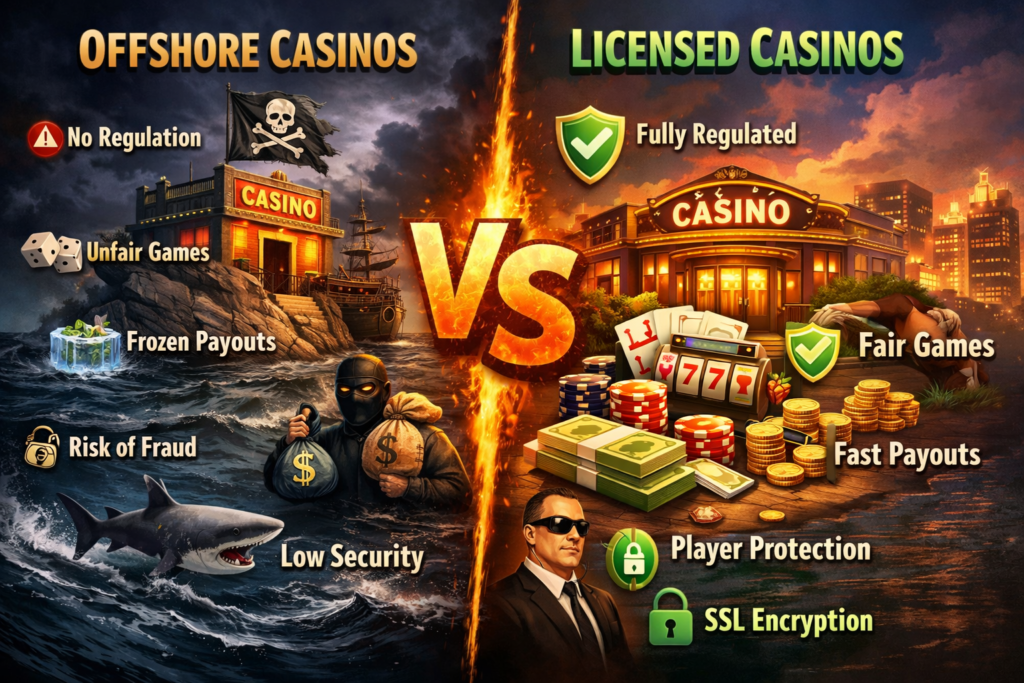
This guide breaks down both sides with no bias, no fluff, and no vague reassurances. By the end, you will have the knowledge to make an informed choice that protects your bankroll and your personal data.
Defining the Two Types of Online Casinos
Before comparing them, it is worth being precise about what each term actually means, because the industry uses them loosely.
What Is a Licensed Casino?
A licensed casino — sometimes called a regulated casino — holds an active gambling license issued by a recognized government authority in the jurisdiction where its players reside or where it legally operates. Examples of highly respected licensing bodies include the UK Gambling Commission (UKGC), the Malta Gaming Authority (MGA), the New Jersey Division of Gaming Enforcement, and the Swedish Gambling Authority. Each enforces strict rules around game fairness, responsible gambling tools, segregated player funds, and transparent complaint procedures.
What Is an Offshore Casino?
An offshore casino is one that is licensed — if at all — in a jurisdiction far removed from the players it targets. Common offshore licensing locations include Curaçao, Panama, Anjouan, and certain Pacific island territories. These locations offer licenses cheaply, quickly, and with minimal ongoing oversight. In many cases, an offshore casino accepting players from the United States, United Kingdom, or Australia is technically operating in a legal gray area — or outright illegality — in those countries.
“A casino license is only as meaningful as the authority that issued it and the enforcement power that backs it up.”
Side-by-Side: Key Differences at a Glance
| Factor | Offshore Casino | Licensed Casino |
| Regulatory Oversight | Minimal or none | Strict and ongoing |
| Player Fund Protection | Rarely guaranteed | Required by law (segregated) |
| Dispute Resolution | No independent body | Independent ADR services |
| Game Fairness Audits | Rare or self-certified | Regular 3rd-party RNG testing |
| Responsible Gambling | Often absent | Mandatory (limits, self-exclusion) |
| Withdrawal Speed | Variable, often slow | Governed by time-limit rules |
| Bonus Transparency | Terms can change without notice | Clear, regulator-reviewed terms |
| Data Privacy | Uncertain, often weak | GDPR / local data laws enforced |
| Legal Recourse | Extremely limited | Full legal rights intact |
The Regulatory Gap: Why It Matters More Than You Think
Regulation is not just red tape. For players, it translates into concrete, measurable protections that offshore casinos simply cannot match. A UK Gambling Commission license requires the operator to submit to regular audits, maintain a complaints process, contribute to problem gambling research funding, and keep player deposits in bank accounts completely separate from operational funds. If that operator goes bankrupt tomorrow, your deposited balance is protected.
Contrast this with a Curaçao-licensed operation. The e-Gaming license from Curaçao is notoriously easy to obtain and offers virtually no player protection. There is no mandatory player fund segregation, no independent Alternative Dispute Resolution (ADR) requirement, and no meaningful penalty for operators who delay or deny withdrawals. Players who have been wronged have no realistic path to recovery.
What Reputable Licenses Require from Operators
◆ Independent auditing of Random Number Generators (RNG) by companies like eCOGRA or iTech Labs
◆ Segregated accounts for all player deposits, completely separate from company funds
◆ Mandatory responsible gambling tools: deposit limits, cooling-off periods, and self-exclusion programs
◆ Clear and enforceable terms and conditions, reviewed by the regulator
◆ Access to a free, independent dispute resolution service for unresolved player complaints
◆ Anti-money laundering (AML) and Know Your Customer (KYC) compliance procedures
Bonuses, Withdrawals, and the Fine Print Trap
One area where the offshore vs licensed divide becomes painfully apparent is in the handling of bonuses and withdrawals. Offshore casinos frequently advertise enormous welcome bonuses — sometimes matching deposits by 300% or more — precisely because there is no authority scrutinizing whether those bonuses are realistically claimable. Wagering requirements buried deep in the terms may effectively make the bonus worthless, and the casino can alter those terms at will.
Licensed casinos in regulated markets face far more scrutiny. The UKGC has specifically banned certain types of bonus structures it deemed misleading, and requires that wagering requirements be prominently disclosed. This introduces a baseline of fairness that players can rely on.
Withdrawal delays are another common pain point with offshore operators. Without a regulator enforcing processing time standards, some offshore casinos routinely hold withdrawals for weeks — or manufacture technical pretexts for outright denial. In regulated jurisdictions, operators face formal complaints and license reviews for such behavior.
If you want to understand how many offshore casinos attract players in the first place, read our complete guide to casino affiliate deception, which explains how misleading marketing tactics drive traffic to unregulated platforms. Our full WE88 Malaysia review covers the bonus structure and payment method depth in full detail.
The Case Some Players Make for Offshore Casinos
A balanced assessment requires acknowledging why millions of players still choose offshore sites. Several legitimate grievances drive this preference.
First, in countries where online gambling remains fully or partially prohibited — including several US states and some Asian markets — licensed domestic options simply do not exist. For players in these regions, an offshore casino may be the only practical avenue for legal online play.
Second, some offshore casinos genuinely do operate with integrity. A long operational history, a strong community reputation on independent review forums, and responsiveness to player complaints can indicate a trustworthy operator even without a premium license.
Third, offshore casinos often accept cryptocurrencies, offer faster onboarding, and carry fewer identity verification hurdles — all of which appeal to players who prioritize privacy or live in underserved markets.
How to Verify Whether a Casino Is Genuinely Licensed
The most important thing to understand here is that displaying a license logo means nothing on its own. Fraudulent casinos regularly copy license badge images from legitimate operators and paste them into their footers. Verifying a license requires a few extra steps, and they are worth taking every time.
Visit the regulator’s official website directly — never via a link on the casino’s own page — and use its public license register to search for the casino by name. The UKGC, MGA, and most credible regulators maintain live, searchable databases of all current and former licensees. If the casino does not appear there, the badge is fake.
Also look for indicators of independent auditing. Seals from eCOGRA, iTech Labs, GLI, or BMM Testlabs indicate that the site’s games and RNG systems have been independently verified. These certifications do not replace a license but add a meaningful layer of accountability on top of one.
Licensed operators must comply with strict player protection and fairness standards set by regulators such as the UK Gambling Commission, which enforces rules around withdrawals, responsible gambling, and transparency.
Frequently Asked Questions About Offshore Casinos vs Licensed Casinos
1. What is the difference between offshore casinos and licensed casinos?
Offshore casinos operate from jurisdictions outside a player’s country and may have limited regulation, while licensed casinos are regulated by recognized gaming authorities that enforce strict rules for fairness, security, and player protection.
2. Are offshore casinos legal to play at?
The legality of offshore casinos depends on the laws of the player’s country. Some countries allow access to offshore platforms, while others restrict or regulate them.
3. Are licensed casinos safer than offshore casinos?
Licensed casinos are generally safer because they must follow strict regulations, provide fair gaming systems, protect player data, and ensure secure payment methods.
4. Do offshore casinos offer better bonuses?
Offshore casinos often advertise larger bonuses and promotions, but they may come with higher wagering requirements and fewer consumer protections.
5. How do licensed casinos ensure fair games?
Licensed casinos use certified random number generators (RNGs) and undergo regular audits by independent testing agencies to ensure fair gameplay.
6. What risks are associated with offshore casinos?
Common risks include limited regulatory oversight, potential payment delays, lack of dispute resolution, and weaker data security measures.
7. Do licensed casinos provide faster payouts?
Licensed casinos usually offer more reliable and transparent payout processes because regulators require them to process withdrawals fairly and on time.
8. Can players file complaints against licensed casinos?
Yes, players can submit complaints to the casino’s licensing authority or regulatory body if they face issues with payments or fairness.
9. How can you verify if an online casino is licensed?
You can check the casino’s website footer for licensing information and verify the license number with the official regulatory authority.
10. Which option is better for online players: offshore or licensed casinos?
Licensed casinos are generally the better option because they provide stronger security, fair gaming standards, and better player protection.










 Malaysia Casino Review1 year ago
WE88: Trusted Online Casino Malaysia | SafeGaming
- Singapore Casino Review1 year ago
Uwin33 Review – Trusted Casino in Singapore 2026 | SafeGaming
- Malaysia Casino Review1 year ago
UWin33 Casino Review Malaysia 2026 | SafeGaming
- Malaysia Casino Review1 year ago
12Play Casino Review Malaysia 2026 | Get Casino Bonus | SafeGaming
- Singapore Casino Review1 year ago
12Play Review Casino Singapore 2026 | SafeGaming
- Malaysia Casino Review1 year ago
WinClub88 Casino Review Malaysia 2026 | Trusted ✅ | SafeGaming
- Thailand Casino Review4 months ago
เว็บพนันออนไลน์ ที่ดีที่สุด 2026 สำหรับผู้เล่นชาวไทย
- Malaysia Casino Review1 year ago
MYBET88 Casino Review Malaysia 2026 | SafeGaming