
When Should You Split in Blackjack? The Complete Strategy Guide


Splitting Pairs: A Simple Rule With a Lot of Hidden depth in blackjack
Splitting pairs is one of the most misunderstood moves in blackjack. Most players know the basics — always split Aces, never split 5s — but the decisions in between are where real money is either saved or lost.
The split option lets a player take a pair and divide it into two separate hands, placing an equal bet on each. Done correctly, splitting turns a weak starting position into two stronger ones. Done wrong, it doubles the money at risk without improving the odds.

Understanding when to split in blackjack requires looking at three things: the player’s pair, the dealer’s upcard, and the table rules in play. Change any one of those factors, and the correct decision can change too. This guide walks through every pair combination, explains the math behind each decision, and covers the edge cases that trip up even experienced players. If you are still building your foundations, our complete blackjack strategy guide covers the full decision framework — including hitting, standing, and doubling — before splitting becomes relevant.
The Pairs You Always Split — No Exceptions in blackjack
Aces: Always Split, Every Time
Splitting Aces is the clearest decision in the game. A pair of Aces has a total value of either 2 or 12 — both awkward positions. But each Ace split into its own hand starts at 11, which is the strongest possible starting point in blackjack. Any 10-value card drawn after produces a 21.
The math is overwhelming in favor of splitting. Even the one-card restriction that most casinos apply to split Aces — meaning each Ace gets exactly one additional card — does not change the decision. The probability of improvement is simply too high to pass up.
Rule Note Most casinos only allow one card per split Ace. Despite that restriction, splitting is still always the correct play. The probability of improving both hands is too significant to ignore.
Eights: Always Split, Even Against Strong Upcards in blackjack
A pair of 8s totals 16 — the single worst hand in blackjack. Hitting 16 against a dealer’s 10 is miserable. Standing is not much better. The point of splitting 8s is not to create two strong hands; it is to escape a losing position and replace it with two fresh starts, each beginning from a neutral 8.
Some players hesitate to split 8s against a dealer’s 9, 10, or Ace, reasoning that starting two hands against a strong upcard seems even worse. But the math disagrees. Standing or hitting on 16 against those upcards carries a higher expected loss than splitting. The split does not guarantee a win — it just makes the situation less bad, which is exactly what strategy is designed to do.
Pairs That Require Judgment: Conditional Splits in blackjack
Nines: Split Against Weakness, Stand Against Strength
A total of 18 sounds strong, but a pair of 9s is deceptive. Against a dealer showing 2 through 6, or 8 through 9, splitting is correct. The dealer is either in bust territory or holding a total that a split hand can beat.
The exception is a dealer showing a 7. Against a 7, a player holding 18 is already in a winning position — the dealer’s most likely outcome is a 17. Standing on the 18 is the right call. The same logic applies to a dealer 10 or Ace, where the risk of creating two weaker hands outweighs the benefit of splitting.
Sevens: Split to Match the Dealer’s Vulnerability
A pair of 7s totals 14, which is a weak hand. Splitting against a dealer showing 2 through 7 makes sense — the dealer is in vulnerable territory, and two hands starting from 7 each have a reasonable chance of reaching 17 or above. Against a dealer 8 or higher, hitting the 14 is the better play.
Sixes: A Dealer Bust Setup
Splitting 6s follows similar logic. Against a dealer showing 2 through 6, the dealer is in prime bust range. Two hands starting at 6 each carry the potential to improve, particularly if the table allows Double After Split. Against a dealer 7 and above, the correct move is to hit the total of 12 — uncomfortable as that feels.
Threes and Twos: Low Pairs Against Weak Dealers
Both 3s and 2s follow the same basic framework: split against a dealer showing 2 through 7, hit everything else. The logic is identical — weak dealer upcards create bust risk, and two low hands each have the chance to build toward a strong total. Without that dealer weakness, splitting just creates two hands that are likely to be in trouble.
When Double After Split (DAS) is available, the split range for 2s and 3s sometimes extends slightly because post-split doubling opportunities add value. Always check the table rules before deciding.
Fours: A DAS-Only Split
A pair of 4s totals 8, which is actually a decent starting point. Splitting into two hands each starting from 4 is only mathematically justified when two conditions are met: the dealer is showing a 5 or 6, and the table allows DAS.
Why DAS matters here specifically: the value of splitting 4s comes from the possibility of drawing a 5, 6, or 7 to create a hand of 9, 10, or 11 — all prime doubling spots. Without the ability to double after splitting, that second layer of value disappears. In multi-deck games without DAS, hitting the total of 8 is the correct move.
The Pairs You Should Never Split
Fives: Double Down, Not Split
A pair of 5s should never be split. The reason is simple: 10 is one of the strongest possible starting totals for doubling down, and splitting 5s turns one strong hand into two weak ones beginning from 5. Against a dealer showing 2 through 9, doubling the 10 is the right play. Against a 10 or Ace, hitting is correct. Splitting is never on the table.
Tens: The Most Misunderstood Split in the Game
A pair of 10s totals 20. That is the second-best hand in blackjack — behind only a natural blackjack. Basic strategy is unambiguous: do not split 10s.
And yet, this is one of the most frequently discussed splits in advanced blackjack circles. The reason is card counting. Under the Hi-Lo counting system, when the true count reaches +4 or higher against a dealer showing a 6, splitting 10s becomes mathematically profitable. The high density of 10-value cards in a rich deck increases the probability of drawing two 20s from the split, and the dealer’s bust probability is elevated.
Card Counter Warning Splitting 10s is a known red flag for casino security. Dealers at many casinos are required to alert the pit boss when a player splits 10s. Even when the math justifies it at TC +4, many professionals skip this deviation entirely to avoid heat.
Even when splitting is technically profitable, the numbers tell a more nuanced story. Here is the expected value breakdown for a $10 bet against a dealer 6:
| Action | Expected Win | Risk Level |
| Stand on 20 | $6.77 avg win | Low — guaranteed strong hand |
| Split once (TC +4) | $5.56 combined | Medium — more money at risk |
| Resplit to 3–4 hands | ~$4.51 combined | High — diminishing returns |
Standing on 20 produces a higher average win than splitting — even when the count justifies the split. The additional money placed on the table creates more variance without a proportional increase in profit. Many professionals conclude it is simply not worth the exposure.
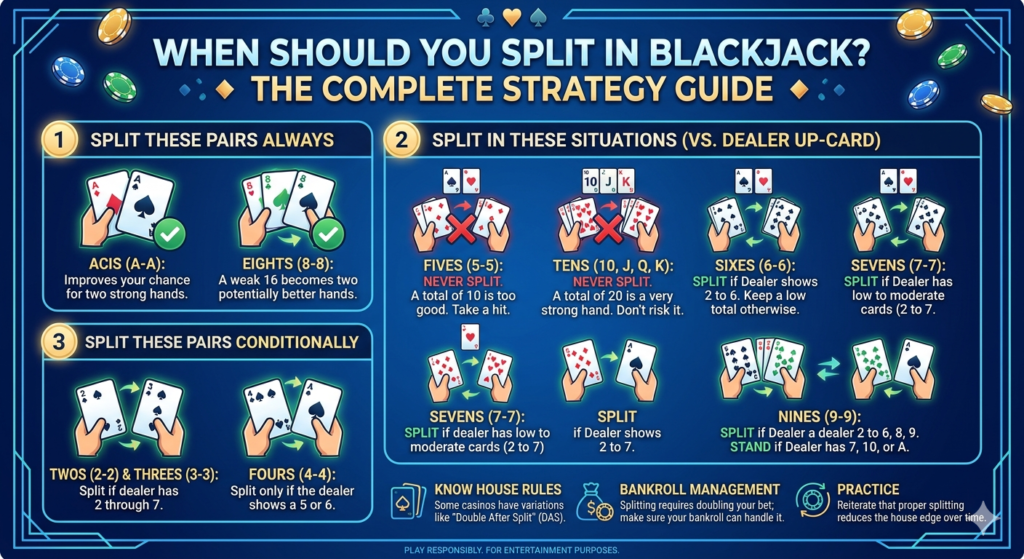
Splitting Strategy: Complete Pair Reference in blackjack
| Pair | Basic Decision | When to Split | Why | Never Split? |
| Aces | Always Split | Every situation | Two hands starting with 11 | No |
| 8s | Always Split | Every situation | 16 is weakest hand; reset to 8 | No |
| 9s | Conditional | 2–6, 8–9 | Beat dealer’s weak upcard | vs 7, 10, Ace |
| 7s | Conditional | 2–7 | Split before dealer 7 ties | vs 8, 9, 10, Ace |
| 6s | Conditional | 2–6 (DAS: 2–6) | Dealer weak; push bust risk | vs 7 and above |
| 4s | Conditional | DAS only: vs 5 or 6 | Only split if can double after | Without DAS: hit |
| 3s | Conditional | 2–7 (DAS: 2–7) | Low risk with DAS available | vs 8 and above |
| 2s | Conditional | 2–7 | Two chances vs weak dealer | vs 8 and above |
| 10s | Never (basic strategy) | Count-based only: TC +4 vs 6 | 20 is too strong to split normally | Yes — unless counting |
| 5s | Never Split | Double down instead | Total of 10 is powerful | Yes |
How House Rules Change Splitting Decisions in blackjack
Double After Split (DAS) — The Rule That Unlocks More Value
DAS is one of the most player-friendly rules a blackjack table can offer. It allows players to double down on a hand created by a split — for example, splitting 4s and drawing a 5 to produce a 9, then doubling that 9 against a weak dealer.
Without DAS, several splits that carry positive expected value lose their mathematical justification. The split range for pairs like 2s, 3s, and 4s narrows considerably at no-DAS tables. Always check whether DAS is available before making splitting decisions on low pairs.
Number of Decks and Splitting Strategy
Single-deck games shift the probabilities around splitting in subtle ways. With fewer cards in play, drawing a specific rank becomes more or less likely depending on what has already been dealt. Some splitting decisions — particularly for marginal pairs like 4s — differ between single-deck and multi-deck charts.
Players using a basic strategy chart should always match it to the specific game conditions: number of decks, H17 or S17, and DAS availability. A multi-deck chart applied to a single-deck game will occasionally give the wrong instruction.
Splitting Mistakes That Cost Players Money in blackjack
- Not splitting 8s against a strong dealer: Standing or hitting 16 against a 10 or Ace loses more on average than splitting. The split does not make things worse — it makes them less bad.
- Splitting 10s without a count: Without a verified true count of +4 or higher, splitting 20 is simply a mistake. There is no basic strategy situation where it is correct.
- Splitting 5s out of habit: Two hands starting at 5 are significantly weaker than one hand at 10. The double-down opportunity on 10 is too valuable to sacrifice.
- Ignoring DAS when splitting low pairs: Without DAS, splits on 2s, 3s, and 4s lose their post-split doubling value. The decision changes depending on table rules.
- Resplitting 10s after the initial count-based split: The thresholds to justify resplitting are significantly higher than for the initial split. Most players give the advantage back by continuing to resplit when the count no longer justifies it.
- For a visual reference to optimal pair decisions, you can review the detailed strategy charts available at Blackjack Apprenticeship, which break down exactly when to split each pair based on dealer upcards and table rules.
FAQ – When Should You Split in Blackjack?
Should you always split Aces and 8s? Yes. Splitting Aces and 8s is the correct basic strategy in every standard blackjack game regardless of the dealer’s upcard, the number of decks, or the table rules. Aces create two hands starting at 11, and splitting 8s escapes the worst hand in the game.
When should you never split in blackjack? Never split 5s or 10s under basic strategy. A pair of 5s is better played as a double down on 10. A pair of 10s is a 20 — the second-strongest hand in the game. Splitting either one breaks a strong position for no mathematical benefit under standard conditions.
Does DAS change when you should split pairs? Yes, significantly for low pairs. When Double After Split is available, the splitting range for 2s, 3s, and 4s expands because the ability to double on the resulting hand adds an additional layer of expected value. Without DAS, these splits often revert to hits.
Can card counters split 10s profitably? Yes, but only under very specific conditions. In the Hi-Lo system, splitting 10s against a dealer 6 becomes mathematically profitable when the true count reaches +4 or higher. However, most professional players avoid this play because it is a widely recognised signal that alerts casino security to card counting activity.
Key Takeaways – When to Split in Blackjack
- Always split Aces and 8s — no exceptions, regardless of the dealer’s upcard
- Never split 5s or 10s under basic strategy — double the 10, stand on the 20
- Conditional splits on 2s, 3s, 6s, 7s, and 9s depend on the dealer’s upcard — split against weakness, hit against strength
- 4s are a DAS-only split — only split against a dealer 5 or 6 when doubling after split is allowed
- Card counting changes the math for 10s — the true count must reach +4 to justify splitting against a dealer 6
- Resplitting 10s requires a higher threshold than the initial split, and often gives the advantage back to the house
- Always match strategy to table rules — DAS availability and deck count both affect which splits are correct
- Every split decision in this guide assumes you are playing at a table with standard, verified rules — finding a safe and trustworthy blackjack site is the prerequisite that makes all of this strategy worth applying
📝 Editorial transparency: Evaluated using our published live casino methodology — our seven-stage evaluation framework with documented test methodology, refresh cadence, and named accountability. Read: How We Test Live Dealer Casinos →














 Malaysia Casino Review1 year ago
WE88: Trusted Online Casino Malaysia | SafeGaming
- Online Slots Malaysia1 year ago
Online Casino Pussy888 Apk & Ios Download for Free
- Singapore Casino Review1 year ago
Uwin33 Review – Trusted Casino in Singapore 2026 | SafeGaming
- Thailand Casino Review5 months ago
เว็บพนันออนไลน์ ที่ดีที่สุด 2026 สำหรับผู้เล่นชาวไทย
- Malaysia Casino Review1 year ago
UWin33 Casino Review Malaysia 2026 | SafeGaming
- Malaysia Casino Review1 year ago
12Play Casino Review Malaysia 2026 | Get Casino Bonus | SafeGaming
- Singapore Casino Review1 year ago
12Play Review Casino Singapore 2026 | SafeGaming
- Malaysia Casino Review1 year ago
WinClub88 Casino Review Malaysia 2026 | Trusted ✅ | SafeGaming