Proven Ways Casino Affiliate Sites Mislead Players

Quick Answer
Casino affiliate sites mislead players by disguising paid advertisements as independent reviews, ranking casinos based on commission fees rather than player safety, and hiding predatory bonus terms behind “risk-free” or “guaranteed win” language. Their earnings from affiliate commissions in gambling — particularly through Revenue Share models — create a direct financial incentive to promote casinos that generate the highest player losses, not the safest playing environments.

Think about the last time you searched for a casino review online. You probably found a polished, confident-looking website with a neat “Top 10 Casinos” list, glowing testimonials, and a big green “CLAIM YOUR BONUS” button. It felt trustworthy. Independent. Like someone had done all the hard work for you.
Here’s the uncomfortable truth: in most cases, that list wasn’t written for you. It was written about you — specifically, about how much money you might be worth to a casino operator who paid to appear on it. Casino affiliate sites misleading players is one of the most widespread and least-discussed problems in digital gambling, and understanding how it works is the first step in protecting yourself.
At SafeGaming, our mission is to cut through the noise and give players the transparent, evidence-based information the affiliate industry actively tries to bury. This investigative report exposes exactly how casino affiliate marketing works — and how to spot when it’s working against you.
What Are Casino Affiliate Sites — Really?
On the surface, casino review sites appear to be independent consumer guides. In reality, most operate as sophisticated marketing funnels. They attract players through SEO, social media, and email, then redirect users to casino landing pages using unique tracking links. When a player registers or makes a deposit, the affiliate collects a commission. The casino gets a customer. The player — more often than not — gets terms they never fully understood.
While legitimate affiliate marketing exists across many industries, the gambling sector has a uniquely severe conflict of interest baked into its commission structure. To understand casino affiliate marketing deception, you have to follow the money.
The Two Commission Models That Corrupt Casino Reviews
There are two primary ways casino affiliates earn money, and both create problems for players:
- CPA (Cost Per Acquisition): The affiliate receives a one-time fixed payment — often between $87 and $550 per player — when someone makes their first deposit. The incentive is simply volume: get as many people depositing as possible, regardless of the experience they’ll have.
- RevShare (Revenue Share): The affiliate earns a percentage — typically 25–40% — of the net revenue the casino generates from the referred player. Net revenue is calculated as: Total Bets minus Wins, minus Admin Fees, Bonuses, and Taxes. In plain English: the affiliate only earns money when the player loses.
⚠ The Core Conflict
Under the RevShare model, an affiliate writing a casino review has a direct financial incentive to recommend the casino where you are most likely to lose money — not the one where you’re most likely to have a safe, fair experience. Their interests and yours are structurally opposed.
The 5 Biggest Ways Casino Affiliate Sites Mislead Players
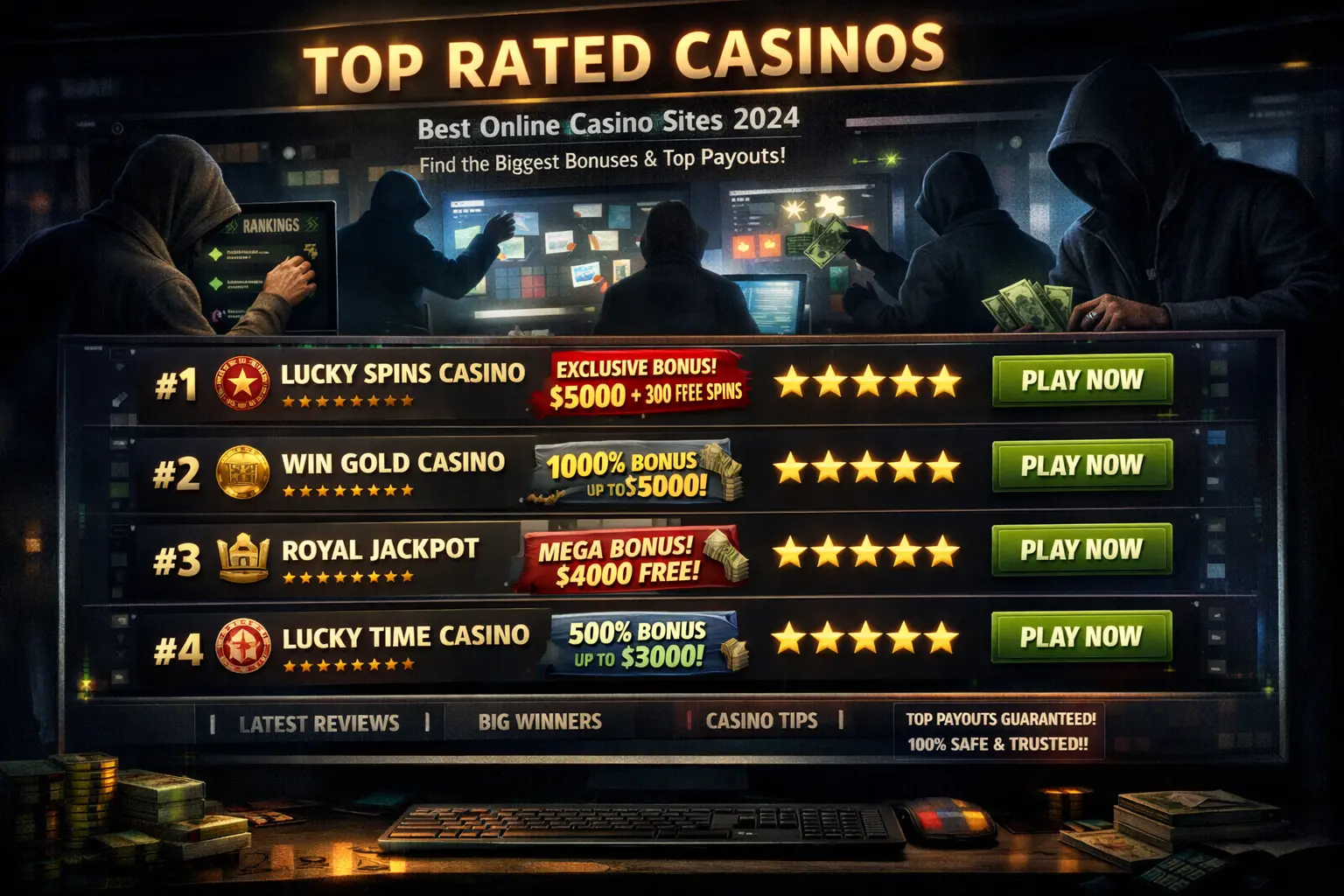
1. Rankings and “Top 10” Lists Are Often Bought
Authoritative-looking ranking lists are among the most common tools of casino affiliate marketing deception. Investigative findings — including the landmark LendEDU case, which resulted in a $350,000 FTC fine — have shown that comparison sites in multiple industries openly offer higher placement to whoever pays the most, then advertise their rankings as “completely objective.” In the casino world, this practice is not the exception. It is standard operating procedure. The casino at the top of the list isn’t necessarily the safest or the fairest. It’s the one paying the highest CPA.
2. Sponsored Content Disguised as Independent Reviews
Under FTC Endorsement Guidelines and equivalent laws in the UK and EU, advertisements must be clearly identified as such. Many misleading casino reviews violate this requirement by presenting commercial content as the unbiased opinion of a neutral expert. Mass-produced AI-generated content — often called “AI junk” in the industry — makes this worse by flooding search results with thousands of pages of generic praise that has no factual basis in real player testing.
3. Hiding Casino Bonus Traps Behind “Free Money” Language
Affiliates frequently lure players with bold claims about “free spins” and “100% matched deposits” while burying the restrictive terms that make those offers nearly impossible to benefit from. This is one of the most direct forms of casino bonus trap promotion:
- Wagering requirements of 40× to 70× are presented as a minor footnote rather than the central fact about the offer.
- Max bet caps — typically $5 per spin — that can trigger total forfeiture of winnings are omitted entirely.
- Win caps that limit cashouts to $50–$100 regardless of actual winnings are buried in separate Terms & Conditions pages the affiliate never links to.
4. Astroturfing and Fake Testimonials
Because players trust peer reviews more than direct advertising, affiliates manufacture that trust artificially. This “astroturfing” involves flooding platforms with AI-generated voices, fabricated winner testimonials, and fake account reviews — purchased for as little as $1 to $10 each — to create the illusion that real players are winning. Review-gating ensures only positive feedback is published, suppressing any genuine complaints about payout delays or withdrawal rejections.
5. Predatory Targeting of Vulnerable Players
The most ethically indefensible tactic is the deliberate targeting of problem gamblers. Illegal operators and their affiliates use SEO specifically to rank for terms like “Not on GAMSTOP,” actively luring players who have enrolled in self-exclusion programs back into unregulated environments with no responsible gambling protections. Additionally, affiliates promote “social casinos” — which use virtual currency — to normalise gambling mechanics among younger audiences, creating a pipeline toward real-money gambling addiction.
“In the affiliate model, the player isn’t the customer — they’re the product. Their losses are the revenue.”
Trusted vs. Misleading Casino Review Sites: A Comparison
| Feature | Trusted Review Site | Misleading Affiliate Site |
| Affiliate Disclosure | Displayed prominently at the top; explains the financial relationship clearly | Hidden in the footer or entirely absent; claims “100% independent” |
| Ranking Method | Based on verified payout speed, licensing, and player complaints | Based on CPA or placement fees paid by operators |
| Content Quality | Human-written with real testing; includes genuine pros and cons | AI-generated; generic, repetitive, uniformly positive |
| Bonus Terms | Wagering requirements prominently displayed next to the offer | Wagering requirements hidden on a separate page or omitted |
| Licensing Verification | Links directly to UKGC or MGA registries for independent verification | Displays vague badges with no verifiable licensing information |
| Vulnerable Player Policy | Never promotes “Not on GAMSTOP” casinos; links to support resources | Actively targets self-excluded players through keyword SEO |
How Black-Hat SEO Keeps Deceptive Sites at the Top of Search Results
Even when players search carefully, the results are manipulated. Deceptive affiliates use Parasite SEO — hosting gambling content on the domains of reputable news outlets or old government websites — to “inherit” credibility they haven’t earned. Combined with link-spam networks and thousands of AI-generated pages targeting long-tail keywords, these tactics systematically push ethical, transparent review sites down the rankings.
The result is an information environment where the safest and most honest content is hardest to find, while the most commercially motivated — and most misleading — content dominates the first page of every search. According to UK Gambling Commission guidelines, operators are required to ensure all promotional material is socially responsible and does not mislead consumers — but enforcement over affiliate third parties remains inconsistent.
🛡 SafeGaming
How SafeGaming Protects You From Affiliate Deception
SafeGaming operates with a strict no-hidden-commission transparency policy. Every casino we reference is assessed against independently verifiable criteria — not placement fees. Before trusting any casino review site, SafeGaming recommends applying this quick verification checklist:
- Does the site display a clear affiliate disclosure at the top of the page?
- Are wagering requirements shown prominently next to every bonus offer?
- Can you verify the casino’s licence directly on the UKGC or MGA website?
- Does the site include genuine negative feedback and documented complaints?
- Does the site refuse to promote “Not on GAMSTOP” or unregulated casinos?
- Is the content clearly human-written with specific, testable claims?
If a review site fails more than two of these checks, treat its recommendations as paid advertising — because that’s almost certainly what they are.
How to Protect Yourself: Practical Steps for Every Player
- Demand the disclosure first. Legitimate affiliates are legally required under FTC and UK ASA rules to disclose their financial relationships. If you can’t find it prominently on the page, that omission is itself a red flag.
- Verify every licence manually. Never rely on a badge from an affiliate site. Go directly to the UK Gambling Commission’s public register or the Malta Gaming Authority’s database and search for the casino yourself.
- Read the casino’s own T&Cs. Never accept a bonus based solely on an affiliate’s description. Go directly to the casino’s website and read the full Terms & Conditions — specifically the sections on wagering requirements, max bets, and withdrawal limits.
- Search for real player complaints. Use forums like Reddit and Trustpilot to find unfiltered player experiences. Even here, exercise scepticism — astroturfing is common — but consistent, detailed negative patterns are harder to fake than generic praise.
- Never download apps from affiliate links. Only install gambling apps from official stores. Third-party APK files promoted by affiliate sites can contain malware designed to steal personal and financial data.
Frequently Asked Questions
Are casino affiliate sites trustworthy?
Most casino affiliate sites operate with a significant conflict of interest. Because they earn affiliate commissions in gambling — either per deposit or as a share of player losses — their financial incentive is to recommend high-commission casinos, not the safest or most transparent ones. While some ethical affiliates do exist, players should treat all “Top 10” lists as commercial recommendations until the site clearly proves otherwise through transparent disclosures and independently verifiable information.
Why do affiliate sites promote bad casinos?
Affiliates promote high-commission casinos because those operators offer the most lucrative CPA payouts or the highest RevShare percentages. Under RevShare, an affiliate earns a percentage of every dollar a player loses — creating a direct financial incentive to recommend casinos with high house edges, predatory bonus terms, and poor payout records. Player safety is not a factor in that calculation.
What are fake casino rankings?
Fake casino rankings are “Top 10” or “Best Casino” lists where positions are determined by placement fees paid by operators rather than objective quality metrics. Casinos that pay the highest commission appear at the top, regardless of their licensing status, payout reliability, or responsible gambling policies. This practice has been documented across multiple comparison industries and is considered a form of covert advertising where undisclosed by regulators.
How do I spot a misleading casino review?
Key red flags include: no visible affiliate disclosure, wagering requirements hidden or absent from bonus descriptions, uniformly positive content with no documented complaints, vague or unverifiable licensing badges, AI-generated writing that lacks specific details, and any promotion of “Not on GAMSTOP” casinos targeting self-excluded players. Cross-reference any review site against independent player forums and always verify licences directly with the regulator. See our verified best online blackjack casinos Malaysia 2026 for platforms offering both formats with tested MYR withdrawal speeds, or our full best online casino Malaysia 2026 ranking.
Are no-deposit casino bonuses ever genuine?
No-deposit bonuses can be genuine on fully regulated platforms, but they are among the most commonly misrepresented offers in affiliate marketing. The critical detail affiliates routinely omit is that these bonuses almost always carry the highest wagering requirements — sometimes 60× or more — and strict win caps that limit withdrawals to as little as $50 regardless of actual winnings. Always read the full T&Cs on the casino’s own website before claiming any no-deposit offer.
📝 Editorial transparency: Based on our published review methodology framework — our seven-stage evaluation framework with documented test methodology, refresh cadence, and named accountability. Read: Editorial Methodology Framework →






 Malaysia Casino Review4 years ago
12Play Casino Review Malaysia 2026 | Get Casino Bonus | SafeGaming
- Singapore Casino Review4 years ago
12Play Review Casino Singapore 2026 | SafeGaming
- Malaysia Casino Review4 years ago
WinClub88 Malaysia 2026: Login Guide, Bonus & Safety
- Malaysia8 months ago
Best Online Casinos in Malaysia 2026 for Real Money
- Singapore Casino Review4 years ago
BK8 Casino Review Singapore 2026 | SafeGaming
- Singapore Casino Review4 years ago
MYBET88 Casino Singapore Review 2026 | SafeGaming
- Singapore Casino Review4 years ago
Maxim88 Casino Review 2026 | Online Casino Singapore
- Malaysia Casino Review4 years ago
QQClubs Casino Review Malaysia 2026 | SafeGaming