Responsible Gambling Guide — Safe Gambling In Malaysia

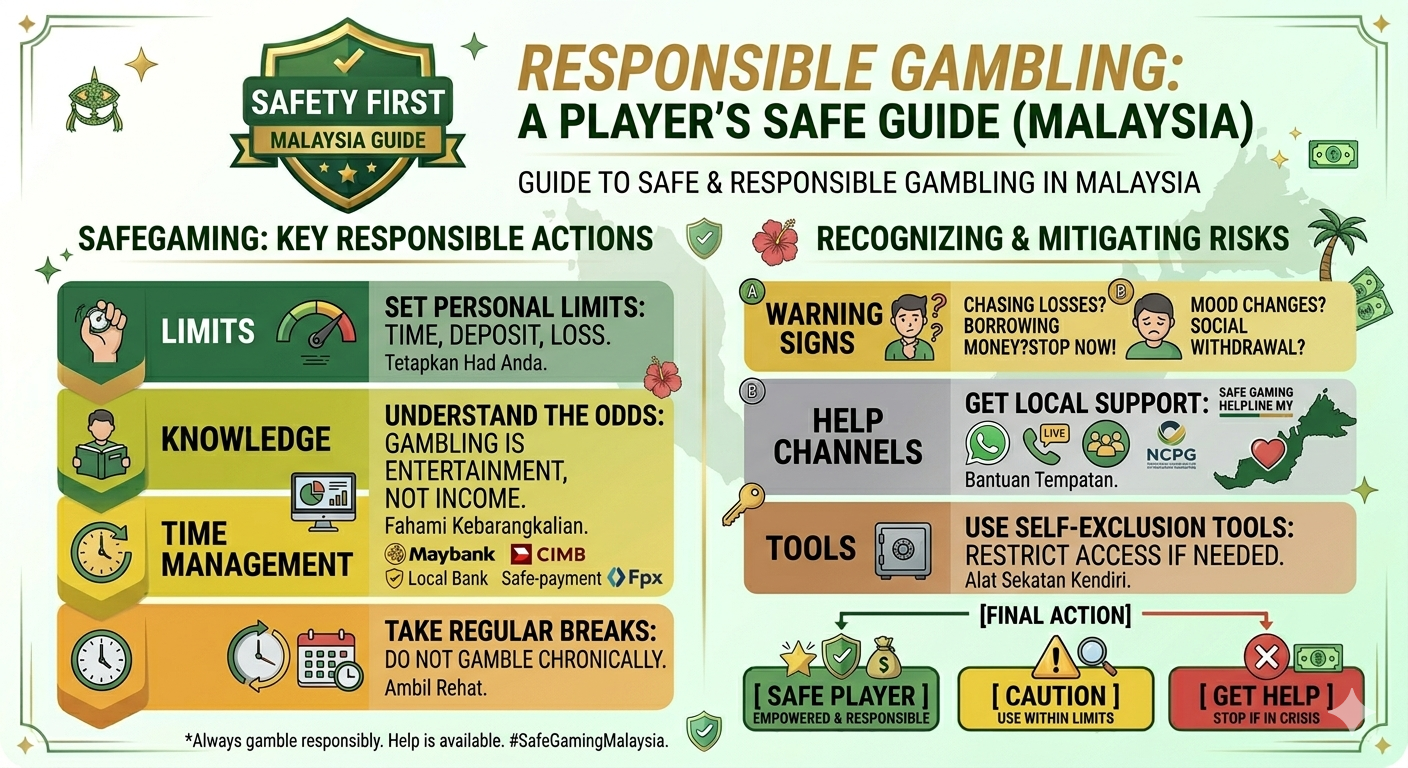
Responsible gambling for Malaysian players in 2026 is not a footer disclaimer — it is a working set of deposit limits, session caps, self-exclusion tools, and helplines that turn casino play from a financial trap into a controlled form of entertainment. If you have ever scrolled past the “responsible gambling” box at the bottom of a casino and assumed it was empty marketing, this is the responsible gambling guide for Malaysia 2026 that explains the tools that actually exist and how to use them.
What Responsible Gambling Actually Means
Responsible gambling is a framework for keeping casino play recreational instead of harmful. It rests on five principles:
Principle 1 — Affordability. Only gamble money you can afford to lose. Treat the spending as entertainment cost, like a movie ticket or a meal — money that does not return.
Principle 2 — Time control. Cap session length and total weekly hours. Time at the table compounds variance and reduces decision quality.
Principle 3 — Loss control. Set hard loss limits per session, per day, per week, and per month. Stop when limits hit, regardless of how it feels.
Principle 4 — Awareness of warning signs. Recognise when play is moving from recreation toward problem behaviour — chasing losses, hiding play from family, gambling instead of sleeping, betting larger to feel the same excitement.
Principle 5 — Asking for help when needed. Free and confidential support is available. Using it is a sign of strength, not weakness.
Bottom line: responsible gambling is not abstinence. It is structured engagement with built-in stop conditions.
The Eight Practical Limits That Work
Every reputable MY-facing operator includes deposit limits and other RG tools in Account Settings. The eight that actually keep play sustainable:
Limit 1 — Monthly deposit cap. Set a hard limit on total deposits per month based on what you can afford to lose. Casinos enforce this at the platform level — once hit, you cannot deposit again until the next period.
Limit 2 — Weekly deposit cap. A finer-grained limit for players who want tighter pacing.
Limit 3 — Daily deposit cap. The strictest deposit guard for players who tilt easily.
Limit 4 — Session loss limit. Walk away when you have lost a fixed percentage of session bankroll. Common setting: 50%.
Limit 5 — Session win goal. Walk away with profit when you have gained a fixed percentage. Common setting: 50%.
Limit 6 — Session time limit. 60–90 minutes per session is the standard recommendation. Longer sessions reduce decision quality.
Limit 7 — Reality checks. Pop-up reminders every 30 minutes during a session showing time elapsed and net win/loss. Most operators include this; turn it on if it is off.
Limit 8 — Cooling-off period. Lock the account for 24 hours, 7 days, or 30 days. Useful when limits are hit or when emotions are high.
For a deeper bankroll plan that integrates with all eight limits, see our casino bankroll management guide.
Self-Exclusion — The Strongest Tool
Self-exclusion locks your account for a chosen period. Standard options at MY-facing operators:
- 24 hours — for cooling off after a tilt session
- 7 days — for breaking a problematic playing pattern
- 30 days — for resetting habits
- 6 months — for serious behavioural change
- Permanent — for players who recognise the activity is harmful
Once active, self-exclusion cannot be reversed before the chosen period expires. The casino is required to enforce it under Curaçao licensing.
For multi-operator self-exclusion in Singapore, the National Council on Problem Gambling administers a centralised self-exclusion register that covers Singapore Pools, Singapore Turf Club, Marina Bay Sands, and Resorts World Sentosa. See our Singapore self-exclusion guide.
Malaysia does not have an equivalent centralised register — self-exclusion at MY-facing offshore operators is per-operator.
Warning Signs of Problem Gambling
Eight signs that recreational gambling is moving toward problem behaviour:
- Spending more than budgeted to “win back” recent losses
- Hiding gambling activity from family or close friends
- Borrowing money to gamble or pay off gambling debts
- Lying about gambling time or amounts
- Skipping meals, sleep, work, or family time for sessions
- Increasing bet sizes to feel the same excitement (tolerance)
- Restlessness or irritability when not gambling
- Repeated unsuccessful attempts to cut back
If three or more of these are present, the activity has likely moved from recreation to dependency. Free confidential support is available — see the resources below.
Where to Get Help in Malaysia
The National Council on Problem Gambling Malaysia (NCPGM) is the dedicated MY problem gambling support body. Services include confidential counselling, helpline support, and referral to treatment programmes.
Visit Malaysia’s National Council on Problem Gambling for full resources.
Additional resources:
- Talian Kasih (Malaysia) — 15999 — broader social support including for gambling-affected families
- AADK (Agensi Anti Dadah Kebangsaan) — services include some gambling addiction support pathways
- BeGambleAware (international) — begambleaware.org — free online self-assessment and resources
Where to Get Help in Singapore
Singapore has a more developed problem gambling support framework:
- National Council on Problem Gambling (NCPG) — ncpg.org.sg — administers the centralised self-exclusion register and provides counselling services
- 24-hour helpline — 1800-6-668-668 — free, confidential, available in English, Mandarin, Malay, and Tamil
- NAMS (National Addictions Management Service) — clinical addiction support including gambling
How to Talk to Family About Gambling Concerns
Approaching gambling concerns with a family member or yourself requires care. Practical steps:
- Choose a calm time. Not during or right after a gambling session.
- Lead with concern, not accusation. “I’m worried about you” lands better than “You have a problem.”
- Bring specific examples. Time spent, money lost, missed events.
- Suggest professional help, not amateur intervention. NCPGM, NCPG, BeGambleAware are equipped for this; family members usually are not.
- Offer support during the process. Self-exclusion enrolment, counselling appointments, financial restructuring.
If you are reading this for yourself rather than a family member, the same principles apply: bring your own specific examples, contact a professional, and accept support during the process.
Regulation, Safety and Responsible Gambling
Responsible gambling tools are required at every Curaçao-licensed operator under the licensing authority’s player protection provisions. The licensing authority — Curaçao eGaming Licensing Authority — audits operator compliance with RG requirements as part of licence renewal.
Malaysia’s Common Gaming Houses Act 1953 and Betting Act 1953 govern domestic gambling but do not contain explicit provisions criminalising individual players who access offshore-licensed casinos. Players operate in a legal grey area: the platforms are not licensed in Malaysia, and individual player prosecution is not documented as of 2026. This is general context, not legal advice.
Singapore’s Remote Gambling Act 2014 prohibits unlicensed remote gambling for Singapore residents. NCPG provides centralised self-exclusion across all licensed Singapore gambling operators. SG players should review their local legal framework — see our Singapore gambling laws guide.
Responsible gambling is the protective layer that makes casino play sustainable. It is not optional. The tools exist whether you use them or not — using them is part of safe play.
Frequently Asked Questions
Q: What is responsible gambling?
A framework for keeping casino play recreational instead of harmful. Built on affordability (only gamble what you can lose), time control (session and weekly caps), loss control (per-session and per-period limits), awareness of warning signs, and asking for help when needed.
Q: What deposit limits should I set?
Hard caps based on what you can afford to lose. Typical pacing for casual players: monthly cap of 5–10% of disposable income, weekly cap of 25% of monthly cap, daily cap of 25% of weekly cap. Adjust downward if you are unsure — limits can always be raised later (after a 24-hour cooldown at most operators).
Q: How does self-exclusion work in Malaysia?
Self-exclusion at MY-facing offshore operators is per-operator. Account Settings → Responsible Gambling → Self-Exclusion lets you lock your account for 24 hours, 7 days, 30 days, 6 months, or permanently. Once active, exclusion cannot be reversed before the period expires.
Q: How does self-exclusion work in Singapore?
Singapore has a centralised self-exclusion register administered by the National Council on Problem Gambling, covering Singapore Pools, Singapore Turf Club, Marina Bay Sands, and Resorts World Sentosa. Apply at ncpg.org.sg. The exclusion covers all four licensed operators simultaneously.
Q: What is the NCPGM helpline?
NCPGM (National Council on Problem Gambling Malaysia) provides confidential counselling and support for problem gambling. Visit ncpgm.org.my for resources and contact options. Free and confidential.
Q: What is the NCPG Singapore helpline?
NCPG Singapore operates a 24-hour helpline at 1800-6-668-668 — free, confidential, available in English, Mandarin, Malay, and Tamil. Online resources at ncpg.org.sg.
Q: How do I know if I have a gambling problem?
Eight common warning signs: spending more than budgeted, hiding gambling activity, borrowing to gamble, lying about gambling, skipping meals or sleep, increasing bet sizes for the same excitement, irritability without gambling, and repeated unsuccessful attempts to cut back. Three or more present = professional support is warranted.
Q: Can I unset my deposit limits if I want to bet more?
Most operators allow limit increases but require a cooling-off period (24 hours minimum) before the increase takes effect. This prevents impulsive limit raises during emotional play. Limit decreases typically take effect immediately.
Q: Are responsible gambling tools the same at every casino?
Curaçao licensing requires deposit limits, session reminders, and self-exclusion tools at minimum. Tier-one operators offer broader RG tooling (loss limits, time-out periods, reality checks). Tier-two operators offer the minimum required. Compare RG tooling visibility before signing up — buried tools are a red flag.
Q: What should I do if I feel I’m gambling too much?
Three immediate steps: trigger a 24-hour or 7-day self-exclusion at every operator you use, set hard deposit limits below your current pace before the exclusion lifts, and contact NCPGM (Malaysia) or NCPG (Singapore) for confidential support. Free counselling is available.
Q: How can family members help someone with a gambling problem?
Approach with concern, not accusation. Bring specific examples of time and money. Suggest professional help (NCPGM, NCPG) rather than attempting amateur intervention. Offer support during the process — self-exclusion enrolment, counselling appointments, financial restructuring.
Q: Are responsible gambling tools mandatory at MY casinos?
Yes. Curaçao eGaming licensing requires deposit limits, session reminders, cooling-off periods, and self-exclusion at every licensed operator. Operators that hide or do not provide these tools are operating outside their licence terms — treat as a red flag.
Sources & References
- National Council on Problem Gambling Malaysia — ncpgm.org.my — used for MY responsible gambling resources
- National Council on Problem Gambling Singapore — ncpg.org.sg — used for SG responsible gambling resources and helpline
- Curaçao eGaming Licensing Authority — curacao-egaming.com — used for operator RG compliance requirements
- BeGambleAware — begambleaware.org — used for international RG self-assessment context
- Singapore Ministry of Home Affairs — mha.gov.sg — used for Remote Gambling Act 2014 context









 Slot Games Hub1 year ago
Online Casino Pussy888 Apk & Ios Download for Free
- Malaysia Casino Review1 year ago
WE88: Trusted Online Casino Malaysia | SafeGaming
- Thailand Casino Review5 months ago
เว็บพนันออนไลน์ ที่ดีที่สุด 2026 สำหรับผู้เล่นชาวไทย
- Singapore Casino Review1 year ago
Uwin33 Review – Trusted Casino in Singapore 2026 | SafeGaming
- Malaysia Casino Review1 year ago
UWin33 Casino Review Malaysia 2026 | SafeGaming
- Malaysia Casino Review1 year ago
12Play Casino Review Malaysia 2026 | Get Casino Bonus | SafeGaming
- Singapore Casino Review1 year ago
12Play Review Casino Singapore 2026 | SafeGaming
- Malaysia Casino Review1 year ago
WinClub88 Casino Review Malaysia 2026 | Trusted ✅ | SafeGaming