
Blackjack Strategy Guide — How to Win at Blackjack 2026

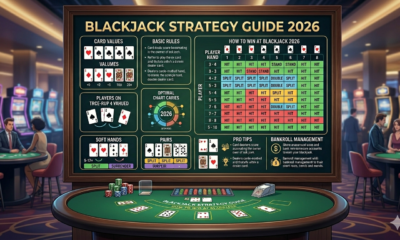

The blackjack strategy that actually wins money in 2026 is not a card-counting trick or a betting system — it is the basic strategy chart that has been mathematically optimal since 1962 and that the average online casino player still ignores on every third hand. If you have ever doubled down on a 9 against a dealer 10 because “it felt right,” this is the blackjack strategy guide that explains what the math actually says and how to follow it without memorising 200 cells.
Why Basic Strategy Is the Only Strategy That Matters
Blackjack basic strategy is the mathematically optimal action for every possible combination of your hand and the dealer’s upcard. It was derived through computer simulation in the 1950s and 1960s and has been refined for modern rule variations since. Following basic strategy reduces the house edge from roughly 2.5% (random play) to 0.5% on standard 6–8 deck blackjack with common rules.
That 2.0% improvement is the difference between a sustainable bankroll and a fast bleed. On MYR 10,000 of total wagering, basic strategy saves you roughly MYR 200 versus instinct play. Across a year of casual play, that is the cost of multiple welcome bonuses.
Bottom line: every legitimate edge in blackjack starts with basic strategy. Card counting, betting systems, and “feel” are downstream of the chart.
The Five Decisions Basic Strategy Tells You to Make
Basic strategy answers five questions for every hand you play:
Hit or Stand? Take another card or stop with what you have.
Double Down? Double your bet and take exactly one more card.
Split? If you have a pair, separate them into two hands and play each independently.
Surrender? At tables that allow it, give up half your bet and end the hand.
Insurance? When the dealer shows an Ace, take a side bet that the dealer has blackjack. Basic strategy says no, almost always — see our blackjack insurance guide for why.
Memorise these decisions for the most common situations and you eliminate most of the cost of suboptimal play.
The Eight Basic Strategy Rules That Cover 80% of Hands
Memorising the full 200-cell chart is not necessary for casual play. These eight rules cover roughly 80% of hands at standard 6–8 deck blackjack:
Rule 1 — Hard 11 or less: always hit (or double on 9, 10, 11 against dealer weak cards). You cannot bust from 11 or less, so taking a card is always at least as good as standing.
Rule 2 — Hard 17 or higher: always stand. Standing is mathematically correct on every hard 17+ regardless of dealer upcard.
Rule 3 — Hard 12–16 vs dealer 7+ : hit. When the dealer shows a strong upcard, you have to take the bust risk to compete.
Rule 4 — Hard 12–16 vs dealer 2–6 : stand. When the dealer shows a weak upcard, let the dealer take the bust risk.
Rule 5 — Soft 17 or less: always hit. With an Ace as 11, you cannot bust. Take cards and improve.
Rule 6 — Always split Aces and 8s. Two Aces split is two strong hands. Two 8s as a hard 16 is the worst hand in blackjack — splitting turns it into two 8s, each playable.
Rule 7 — Never split 5s or 10s. Two 5s = a hard 10, a great doubling hand. Two 10s = a hard 20, already excellent.
Rule 8 — Double on hard 11 against any dealer card except Ace. 11 is the strongest doubling position in blackjack. See our double down blackjack guide for the full doubling matrix.
These eight rules eliminate the most expensive mistakes. Beyond them, the basic strategy chart fills in edge cases.
When to Split — The Quick Reference
Splitting decisions cause the most strategy errors at MY tables. The simplified rules:
- Always split: Aces, 8s
- Never split: 5s, 10s
- Split against dealer 2–6 only: 2s, 3s, 6s, 7s
- Split 9s against dealer 2–6 and 8–9: stand against 7, 10, A
- Split 4s only against dealer 5–6: with double-after-split allowed
For more depth on the splitting math, see our blackjack split strategy guide.
When to Double Down — The Quick Reference
Doubling decisions follow tight rules:
- Hard 11: double against dealer 2–10 (hit against Ace)
- Hard 10: double against dealer 2–9
- Hard 9: double against dealer 3–6
- Soft 13–18: double against dealer 5–6 (and a few specific spots)
- Never double: hard 12+ on the standard 6–8 deck rules
The full breakdown is in our double down blackjack guide.
Side Bets — Almost Always a Bad Idea
21+3 (a poker-style side bet on the first three cards), Perfect Pairs (your two cards making a pair), and other side bets carry house edges of 3–10%, dramatically higher than the 0.5% on the main game. They feel exciting but cost you 5–20x more per hand than the main bet.
If you must play side bets, do it sparingly and only with money outside your main bankroll. Our blackjack side bets guide walks through the math.
Single Deck vs Multi-Deck — Why It Matters
Single-deck blackjack has a significantly lower house edge (roughly 0.15% vs 0.5% on 6–8 deck) because card removal effects favour the player when fewer decks are in play. Most online MY-facing casinos default to 6 or 8 decks. Single-deck variants exist at higher minimum bets and with rule modifications that often offset the deck advantage.
Read the table rules before sitting down — see our single vs multi-deck blackjack guide for which variants are actually worth playing.
Bankroll Management for Blackjack
Basic strategy reduces variance but does not eliminate it. A reasonable bankroll plan for standard blackjack at MY casinos:
- Bring at least 100x your minimum bet to a session
- Cap session loss at 50% of bankroll
- Cap session win goal at 50% gain
- Walk away on either trigger
A MYR 1,000 bankroll at a MYR 10 minimum table = 100 hands of cushion. Basic strategy takes roughly 60 hands per hour at a live table, 200+ at an RNG online table. The bankroll is sized for normal variance.
Regulation, Safety and Responsible Gambling
Online blackjack at MY-facing casinos uses certified RNGs at RNG tables and live dealer feeds at live tables. RNG fairness is audited by labs like eCOGRA’s independent game testing and certification standards. Live dealer studios are regulated by the casino’s licensing jurisdiction.
Most MY-facing operators hold Curaçao eGaming licences. Curaçao licensing means the operator met minimum requirements and is subject to a complaints mechanism — it does not guarantee perfection. Verify any operator’s licence on the regulator’s official registry before depositing.
Malaysia’s Common Gaming Houses Act 1953 and Betting Act 1953 govern domestic gambling but do not contain explicit provisions criminalising individual players who access offshore-licensed casinos. Players operate in a legal grey area: the platforms are not licensed in Malaysia, and individual player prosecution is not documented. This is general context, not legal advice.
Every reputable casino includes deposit limits, loss limits, session reminders, and self-exclusion tools in Account Settings. Use them — strategy is a tool for sustainable play, not a path to certain wins.
If gambling is no longer fun, free and confidential support is available from the National Council on Problem Gambling Malaysia at ncpgm.org.my. For practical limits, see our responsible gambling guide.
Frequently Asked Questions
Q: What is the best blackjack strategy?
Basic strategy — the mathematically optimal action for every combination of your hand and dealer upcard. Following basic strategy reduces the house edge from roughly 2.5% (random play) to 0.5% on standard 6–8 deck blackjack. No system, count, or “feel” beats following the chart.
Q: Can you really win at blackjack with basic strategy?
Basic strategy reduces the house edge to roughly 0.5%, but the house edge is still positive. You will win some sessions and lose more sessions over time. Basic strategy does not turn blackjack into a winning game; it minimises the cost of playing.
Q: Should I always split Aces and 8s?
Yes. Two Aces split into two hands starting with an 11 — the strongest possible starting position. Two 8s as a hard 16 is the worst hand in blackjack; splitting them turns it into two 8s, each playable. Both are mandatory splits at every blackjack rule set.
Q: When should I double down in blackjack?
Hard 11 against any dealer card except Ace; hard 10 against dealer 2–9; hard 9 against dealer 3–6; soft 13–18 in specific spots against dealer 5–6. Doubling is most powerful when you have a strong starting position and the dealer has a weak upcard.
Q: Should I take insurance in blackjack?
Almost never. Insurance is a side bet on the dealer having blackjack when they show an Ace. The math says the bet has a negative expected value of roughly 7%. Even with a strong hand, the insurance bet costs you money long-term. See our blackjack insurance guide for the full breakdown.
Q: Does card counting work at online blackjack?
In RNG online blackjack, no — the deck is shuffled before every hand, so there is no count to maintain. In live dealer blackjack with a 6–8 deck shoe, counting can have a tiny theoretical edge but live tables use continuous shuffle or shallow penetration that wipes out most of the count value.
Q: What is the house edge on blackjack?
With basic strategy on standard 6–8 deck rules, roughly 0.5%. Without basic strategy, roughly 2.5%. With single-deck favourable rules and basic strategy, can drop to 0.15%. Side bets carry house edges of 3–10%.
Q: Should I play single deck or multi-deck blackjack?
Single deck has a lower house edge but online single-deck variants often add unfavourable rule modifications (3:2 to 6:5 blackjack payout, no doubling on 9 or 10, etc.) that offset the deck advantage. Read the table rules before assuming single deck is better. See our single vs multi-deck blackjack guide.
Q: What are blackjack side bets?
Side bets are optional wagers on outcomes other than the main hand result — 21+3 (poker hand on first three cards), Perfect Pairs (your cards making a pair), Hot 3 (sum of your two cards plus dealer upcard), and others. House edges are 3–10%, much higher than the main game. Use sparingly.
Q: How much should I bet at blackjack?
A standard bankroll plan: bring 100x your minimum bet to a session, cap session loss at 50% of bankroll, cap session win at 50% gain. A MYR 1,000 bankroll at a MYR 10 minimum table = 100 hands of cushion. Adjust upward for higher-variance situations like aggressive doubling.
Q: Does basic strategy work in live dealer blackjack?
Yes. Basic strategy is mathematically optimal regardless of whether the cards come from an RNG or a physical shoe. The only adjustment is for specific table rules — some live tables use 8 decks, some 6, some allow surrender, some do not. Verify rules before sitting.
Q: What is the difference between blackjack and 21?
In Malaysia and most modern casinos, “blackjack” and “21” refer to the same game. Historically “21” referred to the casual home game and “blackjack” to the casino version. Some Asian variants (like Pontoon, Pok Deng) are related but use different rules.
Sources & References
- eCOGRA — ecogra.org — used for online blackjack RNG fairness certification context
- Curaçao eGaming Licensing Authority — curacao-egaming.com — used for operator licensing context
- Malaysia Attorney General’s Chambers — agc.gov.my — used for Common Gaming Houses Act 1953 legal context
- National Council on Problem Gambling Malaysia — ncpgm.org.my — used for responsible gambling resources
- iTech Labs — itechlabs.com — used for RNG and game testing certification standards












 Slot Games Hub1 year ago
Online Casino Pussy888 Apk & Ios Download for Free
- Malaysia Casino Review1 year ago
WE88: Trusted Online Casino Malaysia | SafeGaming
- Thailand Casino Review5 months ago
เว็บพนันออนไลน์ ที่ดีที่สุด 2026 สำหรับผู้เล่นชาวไทย
- Singapore Casino Review1 year ago
Uwin33 Review – Trusted Casino in Singapore 2026 | SafeGaming
- Malaysia Casino Review1 year ago
UWin33 Casino Review Malaysia 2026 | SafeGaming
- Malaysia Casino Review1 year ago
12Play Casino Review Malaysia 2026 | Get Casino Bonus | SafeGaming
- Singapore Casino Review1 year ago
12Play Review Casino Singapore 2026 | SafeGaming
- Malaysia Casino Review1 year ago
WinClub88 Casino Review Malaysia 2026 | Trusted ✅ | SafeGaming