Casino Terms, Table Strategies & Game Rules: The Complete Player’s Guide

Everything You Need to Know Before You Sit Down at a Casino Table
Walk into any casino — physical or online — and you’re immediately surrounded by language that assumes you already know what you’re doing. Dealers call out terms, other players use slang, and the rules posted at each table presuppose a level of familiarity that most newcomers simply don’t have yet.
That knowledge gap is expensive. Not because casinos deliberately obscure their rules, but because misunderstanding the terminology often leads to misreading situations, missing strategic opportunities, or making bets you’d never have placed if you’d known what they actually meant.
This guide covers the full spectrum — from foundational financial terms to game-specific vocabulary, from the math behind rule variations to the unwritten social codes at the craps table. Whether you’re playing blackjack for the first time or you’re a regular who wants to tighten up your strategy, there’s something useful here.
Part One: The Language of the Casino Floor
Before diving into individual games, it’s worth understanding the general vocabulary that applies across every table and machine you’ll encounter.
Core Financial and General Terms
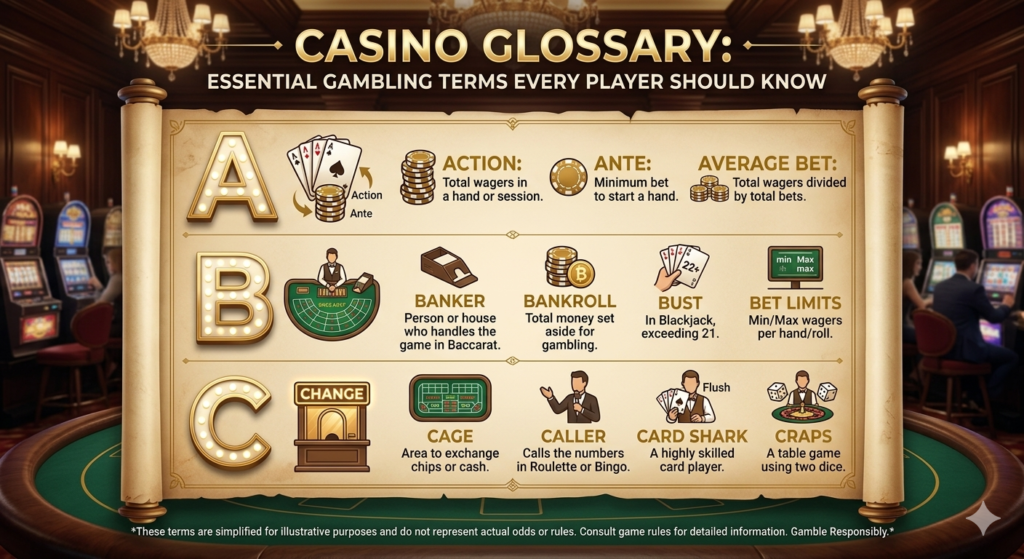
Bankroll is the total amount of money you’ve set aside specifically for gambling in casino. Not your rent money, not your emergency fund — the discrete pool of funds earmarked for play. Managing your bankroll is arguably the most important skill in gambling, and everything else builds from it.
House Edge is the casino’s built-in mathematical advantage, expressed as a percentage of each bet. A house edge of 2% means that, over a long enough run, the casino expects to keep $2 for every $100 wagered. It’s not a guarantee they’ll win any individual hand — it’s a statistical reality that plays out across millions of decisions.
Return to Player (RTP) is the inverse of house edge. A game with a 2.7% house edge has an RTP of 97.3%, meaning the game theoretically returns $97.30 of every $100 wagered to players over time. RTP figures are calculated over vast numbers of rounds, not within a single session in casino.
Action has two distinct meanings depending on context. In a general sense, it refers to the total amount of money wagered during a session. At the table, a dealer saying “your action” simply means it’s your turn to make a decision.
Push is a tie. You and the dealer have the same total, no money changes hands, and your original bet comes back to you. Common in blackjack.
Comp — short for complimentary — refers to any gift or reward a casino provides to incentivize continued play. Free meals, hotel stays, free bets, and cashback programs all fall under this term.
Toke is slang for a tip given to the dealer. Tipping culture varies by game, table, and country, but it’s a recognized part of casino etiquette at physical venues.
The Cage is the cashier’s station at a land-based casino — where you exchange chips for cash or vice versa.
Whale refers to a super high-stakes gambler whose bets are substantially larger than the general player population. Casinos court whales aggressively because a single whale can generate more revenue in a night than hundreds of regular players combined.
Part Two: Blackjack — Terminology and Strategy
blackjack has the best odds of any table game when played correctly. Learning the language is the first step to playing it correctly in casino.
Essential Blackjack Terms
Blackjack (Natural): A first-deal combination of an Ace and any 10-value card — 10, Jack, Queen, or King — totalling 21. A natural typically pays 3:2, though some tables have shifted to the less favourable 6:5. Always check this before sitting down in casino.
Bust: Exceeding 21. The moment your hand total goes over, you lose automatically — even if the dealer busts afterward.
Hard Hand: Any hand that doesn’t contain an Ace, or a hand where the Ace must count as 1 to avoid busting. A hard 16 is a 16 where there’s no flexibility.
Soft Hand: A hand containing an Ace that’s currently counting as 11. The “softness” comes from the safety cushion — if the next card would cause a bust, the Ace simply reverts to 1. A soft 17 (Ace + 6) is very different strategically from a hard 17.
Double Down: Doubling your original bet in exchange for receiving exactly one additional card. Used aggressively on strong totals like 10 or 11, or on certain soft hands in casino.
Split: When your first two cards are a pair, you can separate them into two independent hands, each with its own bet. Always split Aces and 8s. Never split 5s or 10s in casino.
Shoe: The plastic device that holds multiple decks of cards and feeds them to the dealer. Six or eight-deck shoes are standard in most casinos.
The H17 vs. S17 Strategic Difference
This is one of the most consequential rule variations in blackjack, and most players don’t know it exists until someone points it out.
S17 (Dealer Stands on Soft 17) is the player-friendly version. The dealer must stand on all totals of 17 — including soft 17s. This is good for players because a soft 17 is actually a weak dealer hand; forcing the dealer to stand locks in that weakness.
H17 (Dealer Hits Soft 17) costs you approximately 0.22% in additional house edge. That might sound small, but compounded over hundreds of hands it represents real money. Under H17, the dealer can use the Ace’s flexibility to improve from a weak 17 to a stronger total without risking a bust — the same mechanism that makes soft hands attractive for players in casino.
The strategic adjustment most worth knowing: soft 18 against a dealer 2. Under S17, you stand. Under H17, the correct play shifts to hitting. The dealer’s increased ability to improve means your 18 is no longer safe enough to stand pat.
The broader principle in H17 games is this: play more aggressively on marginal totals, and never miss a justified doubling opportunity. The dealer is harder to beat, so you need to extract maximum value from every favorable situation in casino.
Part Three: Roulette — Understanding the Wheels
Roulette looks like a game of pure luck, and in one sense it is — but your choice of which wheel to play dramatically affects how much you’re likely to lose over time.
Core Roulette Terms
Croupier: The French term for the roulette dealer. The term comes from the game’s French origins and is still used formally at many European-style tables.
Inside Bet: Any wager placed on specific numbers or small groups of numbers within the main grid. Higher risk, higher reward.
Outside Bet: Wagers on broad categories — Red/Black, Odd/Even, High/Low. Lower payouts but significantly better odds of winning any individual spin.
Straight Up: A bet on a single number. Pays 35:1, but the true odds are 36:1 in European and 37:1 in American, which is exactly where the house edge lives.
Street Bet: A bet covering a horizontal row of three numbers. Pays 11:1.
En Prison: A player-friendly rule in some French roulette variants. When the ball lands on zero and you have an even-money bet, the bet is “imprisoned” — carried forward to the next spin for a chance to be returned in full rather than forfeited. It effectively cuts your loss on zero events in half.
La Partage: Similar to En Prison, but simpler. When zero hits, half of all even-money bets are returned immediately. No imprisonment, no second spin.
American vs. European Roulette: The Mathematical Case
This isn’t really a matter of preference — it’s arithmetic.
European roulette has 37 pockets: numbers 1 through 36 plus a single zero. The house edge is 2.7% on all standard bets.
American roulette adds a double-zero (00), creating 38 pockets. That one extra pocket nearly doubles the house edge to 5.26% — on the same bets, paying the same amounts in casino.
There’s also a wager unique to American roulette called the Five-Number Bet, covering 0, 00, 1, 2, and 3. It’s the only bet in standard roulette with a house edge higher than 5.26% — pushed further into unfavourable territory by the payout structure. It’s universally discouraged by anyone who understands how it works.
Part Four: Craps — The Most Social Game on the Floor
Craps is the loudest, most communal game in any casino, and it has the deepest vocabulary. Master the language and you stop looking like a tourist.
The Foundation: Pass and Don’t Pass
Every craps table revolves around the relationship between these two bets in casino.
The Pass Line Bet (also called “Betting Right”) means you’re wagering with the shooter:
- Come-Out Roll: Win immediately on a 7 or 11. Lose immediately on 2, 3, or 12.
- After a Point is Set: You win if the shooter rolls the point number again before rolling a 7. You lose if the 7 comes first.
The Don’t Pass Bet (also called “Betting Wrong”) means you’re wagering against the shooter:
- Come-Out Roll: Win on 2 or 3. The 12 typically results in a push. Lose on 7 or 11.
- After a Point is Set: You win when the shooter sevens out before repeating the point.
The social dimension matters here. Most players at a craps table are betting the Pass Line and cheering for the shooter. Don’t Pass bettors win when the majority loses — which creates a notable table dynamic. Neither bet is rude or wrong, but the atmosphere is different in casino.
The Vocabulary of the Dice
Shooter: The player currently rolling the dice.
Come-Out Roll: The first roll of a new round, before a point is established.
Point: The number set by the come-out roll if it lands on 4, 5, 6, 8, 9, or 10. The round continues until the shooter repeats that number or rolls a 7.
Natural: A 7 or 11 on the come-out roll — an immediate win for Pass Line bettors.
Craps Numbers: 2, 3, and 12. An immediate loss for Pass Line bettors on the come-out.
Easy Way / Hard Way: An easy way is hitting an even number (4, 6, 8, 10) with two different die faces — like a 3 and a 1 for an easy 4. A hard way is hitting it as a pair — two 2s for a hard 4 in casino.
The Colorful Slang Vocabulary in casino
Craps has arguably the richest slang tradition of any table game. Here’s what you’ll hear at a busy table:
| Number | Common Slang | Origin/Notes |
| 2 | Snake Eyes / Aces | Two pips resemble eyes |
| 3 | Ace Deuce | Ace (1) + Deuce (2) |
| 4 | Little Joe | “Little Joe from Kokomo” — hard 4 |
| 5 | Fever / Little Phoebe | Traditional table slang |
| 7 | Big Red | Never say “seven” — it’s bad luck |
| 8 | Square Pair / Eighter from Decatur | Hard 8 — two 4s |
| 9 | Nina / Center Field | Center field = position 9 in baseball |
| 10 | Puppy Paws | Hard 10 — two 5s resemble paw prints |
| 11 | Yo / Yo-leven | Avoids confusion with “seven” at loud tables |
| 12 | Boxcars | Two sixes resemble freight car wheels |
Why is 7 called Big Red? It comes down to superstition and table etiquette. Once a point has been established, a 7 means Pass Line bettors lose — a “Seven Out.” Saying the number aloud is considered bad luck and bad form. “Big Red” communicates the same information without invoking the word. A bet on the next roll being a 7 is also called an “Any Seven” bet for the same reason.
Part Five: Slots — Understanding the Mechanics
How Slot Machines Actually Work
Random Number Generator (RNG): Every spin on a digital slot machine is determined by a computer algorithm that produces a random outcome independent of every previous spin. There are no hot machines or cold machines — each spin is statistically fresh.
Payline: The pattern across the reels where matching symbols must land to generate a payout. Classic slots had one payline; modern video slots can have anywhere from 10 to over 1,000.
Scatter: A symbol that triggers a bonus or payout regardless of its position on the reels. Scatters don’t need to land on a payline.
Wild: A substitute symbol that fills in for others to complete winning combinations.
Volatility (Variance): This is perhaps the most practically useful slot concept. High-volatility slots pay out infrequently but in larger amounts when they do. Low-volatility slots pay smaller amounts more regularly. Choosing the right volatility for your bankroll and session length is a meaningful decision.
Part Six: Live Dealer Games — How Fairness Works Without Pure Automation in casino
The Question Players Ask
If a standard online casino game uses an RNG to determine outcomes, what does a live dealer game use — and how do you know it’s fair?
Physical Reality as the Foundation
Live dealer games replace the algorithm with physics. Cards are physically shuffled and dealt. The roulette ball travels a real wheel. Dice are physically thrown. The outcome is determined by the real world, not a computer program — which is, for many players, a more intuitive form of trust.
The Multi-Layer Oversight System
Real-time visibility: High-definition, fixed-angle cameras ensure players can watch every physical action as it happens. Nothing is hidden between the shuffle and the deal.
Continuous supervision: Every live studio employs supervisors who monitor tables and are trained to intervene at the first sign of any irregularity. Dealers follow strict operational protocols and never handle player funds directly.
Result recognition systems: Technology bridges the physical and digital worlds. Optical card recognition reads cards as they’re dealt. Roulette sensors detect where the ball settles. These systems translate physical outcomes into the digital data your betting interface processes.
Regulatory recording: All sessions are recorded and archived. Licensing authorities can pull any session for audit purposes, and recordings are available for dispute resolution. This accountability is only possible because reputable live platforms hold genuine gaming licenses.
Encrypted data streams: Video and data transmissions between the studio and the player are encrypted, preventing any external interception or manipulation of results.
Part Seven: Poker and Betting Slang Worth Knowing in Casino
Even if you don’t play poker, these terms appear across casino culture broadly:
All-In: Wagering every remaining chip on a single hand. The most dramatic play in poker.
The Nuts: The best possible hand given the community cards currently showing. If you have “the nuts,” nobody can beat you.
Tilt: A mental state of emotional frustration that leads a player to make increasingly poor, impulsive decisions. Recognizing when you’re on tilt — and stepping away — is one of the most valuable skills in gambling.
Vig (or Juice): The commission charged by a sportsbook for accepting a bet. Usually built into the odds rather than charged as a visible fee.
Comparison: American Roulette vs. European Roulette vs. French Roulette in casino
| Feature | European Roulette | American Roulette | French Roulette |
| Total Pockets | 37 | 38 | 37 |
| Zero Pockets | Single (0) | Double (0 and 00) | Single (0) |
| House Edge | 2.70% | 5.26% | 1.35% (even bets) |
| RTP | 97.30% | 94.74% | 98.65% (even bets) |
| La Partage Rule | No | No | Yes |
| En Prison Rule | Rare | No | Yes |
| Five-Number Bet | No | Yes (avoid it) | No |
| Best For | Most players | Avoid if alternatives exist | Best overall odds |
Common Mistakes Players Make in CASINO
Playing American roulette when European is available. There is no strategic reason to accept a 5.26% house edge when a 2.7% version is a click or a table away. This mistake alone, compounded over many sessions, represents a significant unnecessary cost.
Ignoring H17 vs. S17 rules at the blackjack table. Most players sit down without checking the placard. That 0.22% difference is small per hand but meaningful per session, and the strategy adjustments it requires are specific. Check the rules before betting.
Saying “seven” at a craps table. Not a financial mistake — a social one. But it marks you as someone who doesn’t know the culture, and that matters at a game where table camaraderie can genuinely affect your experience.
Treating RTP as a session guarantee. A 97% RTP doesn’t mean you’ll get back 97 cents on every dollar in any given hour. It’s a long-run statistical average. Short-session results can vary dramatically in either direction.
Not understanding what “soft” means before hitting or standing. Players regularly make incorrect decisions on soft hands because they’re treating them like hard totals. A soft 18 is not the same as a hard 18. The correct play in many situations is completely different.
Placing the Five-Number Bet. It exists, casinos will take it, and it gives the house a worse-than-average edge even by American roulette standards. There’s no scenario in which it’s the strategically correct choice.
Playing on tilt. Arguably the most expensive mistake across all table games. When frustration starts driving decisions instead of strategy, the mathematical edge you’re working with evaporates. A short break costs nothing. Continuing while tilting costs more than you’d expect.
Expert Advice for Table Game Players
Learn basic strategy before you sit at a blackjack table. It’s not complicated to carry a strategy card — many casinos allow it openly — and it reduces the house edge to below 0.5% when followed correctly. That’s the lowest house edge you’ll find anywhere on the floor.
At craps, start with Pass Line and take the odds. The free odds bet (available after a point is set) is the only bet in any casino with zero house edge. It doesn’t show up on the table layout because casinos would rather you didn’t notice it. Start simple and learn from there.
For roulette, seek out French roulette with La Partage if you can find it. The combination of a single zero and the La Partage rule (returning half of even-money bets when zero hits) reduces the effective house edge to 1.35% on outside bets — better than most blackjack tables you’ll encounter.
Complete KYC before your first withdrawal at online casinos. This applies to live dealer games especially: don’t wait until you want to cash out to discover you need to verify your identity. Get it done when you register.
Use volatility as a budgeting tool for slots. If your session budget is modest, low-volatility games give you more play time and more frequent small wins to keep things interesting. High-volatility games with a limited budget is a formula for short sessions and empty wallets.
Conclusion
The gap between a player who knows the language and one who doesn’t isn’t just about communication — it’s about decision quality. Knowing the difference between a soft and hard hand changes how you play blackjack. Understanding H17 versus S17 tells you which tables to sit at and how to adjust. Recognizing that the Five-Number Bet exists solely to give you worse odds than everything else on the same layout is the kind of knowledge that simply saves money.
The casino will always hold some mathematical edge — that’s the nature of the business. What you control is how large that edge is and how well you play within it. Learning the terminology is step one. Understanding the strategy is step two. Everything after that is experience.
Start with the language.
The rest follows.For an official overview of how casino games, odds, and player protections work, the UK Gambling Commission provides a clear guide to how gambling operates in regulated markets.
Frequently Asked Questions
1. What is the difference between house edge and RTP? They’re two ways of expressing the same mathematical relationship. House edge is the percentage of each wager the casino expects to retain over the long run. RTP is the percentage returned to players. A game with a 2.7% house edge has an RTP of 97.3%. Neither figure predicts any individual session’s outcome — they describe long-run statistical tendencies.
2. Is European roulette always better than American? From a mathematical standpoint, yes. European roulette’s single zero gives it a 2.7% house edge versus American roulette’s 5.26%. Unless you’re specifically seeking the Five-Number Bet (which you shouldn’t be), there’s no strategic reason to prefer the American version when European is available.
3. What is En Prison and how does it help players? En Prison is a rule in some French roulette variants where, when the ball lands on zero, even-money bets are “imprisoned” and carried over to the next spin rather than lost. If the next spin wins, your bet is returned in full. It effectively halves your loss on zero outcomes, reducing the house edge significantly on even-money bets.
4. What does it mean when a dealer “hits soft 17”? It means the dealer must take an additional card when holding a soft 17 — an Ace-plus-6 combination. This is the H17 rule, and it’s less favourable for players because it gives the dealer a chance to improve a weak hand. Tables following the S17 rule (dealer stands on soft 17) are better for players and carry a house edge roughly 0.22% lower.
5. Why is it bad luck to say “seven” at a craps table? It’s a superstition rooted in the game’s mechanics. After a point is established, a 7 causes Pass Line bettors — the majority of most tables — to lose. Saying it aloud is considered to invite that outcome and is seen as poor etiquette. Players use “Big Red” or “Yo” (for 11) to communicate without uttering the word.
6. What is a soft hand in blackjack and why does it matter? A soft hand contains an Ace currently counted as 11. The “soft” quality means that if the next card would bust a hard total, the Ace drops to 1 instead, preventing the bust. This flexibility changes the correct strategy substantially — soft hands should often be hit or doubled when hard hands of the same total should stand.
7. How do live dealer casinos ensure game outcomes are fair? Through a combination of physical gameplay (real cards, real wheels), real-time camera visibility, optical result recognition systems, continuous human supervision, recorded sessions stored for regulatory review, and encrypted data transmission. The physical nature of the game itself is the primary fairness mechanism — outcomes are determined by the real world, not an algorithm.
8. What is the Five-Number Bet and why is it always a bad choice? The Five-Number Bet is an American roulette wager covering 0, 00, 1, 2, and 3. It’s the only bet in standard roulette with a house edge higher than the already-unfavourable American standard of 5.26%. Its payout structure makes it mathematically worse than every other bet on the same table. No strategic justification exists for placing it.
9. What is the difference between Pass and Don’t Pass in craps? Pass Line bets win when the shooter rolls a 7 or 11 on the come-out roll and when the shooter repeats the point before rolling a 7. Don’t Pass bets win on 2 or 3 on the come-out, and when the shooter rolls a 7 before repeating the point. Functionally you’re wagering for and against the shooter respectively. Both carry similar, low house edges.
10. What is “tilt” and how does it affect gambling outcomes? Tilt is a state of emotional frustration — usually triggered by a losing streak or bad beat — that causes a player to abandon rational strategy in favour of impulsive, high-risk decisions. It’s among the most costly psychological states in gambling because it overrides whatever mathematical edge you might otherwise maintain. Recognizing its early signs and stepping away from the table is one of the highest-return actions any player can take.
📝 Editorial transparency: Based on our published review methodology framework — our seven-stage evaluation framework with documented test methodology, refresh cadence, and named accountability. Read: Editorial Methodology Framework →












 Malaysia Casino Review1 year ago
WE88: Trusted Online Casino Malaysia | SafeGaming
- Slot Games Hub1 year ago
Online Casino Pussy888 Apk & Ios Download for Free
- Singapore Casino Review1 year ago
Uwin33 Review – Trusted Casino in Singapore 2026 | SafeGaming
- Thailand Casino Review5 months ago
เว็บพนันออนไลน์ ที่ดีที่สุด 2026 สำหรับผู้เล่นชาวไทย
- Malaysia Casino Review1 year ago
UWin33 Casino Review Malaysia 2026 | SafeGaming
- Malaysia Casino Review1 year ago
12Play Casino Review Malaysia 2026 | Get Casino Bonus | SafeGaming
- Singapore Casino Review1 year ago
12Play Review Casino Singapore 2026 | SafeGaming
- Malaysia Casino Review1 year ago
WinClub88 Casino Review Malaysia 2026 | Trusted ✅ | SafeGaming