
Side Bets in Blackjack Explained (21+3, Perfect Pairs)

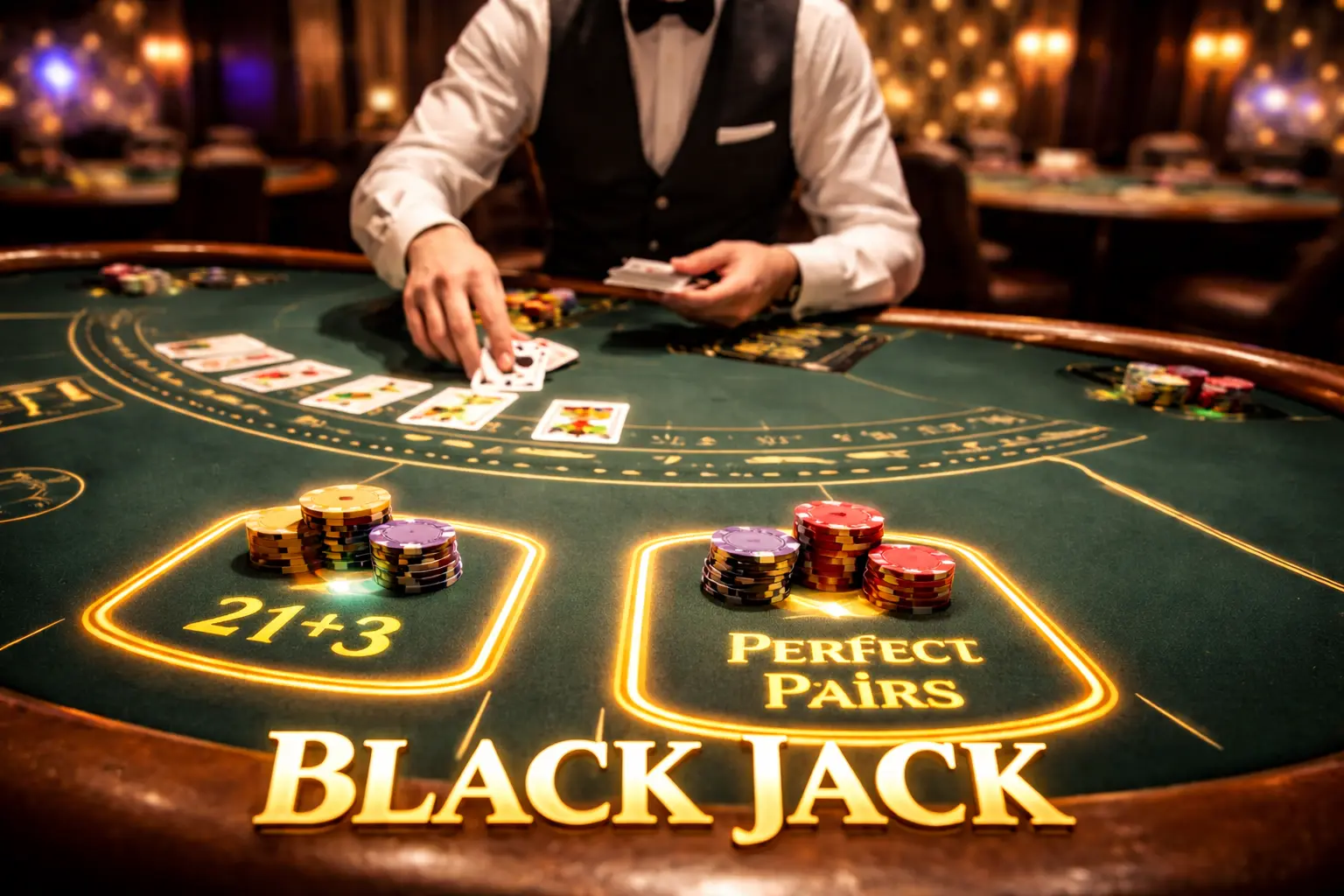
Notice those little extra betting circles printed on the felt. The dealer calls time before the deal and your neighbour tosses a chip into one of them without a second thought. You wonder: what exactly are those, and should you be doing that too?
You’re asking exactly the right question—because the answer is not as simple as the casino would like you to believe.
Blackjack side bets like 21+3 and Perfect Pairs are among the most seductive propositions in table gaming. The payouts look extraordinary—100:1 for a Suited Trips, 30:1 for a Perfect Pair. For a single chip, the possibility of a transformative win feels very real. What the casino does not advertise so prominently is the house edge behind those numbers, which can be ten to twenty times higher than the main game you’re already playing.
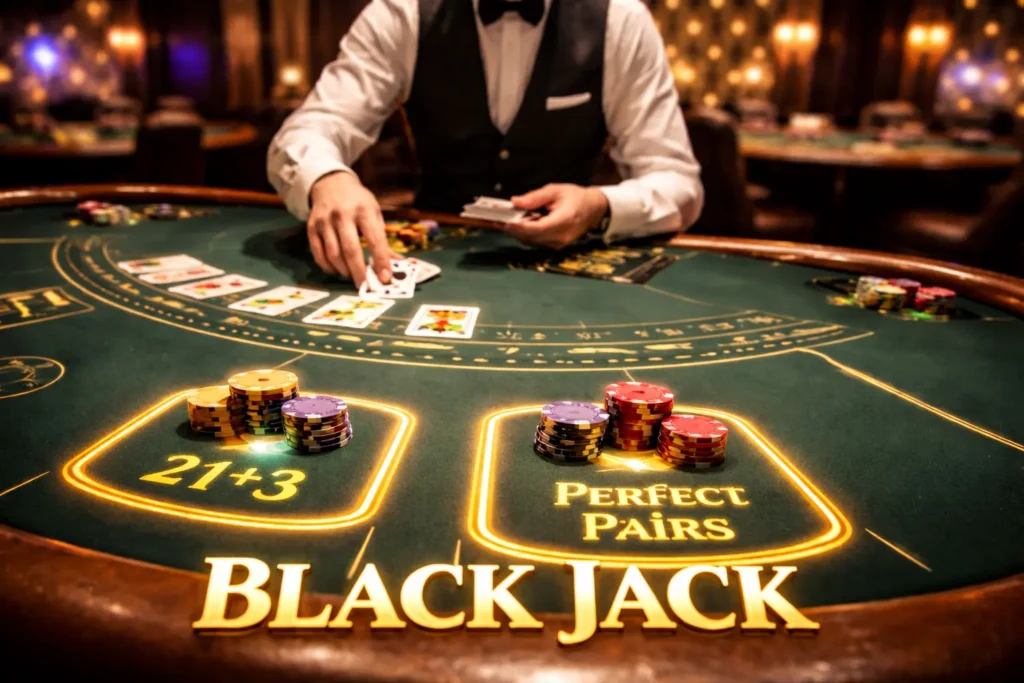
At SafeGaming, we believe that informed players are empowered players. This guide breaks down exactly how blackjack side bets work, what the mathematics really say, and how to approach them with a clear head—whether you play for entertainment or with a sharper strategic focus.
| QUICK ANSWER: What Are Blackjack Side Bets?Blackjack side bets are optional, independent wagers placed alongside your main hand before the deal. The two most popular types are 21+3—which combines your two cards with the dealer’s up-card to form a three-card poker hand—and Perfect Pairs, which pays out if your first two cards are a matching pair. Both carry a significantly higher house edge (3%–11%+) than the standard blackjack main game (~0.5%). |
What Are Side Bets in Blackjack?
Side bets are optional wagers placed in a designated secondary circle on the blackjack table before the cards are dealt. They are completely independent of the main game: you can win your side bet while losing your main hand, or vice versa. This independence is one of the features that makes them appealing—but it is also what makes them financially distinct from the primary game.
The key characteristic of blackjack side bets is that they are resolved on the initial cards dealt—typically after the first two player cards and the dealer’s up-card are visible. Subsequent player decisions—hitting, standing, doubling down, or splitting—have zero effect on the side bet outcome. The result is already determined before you make a single strategic choice.
This structure makes side bets fundamentally different from the main game, where applying blackjack basic strategy can reduce the house edge to approximately 0.5%. No equivalent strategy exists to materially reduce the house edge on most blackjack side bets for a non-counting player.
The casino promotes these bets because they are profitable. The house edge on side bets typically ranges from 3% on the lower end to well over 10% on less favourable tables—a stark contrast to the base game. As SafeGaming consistently advocates, understanding these numbers before placing any wager is the foundation of responsible gambling.
How 21+3 Blackjack Side Bet Works
The 21+3 side bet is the most widely offered blackjack bonus bet in both live casinos and online blackjack platforms. Its popularity comes from the hybrid excitement of merging two well-known games: blackjack and three-card poker.
The Rules of 21+3
Before the deal begins, you place an additional wager in the circle marked ‘21+3.” The outcome is determined by three specific cards:
• Your first face-up card
• Your second face-up card
• The dealer’s visible up-card
These three cards are evaluated against poker-style hand rankings. If they form a qualifying combination, the side bet pays immediately, regardless of what happens on your main hand.
21+3 Winning Hands and Payouts
Payout structures vary by casino and by the number of decks in play, but the most common graduated pay table is as follows:
| Hand | Description | Example | Typical Payout |
| Flush | Three cards of the same suit | 2♥, 7♥, K♥ | 5:1 |
| Straight | Three cards in numerical sequence, mixed suits | 5♥, 6♣, 7♦ | 10:1 |
| Three of a Kind | Three cards of the same rank, any suits | K♥, K♣, K♦ | 30:1 (some tables: 25:1) |
| Straight Flush | Three sequential cards of the same suit | 9♦, 10♦, J♦ | 40:1 |
| Suited Trips | Three identical cards (same rank and suit) | Three 9♦ from a multi-deck shoe | 100:1 |
Note: Aces can function as high or low for straight combinations in 21+3. Suited Trips is only possible in multi-deck games where duplicate cards exist.

21+3 Probability and House Edge
The mathematics of 21+3 are unambiguous. The break-even hit rate for a 5:1 Flush is 16.67%—meaning you must land that combination in at least one out of every six hands just to break even over time. For the 100:1 Suited Trips, the probability of occurrence is below 1% per hand.
The house edge on 21+3 ranges from approximately 3.23% to 7.2% depending on the specific pay table and deck count. This means for every £10 wagered on 21+3 over the long run, you can expect to lose between £0.32 and £0.72—versus £0.05 on the same stake on the main game with basic strategy.
How Perfect Pairs Blackjack Side Bet Works
Perfect Pairs strips the side bet concept down to its simplest possible form: do your first two cards match? If yes, you win. If no, the bet is collected immediately and the main game continues.
This simplicity is part of its appeal—but the house edge on Perfect Pairs is among the highest of all mainstream blackjack side bets, averaging approximately 10.7% and reaching as high as 11% on unfavourable pay tables.
Types of Pairs and Their Payouts
Perfect Pairs distinguishes between three grades of pair, with payouts increasing as the two cards become more identical:
| Pair Type | Definition | Example | Typical Payout |
| Mixed Pair | Same rank, different colour and suit | Red 8 and Black 8 | 5:1 – 7:1 |
| Coloured Pair | Same rank, same colour, different suit | 8♥ and 8♦ (both red) | 12:1 – 15:1 |
| Perfect Pair | Same rank AND same suit (requires multi-deck) | Two Q♥ from different decks | 25:1 – 30:1 |
A Perfect Pair is only possible when the game uses multiple decks—since a single deck contains only one of each card, two identical cards cannot coexist. In a 6-deck shoe, the probability of any pair on the opening two cards is approximately 7.7%, while the probability of a Perfect Pair specifically is far lower.
House Edge and RTP: The Numbers Every Player Needs to Know
The house edge is the single most important metric when evaluating any casino wager. It represents your expected loss as a percentage of each bet placed, calculated over many hands. Here is a direct comparison across all major blackjack bet types:
| Bet Type | House Edge | Return to Player (RTP) | Volatility |
| Main Hand (Basic Strategy) | ~0.5% | ~99.5% | Low – smooth bankroll |
| 21+3 Side Bet | 3.23% – 7.2% | 92.8% – 96.8% | High – infrequent big wins |
| Perfect Pairs | 2.1% – 11% | 89% – 97.9% | High – rare hit frequency |
| Insurance Bet | ~7% – 8.5% | ~91.5% | Moderate – not recommended |
| Lucky Lucky | ~2.7% | ~97.3% | High – but best side bet odds |
| Lucky Ladies | ~25% | ~75% | Very high – avoid |
The pattern is clear: the more exciting the side bet sounds, the worse the expected value tends to be. Lucky Ladies, with its astronomical 25% house edge, offers the worst risk-adjusted return of any mainstream blackjack side wager.
Are Blackjack Side Bets Worth It?
This is the question every player eventually asks. The honest answer has two parts—one mathematical, one personal.
The Mathematical Verdict
For players optimizing for long-term profit, the answer is no. Side bets are negative-expectation wagers. Every unit you stake on 21+3 or Perfect Pairs carries an expected loss that is five to twenty times higher than the same unit on the main hand. Over a typical session of 80 to 100 hands, consistently playing side bets will erode your bankroll at a dramatically accelerated rate compared to main-hand-only play.
The Entertainment Perspective
For players who treat the casino as an entertainment expense—similar to a cinema ticket or a night out—side bets offer something the main game cannot: the genuine possibility of a 100:1 or 30:1 return on a £1 or €5 wager. That is a different conversation from strategic optimization, and a legitimate one, provided the player understands what they are buying.
At SafeGaming, we support both approaches—what we insist upon is that players make this choice with full knowledge of the mathematics, not under the illusion that side bets are a reliable path to profit. Setting a hard limit on side bet stakes (for example, capping them at 10% of your session budget) is one practical way to enjoy the entertainment value without allowing high-edge bets to dominate your session cost.
Strategy: How to Approach Side Bets Intelligently
If you choose to play blackjack side bets, applying the following principles will at minimum ensure you are making informed decisions:
1. Check the pay table before sitting down. The pay table is the primary driver of house edge. A table paying 25:1 for Three of a Kind instead of 30:1 appears similar but carries a materially higher house edge. Always compare before placing your first chip.
2. Prioritise lower-edge side bets if you must play. Lucky Lucky, with a house edge of approximately 2.7% on a six-deck shoe, is the most statistically reasonable mainstream side bet—comparable to European Roulette. Perfect Pairs and Lucky Ladies should be approached with the most caution.
3. Deck count matters. The house edge on Perfect Pairs changes with the number of decks in play. More decks increase the probability of pairs, which can slightly improve the RTP on some pay tables. Always factor in the shoe size.
4. Never chase losses on side bets. The high volatility of side bets creates dramatic swings. Doubling or escalating your side bet stake after losses (a Martingale-style approach) does not alter the house edge—it only accelerates the depletion of your bankroll.
5. Maintain your main hand discipline. Some players become so focused on chasing the 100:1 Suited Trips that they make suboptimal decisions on their main hand—which has the far better odds. Never let side bet excitement compromise basic strategy decisions.
Card Counting and Suit Tracking: Is There an Edge?
Theoretically, tracking suit concentration in a live shoe can improve the probability of 21+3 flushes. If a shoe becomes rich in a single suit, the probability of a three-card flush increases above the standard baseline.
In practice, as blackjack advantage play researcher Dr. Eliot Jacobson has documented, the windows in which a player holds a mathematical edge on 21+3 through suit tracking are infrequent, short-lived, and accompanied by high variance. Executing this in real time in a live casino environment is extremely difficult, and the resulting edge is small relative to the effort required.
For online blackjack using a Random Number Generator (RNG), this technique is entirely inapplicable: the deck is effectively reshuffled after every hand, making any tracking-based approach impossible.
Common Mistakes Players Make with Blackjack Side Bets
• Confusing high payouts with good odds: A 100:1 payout sounds extraordinary. It is—because the event has less than a 1% probability of occurring. High payouts exist to compensate for low probability, not to indicate good value.
• Believing in hot streaks: Each blackjack hand is an independent event. A run of winning side bets does not make the next one more likely. This is the gambler’s fallacy applied to a negative-expectation game.
• Using betting systems: No betting system—Martingale, Fibonacci, or any other—can convert a mathematically negative bet into a positive one over the long run. They only change the shape of your losses.
• Taking insurance as a “side bet”: Insurance is technically a side bet with a house edge of 7% to 8.5%. For non-counting players, it should be declined on every single hand without exception. SafeGaming covers this in detail in our blackjack insurance guide.
• Ignoring the main hand: Side bet excitement can distract players from making correct basic strategy decisions. The main hand, with its 0.5% edge, is always the priority.
Further Reading and Expert Resources
For players who want to verify the mathematics independently or explore advanced advantage play research, the following are the highest-authority resources on blackjack side bet probability and strategy:
•Wizard of Odds – Blackjack Side Bets Analysis: Comprehensive mathematical analysis of house edge across all major blackjack side bets, including 21+3 and Perfect Pairs, with deck-count-specific data.
• Wikipedia – Blackjack: A well-maintained overview of blackjack rules, variants, and the mathematical principles underlying the game.
Conclusion: Entertainment Value vs. Mathematical Reality
The 21+3 and Perfect Pairs side bets add a genuine dimension of excitement to blackjack that the base game alone cannot replicate. The prospect of turning a €5 chip into €500 with a Suited Trips is a real and compelling offer. But it is an entertainment offer, not a strategic one.
The mathematics are clear: side bets carry house edges between 3% and 11%+—far above the 0.5% achievable on the main hand with basic strategy. For players who focus on maximising their expected return, avoiding side bets entirely is the correct decision.
For players who want to add variety, manage side bet exposure as a defined entertainment budget—a fixed stake per session that you’re comfortable losing entirely. Treat it the same way you would any entertainment spend: as a cost, not an investment.
At SafeGaming, our mission is to ensure every player understands what they’re buying at the table. Whether you choose to play 21+3, Perfect Pairs, or neither, the most important hand you can play is an informed one.
Frequently Asked Questions: Blackjack Side Bets
1. What is 21+3 in blackjack?
21+3 is a blackjack side bet that combines your first two cards with the dealer’s up-card to create a three-card poker hand. You win if these three cards form a Flush, Straight, Three of a Kind, Straight Flush, or Suited Trips. The bet is resolved immediately after the initial deal and is independent of your main hand outcome.
2. Are blackjack side bets worth it?
For players focused on long-term expected value, no. Side bets like 21+3 and Perfect Pairs carry a house edge of 3% to 11%+—far higher than the ~0.5% achievable on the main game with basic strategy. They offer entertainment value and the chance of a large payout on a small stake, but they are not a reliable path to profit.
3. Which blackjack side bet has the best odds?
Lucky Lucky is the most statistically favourable mainstream blackjack side bet, with a house edge of approximately 2.7% on a six-deck shoe—comparable to European Roulette. Of the more widely available bets, 21+3 generally offers better odds than Perfect Pairs, particularly on tables with full graduated pay tables rather than a flat-win structure.
4. How does the number of decks affect side bet odds?
Deck count significantly affects side bet probabilities. Perfect Pairs becomes more probable (and slightly better value on some pay tables) as decks increase, since there are more duplicate cards in the shoe. Suited Trips in 21+3 is only possible in multi-deck games. Card counting strategies for side bets, such as suit tracking for 21+3, are also more viable in games with fewer remaining decks—but the practical edge is small.
5. Does basic strategy affect blackjack side bets?
No. Blackjack basic strategy exclusively optimises decisions on the main hand—when to hit, stand, double, or split. Side bets are resolved based solely on the initial cards dealt and cannot be influenced by subsequent player actions. Maintaining correct basic strategy on the main hand is always the priority, regardless of what side bets are in play.
📝 Editorial transparency: Evaluated using our published live casino methodology — our seven-stage evaluation framework with documented test methodology, refresh cadence, and named accountability. Read: How We Test Live Dealer Casinos →

 Malaysia Casino Review4 years ago
12Play Casino Review Malaysia 2026 | Get Casino Bonus | SafeGaming
- Malaysia Casino Review4 years ago
WinClub88 Malaysia 2026: Login Guide, Bonus & Safety
- Singapore Casino Review4 years ago
12Play Review Casino Singapore 2026 | SafeGaming
- Malaysia9 months ago
Best Online Casinos in Malaysia 2026 for Real Money
- Singapore Casino Review4 years ago
BK8 Casino Review Singapore 2026 | SafeGaming
- Singapore Casino Review4 years ago
MYBET88 Casino Singapore Review 2026 | SafeGaming
- Singapore Casino Review4 years ago
Maxim88 Casino Review 2026 | Online Casino Singapore
- Malaysia Casino Review4 years ago
QQClubs Casino Review Malaysia 2026 | SafeGaming