
Crypto Casino Risks, Security & Volatility Explained

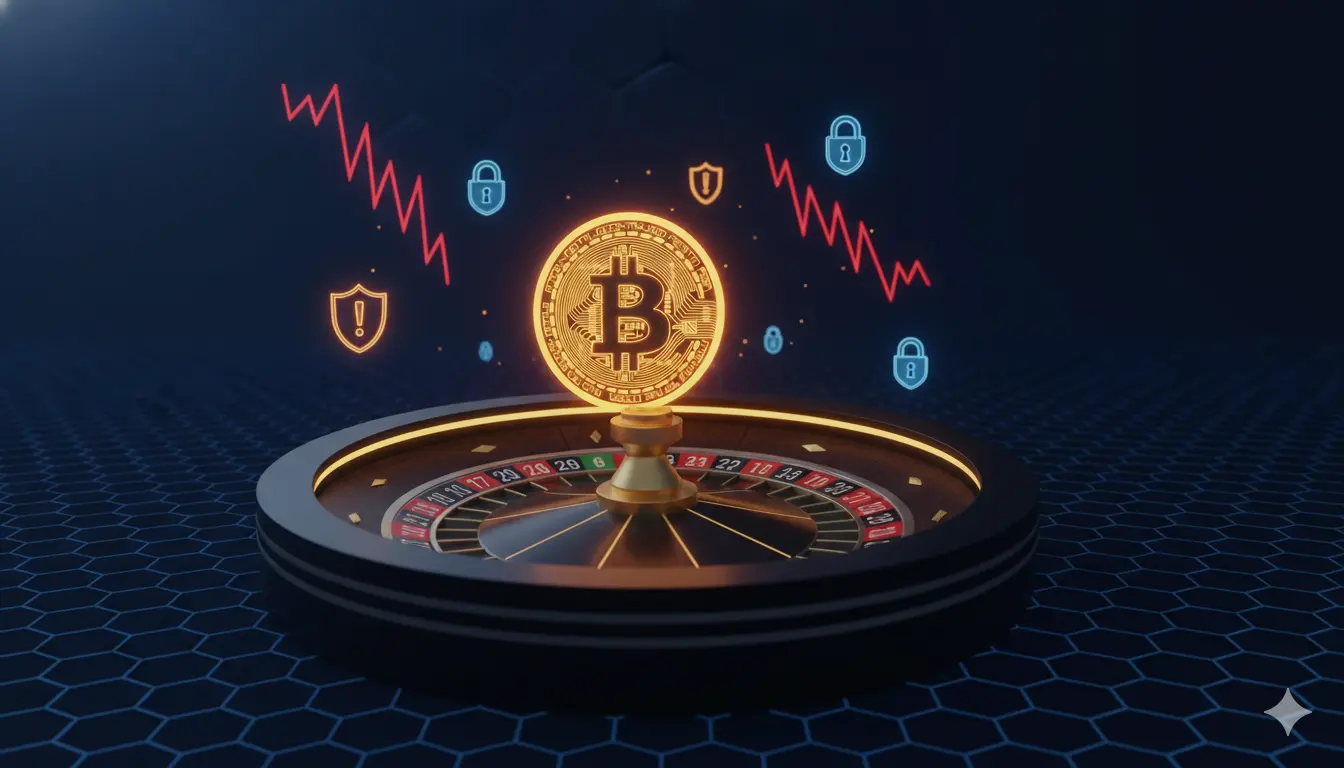
Crypto casinos promise anonymity, instant withdrawals, and provably fair games — but they also carry unique financial and security risks that traditional online casinos don’t. Before you deposit a single satoshi, here’s what every player needs to understand.
⚡ Quick Answer
The main risks of crypto casinos are price volatility (your winnings can lose value before withdrawal), irreversible transactions (no chargebacks), weak regulation (many operate without meaningful oversight), and wallet security threats (phishing, rug pulls, address poisoning). Protect yourself by using licensed casinos, hardware wallets, and never depositing more than you can afford to see drop 50% in value overnight.
🎰 What Makes Crypto Casinos Different — and Riskier
Cryptocurrency gambling differs from fiat-based online casinos in several fundamental ways. Transactions are processed on a blockchain, meaning they are decentralized, pseudonymous, and irreversible. This creates advantages — faster payouts, lower fees, and no bank intervention — but it also strips away the safety nets players take for granted.
At a licensed fiat casino, disputing a fraudulent charge with your bank or credit card provider is straightforward. With crypto, once a transaction is confirmed on-chain, no authority can reverse it. If a scam casino refuses your withdrawal, or your wallet is compromised, your funds are likely gone permanently.
🚨 Core Difference:Traditional gambling disputes can involve card chargebacks, payment processor intervention, or banking ombudsman complaints. Crypto gambling disputes have none of these recourse mechanisms. Your only protection is choosing the right casino before you deposit.
📉 Volatility Risk: The Hidden Cost No One Talks About
Bitcoin, Ethereum, and most altcoins can swing 10–30% in value within a single day. For crypto casino players, this creates a layered risk that most newcomers underestimate.
How Volatility Affects Your Bankroll
Imagine depositing 0.01 BTC when Bitcoin is worth $60,000 — that’s $600. You win and build your balance to 0.015 BTC ($900). But by the time you complete KYC verification and the casino processes your withdrawal (which can take 24–72 hours), Bitcoin drops to $42,000. Your 0.015 BTC is now worth $630 — barely more than you started with despite winning 50% more coins.
This “volatility drain” is a real phenomenon and it works in reverse too. Your deposit could also be worth significantly more when you withdraw — but planning around market upswings is speculation, not gambling strategy.
| Scenario | Deposit Value | BTC at Withdrawal | Fiat Outcome |
|---|---|---|---|
| Break-even at casino, BTC drops 20% | $600 | -20% | $480 (–$120) |
| Win 20% at casino, BTC drops 20% | $600 → $720 | -20% | $576 (–$24) |
| Lose 20% at casino, BTC rises 20% | $600 → $480 | +20% | $576 (+–$24) |
| Win 20% at casino, BTC unchanged | $600 → $720 | 0% | $720 (+$120) |
⚠️ Protection Strategy:Withdraw winnings immediately and convert to a stablecoin (USDT, USDC) or fiat after each session. Do not leave large balances sitting on a casino wallet where you bear both gambling risk and market risk simultaneously.
🔐 Security Threats Unique to Crypto Gambling
The decentralized nature of crypto eliminates middlemen — but middlemen were often the ones catching fraud. Players must now act as their own security department.
1. Phishing Attacks Targeting Casino Players
Scammers create fake casino websites with near-identical domains (e.g., “bittcasino.com” vs. “bitcasino.com”) designed to steal wallet credentials and login tokens. Search engine ads are frequently used to place fake casino sites above legitimate ones.
Protection: Bookmark your casino’s URL directly. Never access a crypto casino via a search engine ad. Check the padlock and domain every time you log in.
2. Wallet Address Poisoning
A sophisticated 2024–2025 scam involves sending a tiny amount of crypto from a wallet address that closely resembles one you’ve used before. Players who copy-paste from their transaction history accidentally withdraw winnings to the scammer’s wallet.
Protection: Always verify the first 6 and last 6 characters of a wallet address before confirming. Use a hardware wallet (Ledger, Trezor) that displays addresses on a trusted screen.
3. Rug Pulls and Exit Scams
Unregulated crypto casinos — particularly those offering native tokens, staking rewards, or “yield farming” bonuses — can execute rug pulls: the operators drain the treasury and disappear overnight. Players holding casino tokens or mid-withdrawal balances lose everything.
4. Smart Contract Vulnerabilities
Blockchain-native casinos that process games via smart contracts are exposed to code exploits. If a smart contract governing a game’s payouts has a vulnerability, attackers can drain the prize pool. Unlike a traditional hack, smart contract exploits are often impossible to reverse even when the victim is obvious.
🔒 Security Baseline:Use a dedicated wallet address for gambling — never your primary holding wallet. Keep only the amount needed for your session in a hot wallet. Store long-term holdings in a hardware wallet that never touches casino-connected interfaces.
⚖️ Regulation Gap: The Biggest Structural Risk
Many crypto casinos deliberately operate in regulatory grey areas. Some hold minimal Curaçao gaming licences with little player protection; others have no licence at all, relying on the pseudonymous nature of crypto to avoid accountability.
Unlike UKGC or MGA-licensed casinos — which must maintain segregated player fund accounts, publish financial audits, and respond to regulator complaints — unlicensed crypto casinos have no obligation to protect your balance. If the operator decides your win is “suspicious,” they can freeze your account with no appeals process and no regulator to complain to.
Provably Fair ≠ Licensed
A critical misconception: provably fair means game outcomes can be cryptographically verified, but it says nothing about whether the casino will actually pay out, how KYC is handled, or whether the operator is legitimate. A casino can be provably fair and still be a scam at the withdrawal stage.
✅ What to Look For:Crypto casinos with legitimate MGA or UKGC licences exist (e.g., casinos that accept both crypto and fiat under proper regulation). These offer the security of provably fair games and regulatory oversight. Always verify the licence on the regulator’s official database before depositing.
📖 Further Reading: The BeGambleAware Safer Gambling Guide covers responsible gambling principles that apply specifically in crypto environments where self-regulation is even more critical — including deposit limits, time tracking, and self-exclusion tools available across licensed platforms.
🎲 RNG vs. Provably Fair: Understanding the Difference
Traditional online casinos use Random Number Generators (RNG) certified by third-party labs like eCOGRA or iTech Labs. Players must trust both the casino and the testing lab. Provably fair crypto games use cryptographic hashing to eliminate that trust requirement — the math is publicly verifiable by the player themselves.
How Provably Fair Works (Simplified)
Before a game round begins, the casino generates a server seed and hashes it. The player can add their own seed. After the round, the casino reveals its unhashed seed — players can verify that the outcome was determined before the bet was placed and was not modified. This makes post-bet manipulation mathematically impossible to hide.
However, not all crypto casinos offering “provably fair” games actually implement it correctly. Always test the verification tool provided and cross-check a few game hashes independently before trusting a platform.
💸 Withdrawal Risks Specific to Crypto
Beyond the standard withdrawal delay red flags covered in our Online Casino Red Flags guide, crypto casinos introduce additional withdrawal complications.
- Crypto-only withdrawals after fiat deposit: Some casinos accept card deposits but only pay out in crypto — converting at a rate they control, often unfavorably.
- Locked crypto value: Casino locks your withdrawal request at the crypto price at request time, not at processing time — you lose any appreciation during their delay.
- Network fee manipulation: Casino quotes unusually high “gas fees” or “network fees” that are far above actual blockchain costs, pocketing the difference.
- Wrong network withdrawals: Player accidentally withdraws ERC-20 token to a BEP-20 address (or vice versa). Funds may be permanently lost. Always verify the network.
- KYC demands after deposit: Crypto casino demands full document KYC after you’ve already deposited, using “compliance review” to delay or prevent withdrawal.
🧮 Crypto Casino Risk Assessment Table
| Risk Type | Severity | Likelihood | Mitigation |
|---|---|---|---|
| Price volatility loss | High | Very likely | Withdraw & convert quickly |
| Unregulated casino exit scam | High | Moderate | Verify licence before depositing |
| Phishing / fake site | High | Moderate | Bookmark, verify URL every time |
| Wallet address poisoning | High | Low-Medium | Hardware wallet, verify addresses |
| Arbitrary win confiscation | High | Moderate (unlicensed) | Stick to licensed operators |
| Wrong network withdrawal | High | Low | Double-check network before sending |
| Smart contract exploit | Medium | Low | Use established platforms only |
| KYC withdrawal stalling | Medium | Moderate | Complete KYC immediately after signup |
✅ Crypto Casino Safety Checklist
- Verify the casino holds a real MGA, UKGC, or equivalent licence (not just Curaçao or unlicensed)
- Use a dedicated gambling wallet — never your main crypto holding address
- Store funds in a hardware wallet; only move to hot wallet what you need for the session
- Bookmark the casino URL directly — never access via search engine ads
- Verify wallet addresses character-by-character before every withdrawal
- Withdraw winnings immediately and convert to stablecoin to lock fiat value
- Complete KYC before your first deposit, not after you try to withdraw
- Test provably fair verification on a few past rounds before trusting any platform
- Never hold a large balance on a casino wallet — treat it as a hot wallet with full custody risk
- If the casino has no responsible gambling tools (deposit limits, self-exclusion), leave immediately
📌 Final Verdict
Crypto casinos offer genuine advantages — speed, privacy, and verifiable fairness — but these come bundled with risks that demand a more sophisticated approach than traditional online gambling. The irreversibility of blockchain transactions means that mistakes and scams cannot be undone. Volatility means your balance is always a moving target. And the regulatory vacuum means your only real protection is your own due diligence before you deposit.
The safest approach is to treat crypto gambling as two separate risk exposures — casino risk and market risk — and manage both independently. Choose licensed operators, withdraw frequently, convert winnings to stablecoins, and never gamble with crypto you cannot afford to see lose half its value overnight.
For more detailed red flags about spotting unsafe casinos of any type, read our full Online Casino Red Flags Guide at SafeGaming.
For crypto players in Malaysia, our team has verified which platforms handle USDT and Bitcoin withdrawals reliably — see the best crypto casino Malaysia 2026 guide. For a broader view across all payment methods, see the best online casino Malaysia 2026 comparison.
📌 Stay safe: Read our full online casino scams & fraud guide before depositing. Compare licensed options in our best online casino Malaysia 2026 ranking, or use DuitNow casino Malaysia for safer local banking.
📝 Editorial transparency: Tested using our published crypto casino methodology — our seven-stage evaluation framework with documented test methodology, refresh cadence, and named accountability. Read: How We Test Crypto Casinos →




 Malaysia Casino Review4 years ago
12Play Casino Review Malaysia 2026 | Get Casino Bonus | SafeGaming
- Malaysia Casino Review4 years ago
WinClub88 Malaysia 2026: Login Guide, Bonus & Safety
- Singapore Casino Review4 years ago
12Play Review Casino Singapore 2026 | SafeGaming
- Malaysia9 months ago
Best Online Casinos in Malaysia 2026 for Real Money
- Singapore Casino Review4 years ago
BK8 Casino Review Singapore 2026 | SafeGaming
- Singapore Casino Review4 years ago
MYBET88 Casino Singapore Review 2026 | SafeGaming
- Singapore Casino Review4 years ago
Maxim88 Casino Review 2026 | Online Casino Singapore
- Malaysia Casino Review4 years ago
QQClubs Casino Review Malaysia 2026 | SafeGaming