
Casinos to Avoid Malaysia — Blacklisted & Scam Casinos 2026

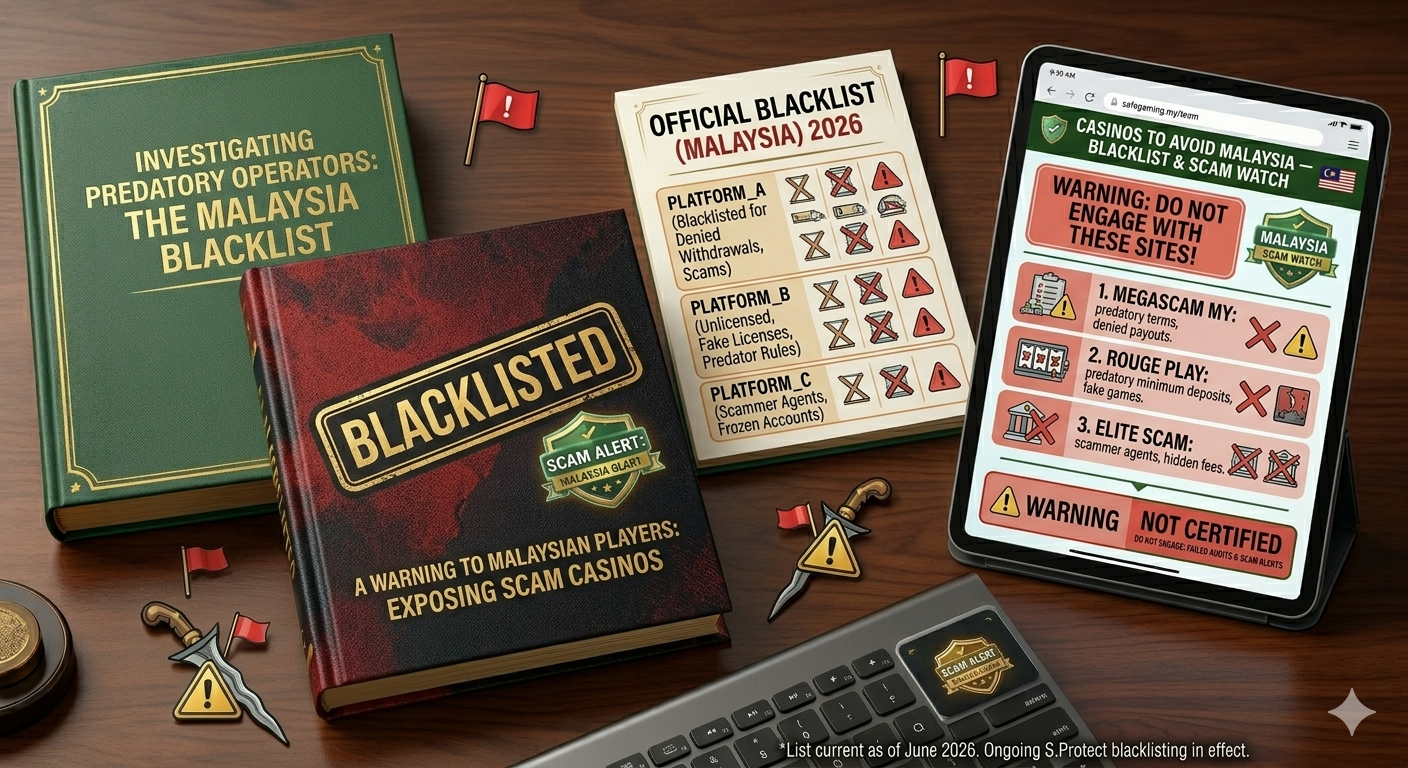
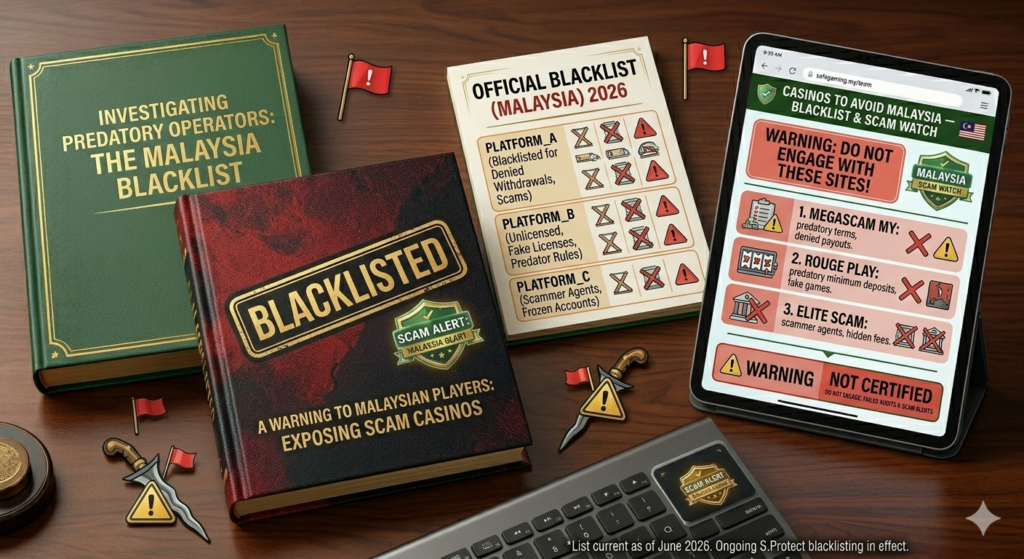
The casinos to avoid in Malaysia in 2026 fall into recognisable patterns — fake Curaçao licences traced back to single repeat offenders, “agent network” operators that route deposits to personal accounts, clone sites of legitimate operators, and KYC-harvesting traps that collect documents without ever paying out. If you have ever been pitched an enormous welcome bonus by a casino you had never heard of, this is the casinos to avoid Malaysia 2026 guide that explains the categorical patterns to walk away from and the verification step that confirms each one.
Note on Naming Specific Operators
We do not publish a “named blacklist” of specific operators in this guide for legal and operational reasons:
- Defamation risk. Naming specific operators as scams without legally adequate documentation creates litigation exposure even when the underlying claims are accurate.
- Whack-a-mole problem. Scam operators rotate domain names monthly. A specific name today is irrelevant in 90 days.
- Pattern-based prevention is more durable. Teaching the patterns lets readers identify scams across thousands of operators rather than just the ones we have time to name.
What we do publish: pattern-based identification, real-time S.Protect membership alerts when verified operators regress, and operator-specific dispute logs accessible via our member portal. For specific case names, the AskGamblers public dispute resolution database and Casino Guru’s “rogue casino” list are the public references we cross-check against.
The Five Operator Categories to Avoid
These five categories cover roughly 95% of operators MY players should walk away from in 2026.
Category 1 — Fake Licence Operators
The casino footer displays a Curaçao eGaming licence number. The number does not appear on Curaçao’s official registry, or it appears registered to a different company, or the licence is suspended.
Detection: 90-second check at curacao-egaming.com (or MGA, PAGCOR equivalent). Number must match active record with the listed operator company.
Why they exist: Operating without a real licence is cheaper than maintaining licensing compliance. The fake licence buys credibility for marketing without the regulatory accountability of real licensing.
What they do to players: Refuse withdrawals citing arbitrary “T&C violations” that the player has no recourse to dispute. Collect KYC documents without paying out. Disappear when complaints accumulate by simply rebranding to a new domain.
Category 2 — Agent Network Operators
The casino requires deposits through a “personal agent” via Telegram or WeChat instead of through the cashier interface to a regulated merchant bank account. The agent collects the deposit and either does not credit the casino account or credits with internal “agent funds.”
Detection: Real casinos take deposits through their cashier displaying a verified merchant account. Telegram or WeChat deposit instructions = agent network = walk away.
Why they exist: Agent networks bypass payment processor compliance. The operator captures deposits without ever being seen by a regulated payment processor that would flag the activity.
What they do to players: Deposits sometimes credit, sometimes do not. Withdrawals routed through “agent” channels and can be denied at the agent’s discretion. Player has no regulatory recourse because the deposit never touched the regulated rail.
Category 3 — Clone / Mirror Site Operators
A scam site that copies a legitimate operator’s branding, T&Cs, and licence display on a different domain. Players think they are at BK8, WE88, or Maxim88. The original operator has no record of the player.
Detection: Domain check. The legitimate operator’s main domain is well-known and stable. Variations like “bk8malaysia2026.com” or “we88-vip.com” are clones.
Why they exist: Clone sites capture the marketing equity of legitimate operators. The clone operator earns deposits without any of the operating overhead of a real operator.
What they do to players: Accept deposits, credit fake balances, void all withdrawals. The legitimate operator cannot help because the player was never registered with them.
Category 4 — KYC Document Harvesters
The operator collects player KYC documents (IC, selfie, address proof) for “verification” but never approves any withdrawal. Documents are sold on data-broker markets or used for identity fraud.
Detection: Withdrawal status remains “verifying” indefinitely while support promises “soon.” Independent dispute sites typically have multiple unresolved complaints with the same pattern.
Why they exist: KYC documents have direct resale value on identity-fraud markets. The casino does not actually need to be a profitable casino — it just needs to be a document-harvesting front.
What they do to players: Real money in, no money out, IC and address now in the hands of identity fraud markets. Recovery is rare; identity protection becomes an ongoing concern.
Category 5 — Withdrawal-Trap Operators
The casino is technically licensed (sometimes) but T&Cs are designed to make withdrawals nearly impossible — wagering above 60x, max-cashout below 3x bonus, max-bet rules during bonus play set at MYR 1, game weighting tables that exclude every game players actually want to play.
Detection: Read T&Cs before depositing. Wagering above 50x, max-cashout below 5x, or max-bet during bonus below MYR 5 are all walk-away signals.
Why they exist: Mathematically, the operator can advertise huge welcome bonuses while structurally ensuring few players ever clear the wagering. The math itself is the trap.
What they do to players: Players play through wagering, hit a bonus-related rule (max-bet, restricted game, time limit), and the entire bonus + winnings are voided. The deposit becomes the loss.
How to Verify Any Operator in 10 Minutes
Three-step verification eliminates exposure to all five categories:
Step 1 — Licence verification (90 seconds). Footer licence number → regulator’s official registry → confirm active status and matching company name.
Step 2 — Deposit channel verification (30 seconds). Open the cashier. Confirm deposits route through the casino’s cashier interface to a verified merchant bank account. Walk away from any operator pushing Telegram or WeChat agents.
Step 3 — Independent reputation cross-check (5–8 minutes). Search the operator on AskGamblers, Casino Guru, Casinomeister, and Trustpilot. Look for unresolved non-payment complaints, KYC mishandling reports, and clone-site warnings. Multiple unresolved complaints across multiple sites = walk away.
For the broader checklist, see our how to choose a safe online casino guide.
What to Do If You Have Already Deposited at a Bad Operator
Immediate steps if a red flag emerges after you have deposited:
- Stop playing immediately. Do not commit additional funds.
- Document everything in writing. Screenshots of T&Cs, deposit confirmations, support chat logs, agent contact details.
- Request a refund through the cashier. Most operators allow refunds before play. Document the request.
- Escalate to the licensing regulator. For real (not fake) Curaçao licences, the regulator’s complaints process can pressure the operator to pay. Fake licences mean no escalation path.
- File on independent dispute resolution sites. AskGamblers and Casino Guru have public dispute programs. Documentation creates pressure.
- For Malaysian banking-side issues. Royal Malaysia Police (PDRM) can investigate financial fraud involving Malaysian bank accounts. Where personal data was collected, MCMC handles digital fraud reporting.
Recovery is sometimes possible. Documentation is mandatory for any recovery effort.
Why the Verified List Matters More Than Any Blacklist
Reading “casinos to avoid” guides is a defensive posture. The offensive posture is using the SafeGaming verified list as the starting point for operator selection. The verified list is built around four-stage testing (licence, real-money tests, reputation cross-check, 60-day surveillance) that structurally eliminates the five blacklist categories.
For the verified list, see our verified Malaysia casino criteria and the operator pages at the Malaysia casino review hub.
Regulation, Safety and Responsible Gambling
Most legitimate MY-facing operators hold Curaçao eGaming licences. The licensing authority — Curaçao eGaming Licensing Authority — runs an operator registry where you can verify any operator’s status. Verification is the single most powerful defence against the five blacklist categories.
Malaysia’s Common Gaming Houses Act 1953 and Betting Act 1953 govern domestic gambling but do not contain explicit provisions criminalising individual players who access offshore-licensed casinos. Players operate in a legal grey area: the platforms are not licensed in Malaysia, and individual player prosecution is not documented as of 2026. This is general context, not legal advice.
Scam operators exploit the offshore market specifically because Malaysian players have limited regulatory recourse against operators based outside Malaysia. The practical defence is operator selection at deposit time. Spending 10 minutes on verification before depositing is the cheapest insurance available.
If gambling is no longer fun — including the stress of dealing with operator problems or scam recovery — free and confidential support is available from the National Council on Problem Gambling Malaysia at ncpgm.org.my. For practical limits, see our responsible gambling guide.
Frequently Asked Questions
Q: Which casinos should I avoid in Malaysia in 2026?
Five operator categories: fake-licence operators (no listing on the regulator’s registry), agent-network operators (deposits via Telegram personal accounts), clone/mirror sites (copying legitimate brand names on different domains), KYC-document harvesters (collecting documents without paying out), and withdrawal-trap operators (T&Cs designed to void winnings).
Q: How do I check if a Malaysian casino is on a blacklist?
Independent dispute resolution sites maintain public lists: AskGamblers’ Casino Complaints database, Casino Guru’s rogue operator list, Casinomeister’s blacklist, and Trustpilot operator profiles. Cross-reference any operator across multiple sources before depositing.
Q: What is a “fake licence” online casino?
A casino that displays a licence number in the footer but the number does not appear on the regulator’s official registry, points to a different company, or has been suspended or revoked. Fake licences provide zero regulatory accountability — the operator can do anything without consequence.
Q: Are Telegram casino “agent” deposits dangerous?
Yes. Real casinos take deposits through their cashier interface displaying a verified merchant bank account. Telegram or WhatsApp “agents” who collect deposits to personal accounts operate outside the regulatory framework with no recourse if funds disappear.
Q: How do clone casino sites work?
A scam site copies legitimate operator branding (BK8, WE88, Maxim88, etc.) on a different domain. Players think they are at the real operator. Deposits go to the scammer; the real operator has no record of the player. Always navigate to operators via well-known main domains or through SafeGaming’s verified links.
Q: What is a “KYC document harvester” casino?
A casino that collects player IC, selfies, and address proofs for “verification” but never approves any withdrawal. Documents are sold on data-broker markets or used for identity fraud. The casino is not actually a casino — it is a document-collection front.
Q: What is a “withdrawal trap” casino?
A licensed (sometimes) casino with T&Cs designed to make withdrawals nearly impossible: wagering above 60x, max-cashout below 3x bonus, max-bet during bonus at MYR 1–MYR 3, restrictive game weighting. Players can play but mathematically cannot withdraw bonus winnings.
Q: How do I report a casino scam in Malaysia?
For Malaysian bank account fraud (deposits to personal accounts), Royal Malaysia Police (PDRM) handles financial fraud cases. For identity theft from KYC misuse, MCMC handles digital fraud. For licensed operators, file complaints with the licensing regulator (Curaçao eGaming, Malta, or PAGCOR). Document everything in writing.
Q: Can I get my money back from a Malaysian casino scam?
Recovery is sometimes possible but not guaranteed. Bank-side chargebacks work in narrow scenarios. Regulator complaints can pressure licensed operators to pay. Cryptocurrency deposits to scam wallets are typically unrecoverable. Documentation is critical for any recovery effort.
Q: Why doesn’t SafeGaming publish a named blacklist?
Three reasons: defamation risk (naming operators as scams without legally adequate documentation creates litigation exposure), whack-a-mole problem (scam operators rotate domain names monthly), and pattern-based prevention being more durable than name-based blacklisting. We teach the patterns and cross-reference public databases like AskGamblers and Casino Guru.
Q: Are all unlicensed online casinos scams?
Not all, but the risk is substantially higher. Unlicensed operators have no regulatory accountability — there is no complaints process, no audit, and no recourse if they refuse to pay. Even if not actively scamming, unlicensed operators can fold without notice and players have no protection.
Q: How does S.Protect help with casino scams?
S.Protect coverage applies only to SafeGaming-verified operators that have passed our four-stage verification. Members are eligible for up to USD 30,000 scam-protection payout if a verified operator subsequently fails to pay a documented withdrawal. Coverage does not extend to unverified or blacklisted operators — operator selection at deposit time matters most.
Sources & References
- Curaçao eGaming Licensing Authority — curacao-egaming.com — used for operator licence verification context
- Royal Malaysia Police — rmp.gov.my — used for fraud reporting context
- Malaysian Communications and Multimedia Commission — mcmc.gov.my — used for digital fraud reporting context
- Malaysia Attorney General’s Chambers — agc.gov.my — used for Common Gaming Houses Act 1953 legal context
- National Council on Problem Gambling Malaysia — ncpgm.org.my — used for responsible gambling resources










 Slot Games Hub1 year ago
Online Casino Pussy888 Apk & Ios Download for Free
- Malaysia Casino Review1 year ago
WE88: Trusted Online Casino Malaysia | SafeGaming
- Thailand Casino Review5 months ago
เว็บพนันออนไลน์ ที่ดีที่สุด 2026 สำหรับผู้เล่นชาวไทย
- Singapore Casino Review1 year ago
Uwin33 Review – Trusted Casino in Singapore 2026 | SafeGaming
- Malaysia Casino Review1 year ago
UWin33 Casino Review Malaysia 2026 | SafeGaming
- Malaysia Casino Review1 year ago
12Play Casino Review Malaysia 2026 | Get Casino Bonus | SafeGaming
- Singapore Casino Review1 year ago
12Play Review Casino Singapore 2026 | SafeGaming
- Malaysia Casino Review1 year ago
WinClub88 Casino Review Malaysia 2026 | Trusted ✅ | SafeGaming