
Casino RNG Explained — How Random Number Generators Work 2026

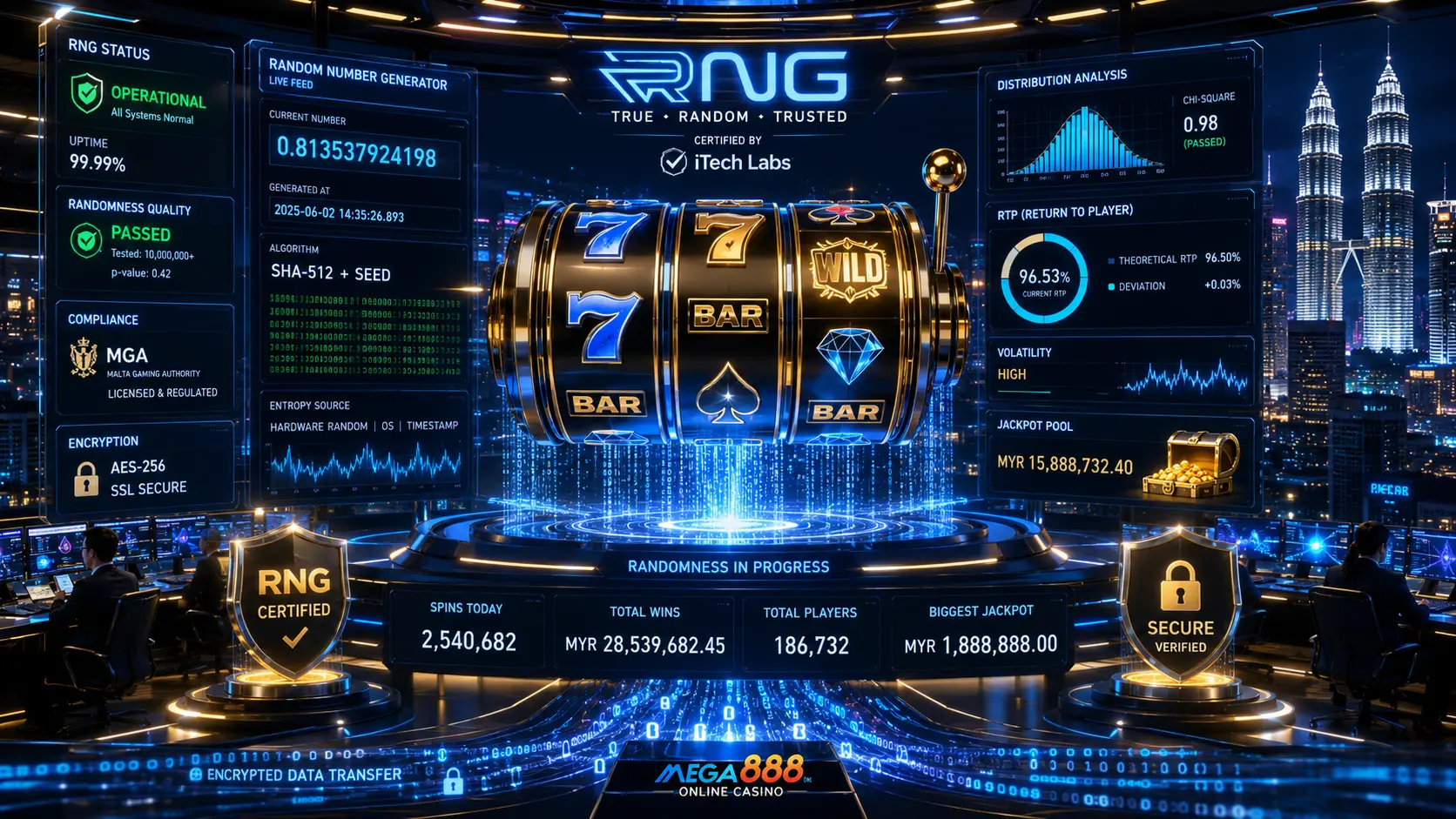
The casino RNG that decides every slot spin and RNG-table outcome at MY-facing operators in 2026 is not a black box of randomness — it is a deterministic algorithm seeded with high-entropy inputs and audited by independent labs to verify it produces statistically uniform output. If you have ever wondered whether online slots are “really random” or whether the casino can flip a switch to make you lose, this is the casino RNG explained guide for Malaysian players that walks through the actual mechanics, the audit process, and the limits of what RNG can and cannot do.
What an casino RNG Actually Is
An Casino RNG (Random Number Generator) in online casino contexts is a software algorithm — typically a “pseudo-random number generator” (PRNG) — that produces sequences of numbers with statistical properties indistinguishable from true randomness.
True randomness in computing is rare and expensive. Most casino RNGs use cryptographically secure algorithms like Mersenne Twister, Fortuna, or hardware-seeded variants of these. The algorithm is deterministic — given the same starting input (seed), it produces the same sequence — but the seed is updated continuously from high-entropy sources (system clock with nanosecond precision, mouse movements at the studio, hardware noise) so the output is unpredictable in practice.
For a slot spin, the Casino RNG generates a number that maps to a specific reel symbol combination based on the slot’s mathematical model. The result is decided in microseconds. The visual reel animation you see is theatre — the outcome was set before the reels visually moved.
Bottom line: certified casino RNGs produce statistically random output. They are not biased toward any specific player or any specific outcome.
Why “Pseudo-Random” Is Still Truly Random for Casino Use
Pseudo-random does not mean “fake random.” It means deterministic algorithm seeded with unpredictable inputs. The output passes statistical tests for randomness — including the NIST randomness test suite, the Diehard tests, and TestU01 — that distinguish true random from non-random sequences.
For casino purposes, the standard is: can a player or insider predict the next outcome with better than random chance? The answer for certified Casino RNGs is no. The seeds are updated faster than any practical observation could capture, and the algorithm output is computationally infeasible to reverse-engineer.
Pseudo-random is “real random” for any practical casino game.
How the Casino RNG Decides a Slot Spin
A walk-through of what happens behind the scenes when you press Spin on a Pragmatic Play slot:
- Your browser sends a spin request with bet amount and active paylines
- The casino’s game server forwards the request to Pragmatic Play’s game engine
- Pragmatic’s Casino RNG generates a 32-bit or 64-bit random number
- The number is mapped through the slot’s math model to a specific reel position outcome
- The math model determines which symbols appear on which reels and any bonus features triggered
- Pragmatic returns the result — symbols, win amount, bonus triggers — to the casino
- The casino credits any win to your balance
- Your browser receives the result and animates the reels to the predetermined outcome
The reel animation is purely visual. The outcome was decided in step 3, before any reels visually spun. This is true for every certified slot from every legitimate provider — the visual experience is decoupled from the math.
What Independent RNG Certification Actually Tests
Independent testing labs run multiple statistical tests on the Casino RNG and the game’s overall behaviour:
RNG distribution tests: Verify that the algorithm produces statistically uniform output across millions of generated numbers.
Game-specific RTP verification: Run the game through 100 million or more simulated spins and compare actual return percentage to the published RTP.
Game-specific volatility verification: Confirm the variance of outcomes matches the published model.
Bonus trigger verification: Confirm bonus features trigger at the published frequencies.
Hit frequency verification: Confirm the published hit rate matches simulated outcomes.
The major labs are eCOGRA’s independent game testing and certification standards, iTech Labs, GLI (Gaming Laboratories International), and BMM Testlabs. Certification reports are typically renewed annually.
A casino displaying current eCOGRA, iTech Labs, GLI, or BMM certification on its footer is signalling that an independent third party has verified the RNG and RTP. A casino without this signalling has not been independently audited.
What RNG Cannot Do — Common Misconceptions
Five misconceptions about casino RNGs that consistently mislead MY players:
Misconception 1 — “The RNG can be flipped to make you lose.” Certified RNGs run as part of the game provider’s infrastructure, not the casino’s. The casino cannot modify RNG output without breaking certification and forfeiting their game licences.
Misconception 2 — “The RNG remembers past results.” RNG output is independent at every spin. The next spin has no memory of previous spins. “Hot” or “cold” patterns are variance, not memory.
Misconception 3 — “Bigger bets get worse RNG results.” Bet size has no effect on RNG output. The RNG generates a number; the math model maps it to symbols. Bet size only changes the payout amount on a winning combination.
Misconception 4 — “Time of day affects RNG.” RNG output is independent of clock time, day, or session length. The same algorithm runs continuously.
Misconception 5 — “VIP players get better RNG.” Loyalty status does not affect RNG output. VIPs may receive better cashback, faster withdrawals, and lower wagering on bonuses — but the underlying RNG is identical for every player.
The RNG does what it is certified to do: produce statistically random outcomes within the game’s mathematical model. Nothing more, nothing less.
How RNG Differs from Live Dealer
Live dealer games (baccarat, blackjack, roulette, Sic Bo at MY-facing operators) use physical cards, dice, or wheels under camera supervision instead of an RNG. The “randomness” comes from physical shuffling, dice tossing, or wheel spinning by trained dealers in regulated studios.
Live dealer game integrity is enforced by:
- Multi-camera supervision
- Studio licensing under the operator’s gambling jurisdiction
- Dealer training and compliance protocols
- Regular shoe changes and equipment audits
Live dealer is more transparent than RNG (you see the cards) but the underlying math — house edge, RTP, hand probabilities — is identical to RNG versions of the same game.
RNG and Game Fairness in Malaysia 2026
For MY-facing online casinos in 2026, the RNG and certification picture is:
- All major game providers (Pragmatic Play, PG Soft, Microgaming, NetEnt, Habanero, JILI, CQ9) hold current RNG certifications
- All tier-one MY-facing operators (BK8, WE88, Maxim88, W88, M88) use these certified providers
- Mid-tier and unknown operators sometimes deploy uncertified or stale-certified games — the warning sign is no current certification displayed on the casino footer
Always check the casino’s footer for current certification seals before playing. The seal links to the lab’s verification page where you can confirm the certificate is active.
Regulation, Safety and Responsible Gambling
Online casino RNGs at MY-facing operators are certified by independent labs as part of game provider compliance. The certification process is the primary mechanism through which players can verify game fairness without trusting the operator’s own claims.
Most MY-facing operators hold Curaçao eGaming licences. Curaçao licensing requires RNG-certified games and game-fairness audits. Verify the operator’s licence on the regulator’s official registry before depositing.
Malaysia’s Common Gaming Houses Act 1953 and Betting Act 1953 govern domestic gambling but do not contain explicit provisions criminalising individual players who access offshore-licensed casinos. Players operate in a legal grey area: the platforms are not licensed in Malaysia, and individual player prosecution is not documented. This is general context, not legal advice.
RNG fairness does not mean RNG generosity. The math is in the casino’s favour by design (the house edge); the RNG just makes sure the math runs honestly. If you are losing because of variance within a fair game, that is variance, not unfair RNG.
If gambling is no longer fun, free and confidential support is available from the National Council on Problem Gambling Malaysia at ncpgm.org.my. For practical limits, see our responsible gambling guide.
Frequently Asked Questions
Q: What is an RNG in casino games?
An RNG (Random Number Generator) is a software algorithm that produces sequences of numbers with statistical properties indistinguishable from true randomness. In online casinos, the RNG decides every slot spin, RNG-based table game outcome, and bonus trigger. Certified RNGs are audited by independent labs to verify their fairness.
Q: Are casino RNGs really random?
Certified casino RNGs are pseudo-random — produced by deterministic algorithms seeded with high-entropy inputs. The output passes statistical randomness tests and is computationally infeasible to predict. For practical casino purposes, the output is indistinguishable from true randomness.
Q: Can casinos manipulate the RNG?
Certified RNGs run as part of the game provider’s infrastructure (Pragmatic Play, PG Soft, Microgaming etc.), not the casino’s. The casino cannot modify RNG output without breaking certification and forfeiting game licences. Manipulation by reputable casinos is structurally impossible.
Q: Does the RNG remember past spins?
No. Each RNG output is independent. The next spin has no memory of previous spins. “Hot” or “cold” patterns are variance — statistical clusters in random sequences — not memory effects. The gambler’s fallacy of expecting “due wins” is mathematically wrong.
Q: Are slots online really random?
Certified slots from major providers (Pragmatic Play, PG Soft, Microgaming, NetEnt, Habanero, JILI, CQ9) use audited RNGs that pass statistical randomness tests. The slots are random within their published RTP and volatility models. The math is in the casino’s favour, but the math runs honestly.
Q: What is RNG certification?
Independent testing labs run statistical tests on game RNGs and verify the published RTP, volatility, and bonus trigger frequencies match actual output across millions of simulated spins. Certification reports are typically renewed annually. Major labs: eCOGRA, iTech Labs, GLI, BMM Testlabs.
Q: How do I know if a casino’s games are using a fair RNG?
Look for current certification seals on the casino’s footer (eCOGRA, iTech Labs, GLI, BMM Testlabs). Click through to verify the certificate is active. Major game providers (Pragmatic Play, Evolution Gaming, Microgaming) all hold current certifications. Mid-tier operators sometimes deploy uncertified games — that is the warning sign.
Q: Does bet size affect RNG outcomes?
No. The RNG generates a number independent of your bet. The math model maps the number to symbols and combinations. Bet size only changes the payout amount on winning combinations, not the probability of any specific outcome.
Q: Does the RNG favour VIP players?
No. RNG output is identical for every player at the same game. VIP loyalty programmes provide better cashback, faster withdrawals, and lower wagering requirements — but the underlying RNG is the same.
Q: How is live dealer different from RNG?
Live dealer games use physical cards, dice, or wheels under camera supervision in regulated studios. The randomness comes from physical shuffling, dice tossing, or wheel spinning by trained dealers. Live dealer is more visually transparent but the underlying math (house edge, RTP) is identical to RNG versions.
Q: Can I track RNG patterns to predict wins?
No. Certified RNGs are designed specifically to defeat pattern recognition. Their output passes statistical randomness tests including pattern-detection algorithms. Past results have no predictive value for future spins.
Q: What happens if a casino deploys an uncertified RNG?
If discovered, the operator faces licence sanctions or revocation by their gambling regulator. The game provider faces certification suspension. This is why reputable operators only deploy certified games — the regulatory risk of running uncertified games dwarfs any short-term financial benefit.
Sources & References
- eCOGRA — ecogra.org — used for RNG certification and game testing standards
- iTech Labs — itechlabs.com — used for RNG and game certification context
- Curaçao eGaming Licensing Authority — curacao-egaming.com — used for operator licensing and game-fairness audit context
- Malaysia Attorney General’s Chambers — agc.gov.my — used for Common Gaming Houses Act 1953 legal context
- National Council on Problem Gambling Malaysia — ncpgm.org.my — used for responsible gambling resources










 Slot Games Hub1 year ago
Online Casino Pussy888 Apk & Ios Download for Free
- Malaysia Casino Review1 year ago
WE88: Trusted Online Casino Malaysia | SafeGaming
- Thailand Casino Review5 months ago
เว็บพนันออนไลน์ ที่ดีที่สุด 2026 สำหรับผู้เล่นชาวไทย
- Singapore Casino Review1 year ago
Uwin33 Review – Trusted Casino in Singapore 2026 | SafeGaming
- Malaysia Casino Review1 year ago
UWin33 Casino Review Malaysia 2026 | SafeGaming
- Malaysia Casino Review1 year ago
12Play Casino Review Malaysia 2026 | Get Casino Bonus | SafeGaming
- Singapore Casino Review1 year ago
12Play Review Casino Singapore 2026 | SafeGaming
- Malaysia Casino Review1 year ago
WinClub88 Casino Review Malaysia 2026 | Trusted ✅ | SafeGaming