
What is House Edge? — Casino Odds Explained 2026

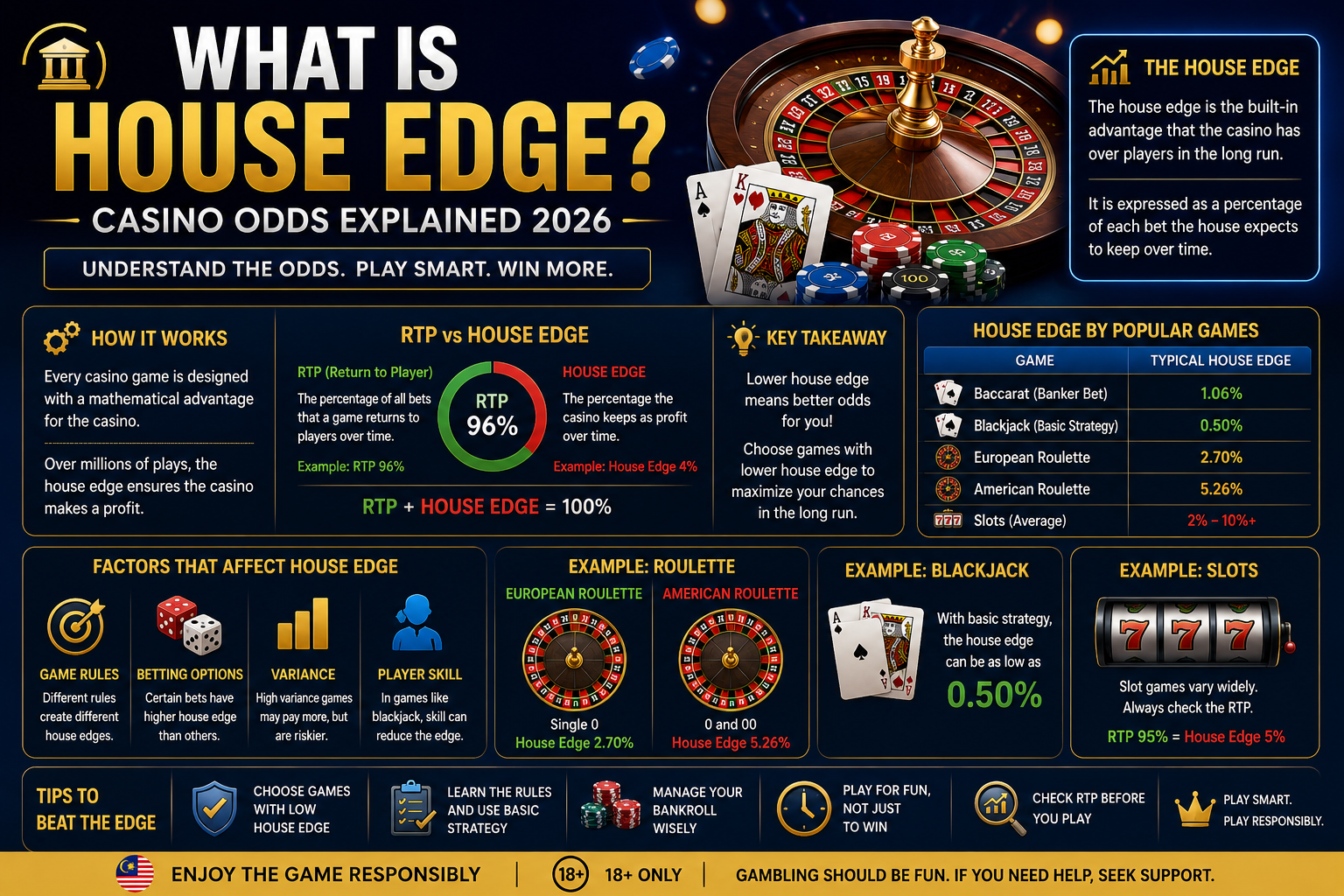
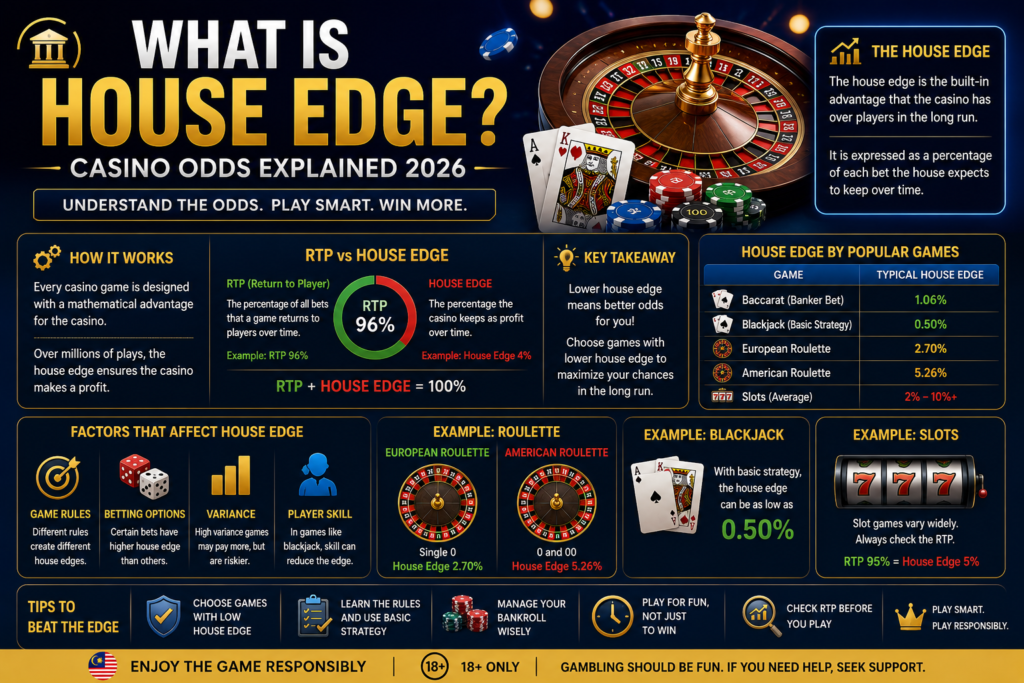
House edge is the single most useful number in any casino — it tells you, in one percentage, the long-term cost of playing every game on the floor. If you have ever been told a casino game is “fair” without knowing what fair actually means in mathematical terms, this is the what is house edge guide for Malaysian players that explains the math, the ranges, and how to use the number to choose better games.
House Edge Defined — The One-Sentence Version
House edge is the percentage of every wager the casino expects to keep on average over the long run.
A game with a 1% house edge keeps MYR 1 of every MYR 100 wagered as long-term average. Across 1,000 hands at MYR 100 each, the casino expects to win MYR 1,000 on average; the player expects to lose MYR 1,000.
House edge is the mirror image of RTP. RTP + house edge = 100%. A 96.5% RTP slot has a 3.5% house edge. A 1.06% house edge baccarat Banker bet is a 98.94% RTP bet.
Bottom line: house edge tells you the cost of playing. Lower house edge = lower cost = more sustainable play.
House Edge by Game — The Reference Table
A clean reference for typical house edges at MY-facing online casinos in 2026:
Lowest house edge — best bets in the casino:
- Video Poker (full-pay variants, optimal strategy): -0.5% to 0.5%
- Blackjack (basic strategy, favourable rules): 0.15% – 0.5%
- Baccarat Banker bet: 1.06%
- Baccarat Player bet: 1.24%
- French Roulette even-money bets (La Partage): 1.35%
- Sic Bo Big/Small or Even/Odd: 2.78%
- European Roulette (any bet): 2.70%
- Craps Pass/Don’t Pass with odds: 0.6% – 0.8%
Mid-range house edge:
- American Roulette (any bet): 5.26%
- Caribbean Stud Poker: 5.22%
- Three Card Poker: 3.37%
- Most slots: 2.5% – 5.5%
Highest house edge — avoid:
- Baccarat Tie bet: 14.36%
- Sic Bo Specific Triple: 49.07%
- Most casino side bets (21+3, Perfect Pairs etc.): 3% – 10%
- Slot side bets and progressive triggers: variable, often 5%+
A 0.5% house edge versus a 5% house edge across MYR 10,000 of wagering is a MYR 450 difference in expected loss. Game choice matters more than betting strategy.
Why House Edge Exists — The Casino’s Math
The house edge is built into the rules of every game. It is not a fee the casino takes; it is a structural advantage in the game’s payout structure.
In roulette, a single-number win pays 35:1, but the actual probability is 1/37 (European) or 1/38 (American). The “missing” payout — the gap between fair odds (36:1 European, 37:1 American) and the actual payout — is the house edge.
In blackjack, the dealer plays last, meaning the player can bust before the dealer plays. When the player busts, the dealer wins automatically without needing to play out the hand. This single rule creates most of the blackjack house edge.
In baccarat, the structural information advantage in third-card drawing rules makes Banker win slightly more often than Player. The 5% commission on Banker wins is the casino’s mechanism for capturing that edge.
Casinos do not need to cheat. The math works.
How to Use House Edge to Pick Better Games
A practical decision framework for MY players in 2026:
If you want to play table games, pick the lowest-edge bet on the lowest-edge game:
- Video poker with full pay and optimal strategy
- Blackjack with basic strategy (avoid 6:5 blackjack tables)
- Baccarat Banker bet (avoid Tie always)
- French roulette even-money bets (or European if French unavailable)
If you want to play slots, focus on RTP not headline features:
- 96%+ RTP is the threshold for sustainable play
- Match volatility to your bankroll
- Skip slot side bets and aggressive bonus-buy features
If you want sustainable session length:
- Choose 1–2% house edge games (baccarat Banker, blackjack basic strategy)
- Flat bet 1–2% of session bankroll
- Cap session length and use stop-loss / stop-win rules
For more on sustainable play, see our casino bankroll management guide.
House Edge vs Variance — Why You Can Lose Even on Low-Edge Games
House edge is the long-term average. Variance is the short-term swing.
A baccarat Banker bet has a 1.06% house edge — among the lowest in any casino. But individual sessions can lose 30–50% of bankroll due to variance even when the math is firmly in your favour. Variance dominates short-term outcomes.
Practical implication: even with the best house edge in the casino, you need bankroll discipline to survive variance. The math averages out over thousands of hands, not over a single session.
This is also why the house edge of a game and the experience of playing it can feel disconnected. A 96% RTP / 4% house edge slot can produce a 50% bankroll loss in 100 spins through pure variance, even though the math says “MYR 96 back per MYR 100 wagered.”
House Edge and Wagering Requirements — How Bonuses Multiply Cost
Bonuses change the math. A 100% deposit match with 30x deposit + bonus wagering = MYR 30,000 of wagering on a MYR 1,000 total balance.
If you complete that wagering on a 4% house edge slot, expected loss is MYR 1,200 on MYR 30,000 wagered. Your starting balance was MYR 1,000 (your deposit). Net expected return: -MYR 200.
The bonus is statistically a small loser before considering variance. Bonuses pay out via variance — the math says you should lose, but variance can make you win or lose much more than expected.
For the bonus math in detail, see our casino bonus types and wagering guide.
Regulation, Safety and Responsible Gambling
House edge percentages at MY-facing casinos are mathematically verifiable through certification reports from independent labs. eCOGRA’s independent game testing and certification standards, iTech Labs, and GLI all publish audit reports that operators can reference. Always verify that the operator displays current certification.
Most MY-facing operators hold Curaçao eGaming licences. Curaçao licensing means the operator met minimum requirements and is subject to a complaints mechanism. Verify any operator’s licence on the regulator’s official registry before depositing.
Malaysia’s Common Gaming Houses Act 1953 and Betting Act 1953 govern domestic gambling but do not contain explicit provisions criminalising individual players who access offshore-licensed casinos. Players operate in a legal grey area: the platforms are not licensed in Malaysia, and individual player prosecution is not documented. This is general context, not legal advice.
House edge is the long-term cost of playing. Treating low house edge as “almost guaranteed wins” is variance bias. The math is in the casino’s favour on every legitimate game — the question is how much.
If gambling is no longer fun, free and confidential support is available from the National Council on Problem Gambling Malaysia at ncpgm.org.my. For practical limits, see our responsible gambling guide.
Frequently Asked Questions
Q: What is house edge in casino games?
House edge is the percentage of every wager the casino expects to keep on average over the long run. A game with a 1% house edge keeps MYR 1 of every MYR 100 wagered. House edge is the mirror image of RTP — they sum to 100%.
Q: Which casino game has the lowest house edge?
Video poker (full-pay variants with optimal strategy) has the lowest house edge — sometimes negative. Blackjack with basic strategy on favourable rules: 0.15%–0.5%. Baccarat Banker bet: 1.06%. These three are the most player-favourable bets in any casino.
Q: Which casino bet has the highest house edge?
Some Sic Bo specific triples carry house edges above 49%. Baccarat Tie bet: 14.36%. American roulette: 5.26%. Slot side bets: 5%–10%. Avoid these — the cost of play is dramatically higher than the alternatives at the same table.
Q: What is the difference between house edge and RTP?
They are inverses. RTP + house edge = 100%. A 96.5% RTP slot has a 3.5% house edge. RTP describes the math from the player’s perspective; house edge describes it from the casino’s.
Q: Does the house edge change?
The house edge is built into the rules of each game. It does not change during play. Some games offer multiple variants with different rules and different house edges (e.g., European vs American roulette). The casino chooses which variants to offer; the rules within each variant are fixed.
Q: Can I beat the house edge?
In some specific situations, yes — full-pay video poker with optimal strategy can carry a slight player edge. Card counting in physical blackjack with deep penetration can shift the edge to the player. In RNG online casino play, the house edge stands and cannot be overcome by strategy alone.
Q: How does house edge affect my bankroll?
Across long sessions, the house edge grinds down your bankroll at a rate proportional to the edge times the total wagered. A 5% edge across MYR 10,000 wagered = MYR 500 expected loss. A 0.5% edge across the same MYR 10,000 = MYR 50 expected loss. Lower edge = longer sustainable play.
Q: What is the house edge on slots?
Most modern slots carry house edges in the 2.5%–5.5% range, corresponding to 94.5%–97.5% RTP. Some slots offer multiple RTP versions; the casino chooses which to deploy. Always check the slot’s actual RTP in the in-game info panel.
Q: What is the house edge on online blackjack?
With basic strategy on standard 6–8 deck rules: roughly 0.5%. Without basic strategy: roughly 2.5%. Single-deck favourable rules with basic strategy: as low as 0.15%. Always check the table rules — some online blackjack variants pay 6:5 instead of 3:2 on blackjack, which significantly increases the house edge.
Q: Why is the house edge on Tie in baccarat so high?
The Tie bet pays 8:1 (or 9:1 at some tables) but ties only happen ~9.52% of the time. The 8:1 payout requires an 11.1% hit rate to break even. The gap creates a 14.36% house edge — by far the worst bet on the baccarat table.
Q: Does house edge apply to bonuses?
Yes. Bonuses with wagering requirements concentrate playthrough on games where the house edge applies. A 100% deposit match with 30x bonus + deposit wagering on a 4% house edge slot has a negative expected value before variance — meaning the math says you should lose money even with the bonus. See our casino bonus types and wagering guide.
Q: How do I find the house edge of a specific game?
Reputable casinos display RTP (and therefore house edge) in the in-game info panel. Independent testing labs publish certification reports with verified house edge figures. For RNG games, RTP is fixed per deployed version. For table games, house edge depends on the specific rules of the table — read them before playing.
Sources & References
- eCOGRA — ecogra.org — used for game certification and house edge verification standards
- iTech Labs — itechlabs.com — used for RNG game testing standards
- Curaçao eGaming Licensing Authority — curacao-egaming.com — used for operator licensing context
- Malaysia Attorney General’s Chambers — agc.gov.my — used for Common Gaming Houses Act 1953 legal context
- National Council on Problem Gambling Malaysia — ncpgm.org.my — used for responsible gambling resources











 Slot Games Hub1 year ago
Online Casino Pussy888 Apk & Ios Download for Free
- Malaysia Casino Review1 year ago
WE88: Trusted Online Casino Malaysia | SafeGaming
- Thailand Casino Review6 months ago
เว็บพนันออนไลน์ ที่ดีที่สุด 2026 สำหรับผู้เล่นชาวไทย
- Singapore Casino Review1 year ago
Uwin33 Review – Trusted Casino in Singapore 2026 | SafeGaming
- Malaysia Casino Review1 year ago
UWin33 Casino Review Malaysia 2026 | SafeGaming
- Malaysia Casino Review1 year ago
12Play Casino Review Malaysia 2026 | Get Casino Bonus | SafeGaming
- Singapore Casino Review1 year ago
12Play Review Casino Singapore 2026 | SafeGaming
- Malaysia Casino Review1 year ago
WinClub88 Casino Review Malaysia 2026 | Trusted ✅ | SafeGaming